
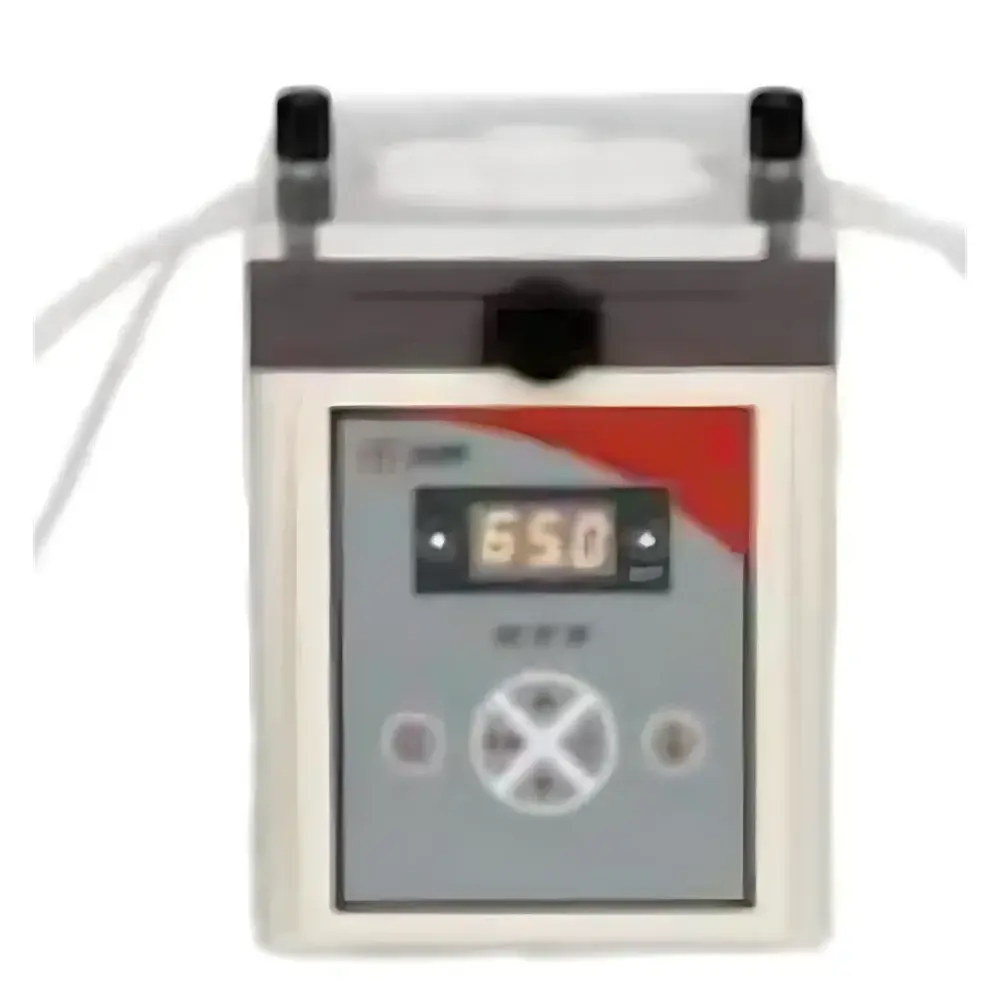
Jipeng HL-2S Dual-Channel Peristaltic Pump
| Brand | Jipeng |
|---|---|
| Origin | Shanghai, China |
| Model | HL-2S |
| Pump Type | Peristaltic Pump |
| Flow Rate Range | 2 × (0.5–900) mL/h |
| Speed Range | 0–65 rpm |
| Pressure Rating | ≥3 kg/cm² |
| Display | Gold LED Digital Display |
| Pump Head | Dual-channel, 6-roller, PTFE-lined |
| Tube Compatibility | 1.2×3 mm and 3×5 mm silicone/PTFE tubing |
| Power Supply | AC 220 V, 50/60 Hz |
| Dimensions (L×W×H) | 125×150×180 mm |
| Weight | 1.5 kg |
| Direction Control | Reversible (forward/reverse) |
| External Control Interface | Yes |
| Housing Material | ABS plastic, injection-molded, ergonomic 80° angled panel |
Overview
The Jipeng HL-2S is a dual-channel, digitally controlled peristaltic pump engineered for precise, repeatable fluid delivery in analytical and preparative laboratory workflows. Operating on the principle of occlusion-based positive displacement—where rollers compress flexible tubing against a rigid housing to generate unidirectional flow—the HL-2S delivers consistent volumetric throughput without internal valves or seals that risk contamination or wear. Its design prioritizes compatibility with sensitive biochemical applications, including integration into liquid chromatography (LC) systems, fraction collection setups, and continuous sampling protocols. The pump supports bidirectional operation and features a robust PTFE-lined pump head to ensure chemical resistance when handling mildly corrosive solvents, buffers, and aqueous reagents commonly used in protein purification, nucleic acid analysis, and HPLC sample introduction.
Key Features
- Dual independent channels with synchronized or asynchronous control, enabling parallel delivery or differential flow rates across two fluid paths.
- Gold LED digital display providing real-time, high-contrast readout of rotational speed (rpm), eliminating ambiguity during calibration or method transfer.
- Ergonomic 80° inclined control panel—designed per ISO 11228-2 human factors guidelines—to reduce operator fatigue during extended use in benchtop environments.
- High-torque microstepping motor drive system ensures smooth, low-vibration operation across the full 0–65 rpm range, minimizing pulsation and improving flow stability.
- PTFE-coated 6-roller pump head accommodates standard tubing sizes (1.2×3 mm and 3×5 mm), offering enhanced durability and resistance to swelling or degradation from organic solvents and acidic/basic solutions.
- Reversible rotation capability allows for priming, backflushing, and system purge functions—critical for maintaining line integrity in closed-loop chromatographic configurations.
- External TTL-compatible control interface enables hardware-level synchronization with fraction collectors (e.g., Jipeng BS series) or data acquisition systems, supporting automated, time- or volume-triggered collection events.
Sample Compatibility & Compliance
The HL-2S is intended for use with non-hazardous, low-viscosity liquids (≤1,000 mPa·s) at ambient temperatures (5–40 °C). It is compatible with medical-grade silicone, Tygon®, and fluoropolymer-reinforced tubing meeting USP Class VI and ISO 10993-5 biocompatibility standards. While not certified for explosive atmospheres or sterile processing, its ABS enclosure conforms to IEC 61010-1:2010 safety requirements for laboratory electrical equipment. The pump does not require recalibration between routine uses; however, users performing GLP- or GMP-aligned workflows are advised to document speed verification using traceable tachometric methods prior to critical runs.
Software & Data Management
The HL-2S operates as a standalone instrument with no embedded firmware or proprietary software dependency. All operational parameters—including speed setpoint, direction, and run duration—are configured manually via front-panel controls. For laboratories requiring audit trails or electronic records, external programmable logic controllers (PLCs) or LabVIEW-based DAQ systems may interface via the pump’s open-collector TTL input/output port. This architecture aligns with FDA 21 CFR Part 11 principles when integrated into validated systems, provided user-defined access controls, electronic signatures, and change logs are implemented at the supervisory control layer.
Applications
- Integration with UV/visible spectrophotometric detectors and fraction collectors to construct cost-effective, benchtop gel filtration or ion-exchange chromatography systems.
- Controlled eluent delivery in gravity-fed or low-pressure LC separations where gradient formation is achieved via pump-driven solvent blending.
- Continuous sampling in environmental water analysis, pharmaceutical dissolution testing, and fermentation broth monitoring.
- Calibration fluid delivery in flow cytometry setup validation and microfluidic device characterization.
- Reagent dispensing in ELISA plate preparation and enzymatic assay workflows requiring metered, bubble-free aspiration.
FAQ
What tubing sizes are supported by the HL-2S pump head?
The HL-2S accommodates two standard inner/outer diameter configurations: 1.2 mm × 3 mm and 3 mm × 5 mm—compatible with silicone, PVC, and fluoropolymer composite tubing.
Is the HL-2S suitable for use with organic solvents such as acetonitrile or methanol?
Yes, when equipped with chemically resistant tubing (e.g., Pharmed® BPT or FluoRprene®) and operated within its pressure rating (≥3 kg/cm²), the HL-2S maintains integrity with common HPLC-grade solvents.
Does the pump include flow calibration functionality?
No—flow rate is inferred from rotational speed and tubing geometry. Users must perform gravimetric or volumetric flow verification using calibrated vessels and timers per ASTM D3597 or ISO 8503-2 practices.
Can the HL-2S be operated in a cleanroom environment?
Its ABS housing and absence of particulate-generating components (e.g., brushes or lubricants) make it suitable for ISO Class 7 (10,000) cleanrooms, though sterilization via autoclaving or gamma irradiation is not recommended.
What maintenance intervals are recommended for long-term reliability?
Roller and housing wear should be inspected every 500 operational hours; tubing replacement is advised after 100–200 hours of continuous use or upon visible compression deformation.



