
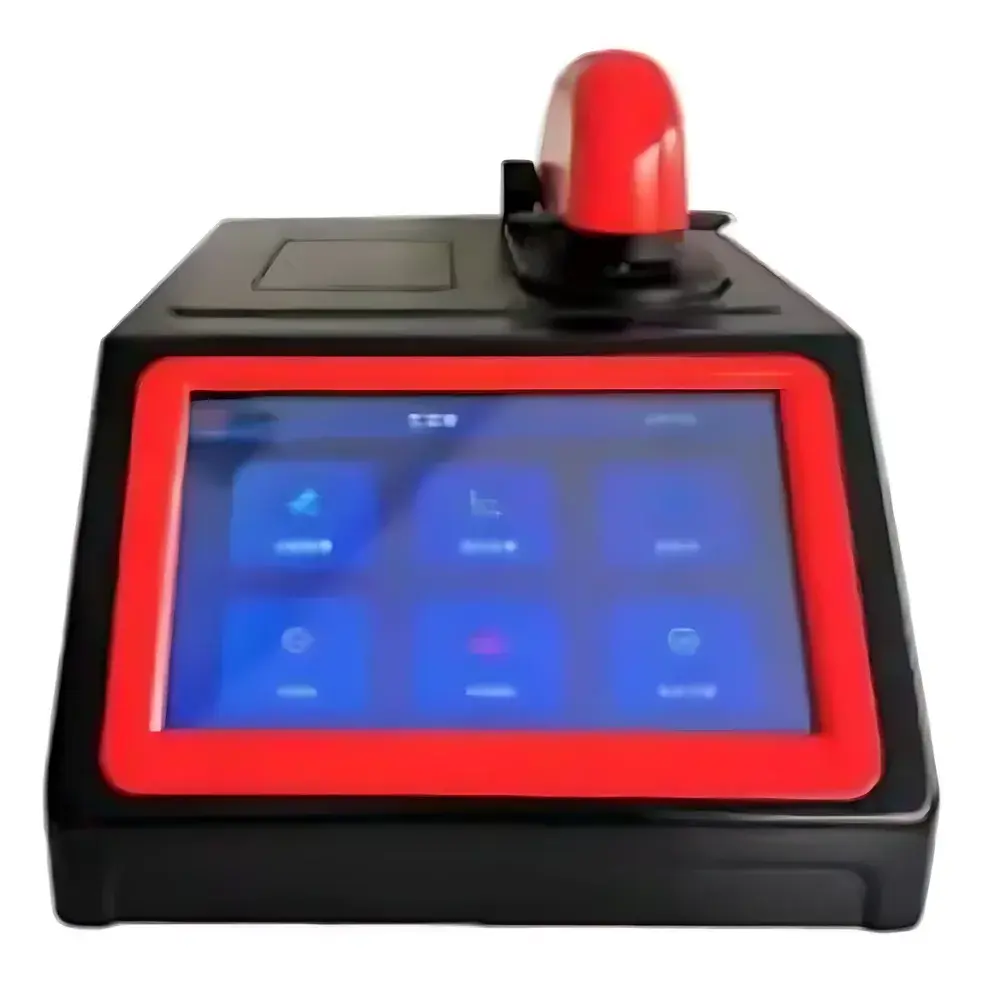
Jiapeng Nano-900 Ultra-Micro Nucleic Acid and Protein Analyzer
| Brand | Jiapeng |
|---|---|
| Origin | Shanghai, China |
| Model | Nano-900 |
| Detection Time | ≤5 s |
| Wavelength Accuracy | ±1 nm (7.332 Abs at 260 nm) |
| BSA Detection Range | 0.06–1100 mg/mL |
| dsDNA Detection Range | 0–38880 ng/µL |
| Sample Volume Requirement | 0.5–2 µL |
| Wavelength Range | 185–910 nm |
| Absorbance Range (10-mm equivalent) | 0–780 A |
| OD600 Mode | 600 ± 8 nm, 0–4 A |
| Light Source | Xenon flash lamp (≥10-year lifetime) |
| Detector | 3648-pixel linear CCD array |
| Wavelength Resolution | ≤3 nm (FWHM at Hg 546 nm) |
| Absorbance Precision | ±0.002 Abs |
| Absorbance Accuracy | ±1% (at 7.332 Abs, 260 nm) |
| Optical Path Lengths | Auto-switching 1.0 / 0.5 / 0.1 / 0.05 / 0.02 mm |
| Fluorescence Option | Excitation 460 nm, Emission 525 nm |
| Power Supply | AC 220 V, 50/60 Hz |
| Dimensions | 270 × 210 × 190 mm |
| Weight | 4.6 kg |
| Data Export | USB port, SD-RAM card |
Overview
The Jiapeng Nano-900 Ultra-Micro Nucleic Acid and Protein Analyzer is a dual-mode spectrophotometer engineered for rapid, high-reproducibility quantification and purity assessment of nucleic acids and proteins using microvolume absorbance spectroscopy. Based on the principle of UV-Vis absorption—specifically Beer-Lambert law compliance across 185–910 nm—the instrument employs a pulsed xenon flash lamp and a 3648-pixel linear CCD detector to deliver high-fidelity spectral acquisition with <3 nm resolution (FWHM at Hg 546 nm). Its core architecture integrates both pedestal-based microvolume measurement and cuvette-based OD600 analysis, enabling seamless transition between nucleic acid/protein quantification (e.g., A260/A280, A260/A230) and microbial culture density monitoring. With automatic optical path length adjustment (1.0, 0.5, 0.1, 0.05, and 0.02 mm), the Nano-900 dynamically optimizes signal-to-noise ratio across an exceptionally broad concentration range—eliminating manual dilution for samples spanning 0–38,880 ng/µL dsDNA or 0.06–1100 mg/mL BSA. All measurements are completed in ≤5 seconds per sample, with no consumables required for pedestal mode and full sample recovery post-analysis.
Key Features
- Dual detection modes: Microvolume pedestal (0.5–2 µL) and standard 1-cm cuvette (OD600 mode, 600 ± 8 nm, 0–4 A range)
- Auto-ranging optical path lengths (1.0 / 0.5 / 0.1 / 0.05 / 0.02 mm) ensure optimal dynamic range without user intervention
- High-stability xenon flash lamp with >10-year operational lifetime and minimal spectral drift
- 7-inch capacitive touchscreen running Android OS, supporting intuitive workflow navigation and real-time spectral visualization
- Built-in thermal printer for immediate hardcopy reporting compliant with GLP documentation requirements
- Onboard data storage with dual export options: USB 2.0 interface and SD-RAM card slot (up to 32 GB)
- Optional fluorescence module (460 nm excitation / 525 nm emission) compatible with SYBR Green, PicoGreen, and other common fluorophores
- Robust mechanical design: Quartz fiber-optic pedestal combined with high-hardness aluminum chassis (4.6 kg net weight, compact 270 × 210 × 190 mm footprint)
Sample Compatibility & Compliance
The Nano-900 supports direct quantification of double-stranded DNA, single-stranded DNA, RNA, oligonucleotides, and proteins—including BSA, IgG, and lysozyme—without dilution across its full dynamic range. The pedestal mode accommodates viscous or particulate-containing samples (e.g., lysates, CRISPR ribonucleoprotein complexes) due to its non-contact, surface-tension-dependent loading mechanism. Cuvette mode conforms to ISO 8655-7 (volumetric instruments) and ASTM E275 for spectrophotometric performance verification. Absorbance accuracy (±1% at 7.332 Abs, 260 nm) and precision (±0.002 Abs) meet USP and CLSI EP10-A3 guidelines for analytical instrument verification. Data integrity features—including timestamped audit trails, user authentication, and immutable file export—support alignment with FDA 21 CFR Part 11 requirements when used in regulated QC environments.
Software & Data Management
The embedded Android-based application provides preconfigured assay templates (dsDNA, ssDNA, RNA, protein, OD600, and custom methods), wavelength-scan mode, and kinetic profiling (for time-resolved assays using optional fluorescence). All spectra and calculated results are stored with metadata (date/time, operator ID, sample ID, path length, wavelength settings). Export formats include CSV (for Excel/LabArchives integration), PDF (print-ready reports), and XML (LIMS-compatible structured data). No cloud dependency: all processing occurs locally; firmware updates are delivered via USB. Software validation documentation (IQ/OQ protocols) is available upon request for GMP/GLP laboratories.
Applications
- Pre-NGS library quantification and QC (A260/A280, A260/A230 ratios)
- CRISPR-Cas9 RNP complex characterization prior to electroporation
- Routine QC of purified plasmids, mRNA, and viral vectors
- Protein expression screening in E. coli and mammalian cell lysates
- Microbial growth curve monitoring in bioreactor development (OD600 mode)
- Verification of dye-labeling efficiency in fluorescent probe synthesis
- Educational labs requiring robust, low-maintenance instrumentation with minimal training overhead
FAQ
Does the Nano-900 require calibration with NIST-traceable standards?
Yes—factory calibration uses NIST-traceable neutral density filters and holmium oxide reference standards. Users may perform routine performance verification using supplied quartz cuvettes and certified reference materials (e.g., potassium dichromate for absorbance accuracy).
Can the instrument be integrated into automated liquid handling workflows?
While not robotically interfaced out-of-the-box, the Nano-900 supports external trigger input (TTL signal) for synchronized measurement initiation, enabling integration with third-party automation platforms via custom scripting.
Is the pedestal surface resistant to DNase/RNase contamination?
The quartz fiber-optic pedestal is chemically inert and fully cleanable with 70% ethanol, 10% bleach, or RNaseZap®—validated for >1000 consecutive uses without measurable carryover (tested per ISO 20387 Annex B).
What regulatory documentation is provided for GxP environments?
Standard shipment includes Factory Acceptance Test (FAT) report, Certificate of Conformance, and electronic copies of IQ/OQ protocols. Full 21 CFR Part 11 validation packages—including risk assessments and change control logs—are available as optional services.
How is photometric linearity verified across the 0–780 A range?
Linearity is confirmed per ASTM E275 using serial dilutions of potassium dichromate (0.02–2.0 g/L in 0.005 M H2SO4) measured at 350 nm, yielding R² ≥ 0.9999 across the full extended range.





