
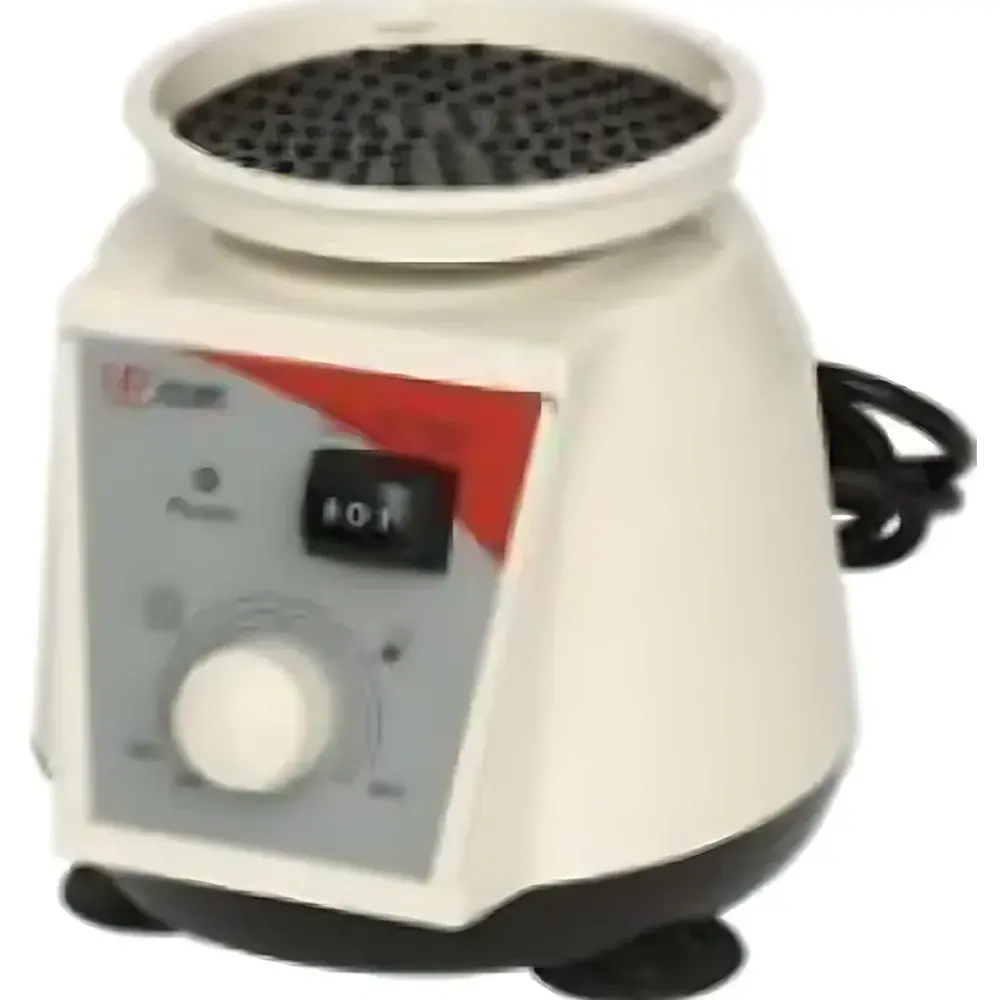
Jiapeng Vortex-3 Adjustable Orbital Shaker
| Brand | Jiapeng |
|---|---|
| Origin | Shanghai, China |
| Model | Vortex-3 |
| Speed Range | 0–2800 rpm |
| Operating Modes | Continuous / Touch-Start (Pulse) |
| Motion Type | Orbital (Circular) |
| Platform Amplitude | 5 mm |
| Display | Analog Scale (Calibrated Dial) |
| Housing Material | ABS Engineering Plastic |
| Platform Surface | Wear-Resistant Rubber |
| Input Voltage | 198–242 V AC, 50 Hz |
| Power Consumption | 60 W (Motor Input: 85 W |
| Mechanical Output | 15 W) |
| Ambient Operating Conditions | 5–40 °C, ≤80% RH |
| IP Rating | IP56 |
| Dimensions (W×D×H) | 140 × 145 × 145 mm |
| Net Weight | 1.75 kg |
| Compliance | Designed for general laboratory use per IEC 61010-1 safety requirements |
Overview
The Jiapeng Vortex-3 Adjustable Orbital Shaker is a compact, benchtop mixing instrument engineered for reproducible, low-shear homogenization of liquid samples in tubes and microplates. It operates on the principle of orbital (circular) motion—generating consistent centrifugal force through a horizontally rotating platform with a fixed 5 mm orbit diameter. This motion induces vigorous vortex formation within containers placed off-center on the rubber-coated platform, enabling rapid and uniform suspension of particulates, reconstitution of lyophilized reagents, or homogenization of viscous solutions without foaming or sample splashing. Unlike linear shakers or magnetic stirrers, the Vortex-3 delivers high-efficiency mixing at low energy input, making it ideal for routine QC workflows, clinical sample preparation, and pre-analytical processing in life science, pharmaceutical, and environmental laboratories.
Key Features
- Adjustable speed control via calibrated analog dial (0–2800 rpm), enabling precise optimization across viscosity ranges—from aqueous buffers to glycerol-based storage solutions.
- Dual-mode operation: continuous rotation for extended incubation-mixing protocols, and touch-activated pulse mode for transient agitation during sensitive assays (e.g., enzyme kinetics or cell lysis).
- Robust ABS housing with IP56-rated enclosure—providing protection against dust ingress and water jets from any direction—ensuring reliable performance in shared lab environments with variable humidity and incidental spills.
- Chemically resistant, wear-resistant rubber platform surface minimizes tube slippage and absorbs mechanical shock, preserving tube integrity during high-speed operation.
- Low thermal signature and energy-efficient design (60 W nominal power draw) reduce ambient heat load and support sustainable lab infrastructure planning.
- Modular accessory compatibility—including flat platforms, concave cup holders, and multi-well adapters for 0.2 mL PCR tubes, 0.5/1.5/2.0 mL microcentrifuge tubes, 5–10 mL culture tubes, and 96-well plates—enables seamless transition between assay formats without hardware replacement.
Sample Compatibility & Compliance
The Vortex-3 accommodates standard laboratory consumables ranging from 0.2 mL PCR strips to 10 mL conical tubes, with optional adapters supporting simultaneous processing of up to 24 × 1.5 mL tubes or 96-well microplates. Its orbital geometry ensures effective mixing even with partially filled vessels or heterogeneous suspensions (e.g., bacterial pellets, antibody-coated beads, or sedimented exosomes). The device conforms to IEC 61010-1:2010 for electrical safety in laboratory equipment and meets general requirements for non-medical electrical apparatus under ISO/IEC 17025-accredited quality systems. While not classified as a medical device or GLP/GMP-critical instrument, its mechanical consistency supports traceable, repeatable mixing steps in validated SOPs—particularly where mixing time and speed are defined parameters in ASTM D4097 (standard practice for mixing liquid samples prior to analysis) or USP (analytical instrument qualification).
Software & Data Management
As a manually operated, analog-control instrument, the Vortex-3 does not incorporate embedded software, digital interfaces, or data logging capabilities. This design prioritizes operational simplicity, electromagnetic interference (EMI) immunity, and long-term reliability in electromagnetically noisy environments (e.g., adjacent to centrifuges, PCR cyclers, or mass spectrometers). All operating parameters—including speed setting, run duration, and mode selection—are recorded manually in lab notebooks or electronic lab notebooks (ELNs) as part of standard experimental metadata. For labs requiring audit-ready documentation, integration with LIMS or ELN systems is achieved through procedural SOPs that define mixing conditions as discrete, user-entered variables—fully compatible with FDA 21 CFR Part 11-compliant electronic records when paired with appropriate access controls and electronic signatures.
Applications
- Routine resuspension of lyophilized standards, calibration materials, and reference controls prior to HPLC, GC, or immunoassay analysis.
- Homogenization of blood, urine, or saliva specimens prior to nucleic acid extraction or protein quantification.
- Pre-incubation mixing of ELISA plate wells to ensure uniform antigen–antibody binding kinetics.
- Reconstitution and dispersion of nanoparticles, liposomes, or polymer micelles in formulation development.
- Cell detachment support in adherent culture workflows (e.g., combined with trypsin-EDTA treatment).
- Quality control testing of viscosity-sensitive formulations, including ophthalmic solutions and topical gels.
FAQ
Is the Vortex-3 suitable for mixing viscous samples such as glycerol stocks or agarose solutions?
Yes—the 5 mm orbital amplitude and torque-stable motor deliver consistent agitation across viscosities up to ~200 mPa·s when used with appropriately sized tubes and optimized speed settings (typically 1800–2500 rpm).
Can the unit be used inside a cold room or incubator?
It is rated for operation between 5–40 °C and ≤80% RH; however, condensation risk in cold rooms may compromise electrical safety—use only in climate-controlled environments meeting the specified ambient conditions.
Does the Vortex-3 support regulatory compliance for GxP environments?
While not individually 21 CFR Part 11-certified, its mechanical repeatability and analog control architecture allow full integration into GxP workflows when validated per internal SOPs and supported by documented calibration and maintenance logs.
What maintenance is required?
No scheduled maintenance is needed; periodic cleaning of the rubber platform with 70% ethanol and visual inspection of the housing for cracks or deformation are sufficient for long-term reliability.
Are replacement platforms or adapters available?
Yes—Jiapeng offers certified OEM accessories including flat, concave, and multi-tube adapter plates, all designed to maintain consistent orbital geometry and mechanical coupling with the drive mechanism.



