
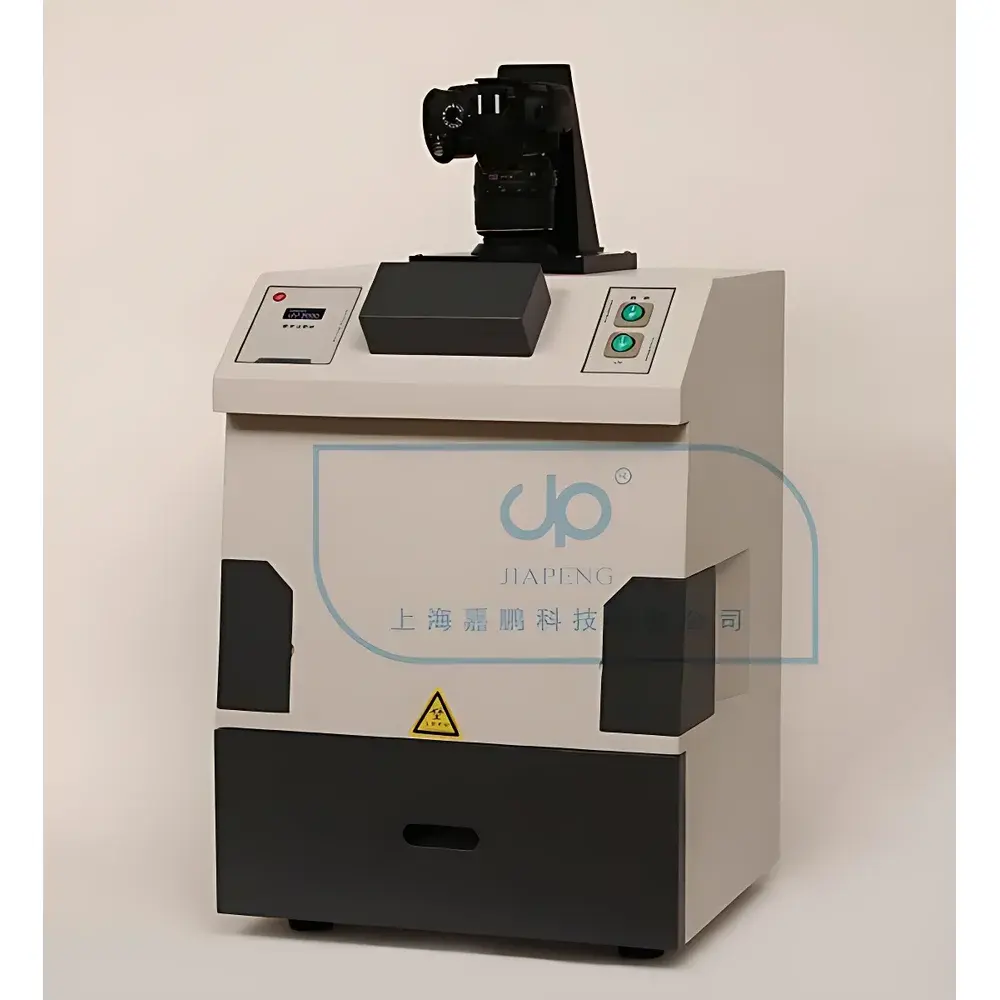
Jiapeng UV-2000 High-Intensity UV Transilluminator and Gel Cutter
| Brand | Jiapeng |
|---|---|
| Origin | Shanghai, China |
| Model | UV-2000 |
| Instrument Type | Darkroom-style transilluminator |
| Wavelength Modes | Multi-wavelength (transmission: 302 nm |
| reflection | 254 nm & 365 nm) |
| UV Lamp Count | 12 × 8 W tubes |
| Transmission Filter Size | 200 × 250 mm |
| Transmission Area | 200 × 250 mm |
| Reflected Light Filter Size | 200 × 50 mm (for 254/365 nm) |
| White Light Panel Size | 210 × 260 mm |
| Power Supply | AC 220 V, 50/60 Hz |
| Dimensions (L×W×H) | 420 × 355 × 580 mm |
| Weight | 10 kg |
| UV Intensity | ≥20 µW/cm² at 20 cm distance (302 nm transmission) |
| Safety Features | UV-blocking shield (blocks >99% UV), automatic lamp shutoff upon drawer opening, integrated cooling fan |
| Compliance | Designed per JJF 1936–2021 “Verification Regulation for UV Analyzers” (PRC National Metrological Technical Specification) |
Overview
The Jiapeng UV-2000 is a high-intensity, darkroom-style multi-wavelength UV transilluminator engineered for precise visualization, documentation, and excision of nucleic acid and protein bands in electrophoretic gels. It operates on the principle of ultraviolet-induced fluorescence: when nucleic acids (e.g., DNA or RNA stained with ethidium bromide, SYBR Safe, or similar intercalating dyes) are exposed to UV light at specific wavelengths, they absorb photons and re-emit visible fluorescence—enabling detection at nanogram sensitivity levels. The UV-2000 integrates three discrete UV emission modes—302 nm for optimal ethidium bromide excitation (transmission mode), and 254 nm and 365 nm for reflective surface analysis (e.g., TLC plates, UV-active compounds, or UV-shadowing)—making it suitable for both routine gel documentation and specialized analytical workflows. Its fully enclosed ABS polymer chassis eliminates ambient light interference and provides structural rigidity while maintaining operator safety through certified UV attenuation.
Key Features
- Twelve 8 W UV lamps delivering uniform irradiance across the full 200 × 250 mm transmission area—optimized for consistent band visibility and reduced exposure time.
- Integrated dual-side UV-protected access ports with sliding covers, enabling safe manual gel manipulation—including precise excision—without lamp deactivation or external shielding.
- Automatic lamp cutoff mechanism triggered by drawer extension, preventing inadvertent UV exposure during sample loading or cutting.
- Dedicated DSLR camera mount and adjustable tripod interface compatible with standard C-mount and universal lens adapters—facilitating reproducible, high-resolution imaging under controlled illumination.
- High-transmission 200 × 250 mm UV filter optimized for 302 nm, paired with optional 200 × 50 mm reflective filters for 254 nm and 365 nm applications.
- Integrated white-light panel (210 × 260 mm) for Coomassie- or silver-stained protein gel documentation without lamp switching.
- Active thermal management via built-in low-noise cooling fan, ensuring stable lamp output and extended component service life during prolonged operation.
- Compliance with JJF 1936–2021—the national metrological verification regulation for UV analyzers in China—supporting traceable intensity calibration and routine performance validation.
Sample Compatibility & Compliance
The UV-2000 supports a broad range of sample formats including agarose and polyacrylamide gels (up to 200 × 250 mm), thin-layer chromatography (TLC) plates, and nitrocellulose or PVDF membranes. Its multi-wavelength capability enables compatibility with common fluorescent dyes (e.g., ethidium bromide, GelRed, SYBR Gold, SYPRO Ruby) and UV-absorbing compounds (e.g., aromatic amino acids, nucleotides, coumarin derivatives). While not FDA-cleared or CE-marked as an IVD device, the instrument conforms to general laboratory safety standards for Class 3B UV radiation equipment (IEC 62471) and incorporates engineering controls aligned with ISO 15223-1 labeling requirements for medical device accessories. Its design facilitates integration into GLP-compliant environments where audit trails for gel documentation and sample handling are maintained externally via LIMS or ELN systems.
Software & Data Management
The UV-2000 is a hardware-only platform—no proprietary software is bundled. It is fully interoperable with third-party imaging software suites (e.g., ImageLab, AlphaView SA, Fiji/ImageJ, GeneTools) via standard USB or HDMI camera interfaces. All image capture, annotation, molecular weight estimation, and densitometric quantification must be performed using externally validated software. For regulated laboratories, users may configure camera acquisition parameters (exposure time, gain, white balance) within compliant software environments that support 21 CFR Part 11 audit trails—provided such software is installed on validated workstations and operated under documented SOPs. The unit includes no onboard storage, network interface, or firmware update capability, minimizing cybersecurity risk and simplifying IQ/OQ validation.
Applications
- Visualization and quantitative analysis of DNA/RNA fragments in agarose and PAGE gels post-electrophoresis.
- PCR product verification and genotyping via fragment size differentiation.
- Restriction digest profiling and DNA fingerprinting (e.g., RFLP, AFLP).
- Thin-layer chromatography (TLC) spot detection and Rf value determination for small molecules and metabolites.
- UV shadowing of nucleic acids on membranes for rapid localization prior to hybridization.
- Coomassie- and silver-stained protein gel documentation under white light illumination.
- Preparative gel excision for downstream cloning, sequencing, or mass spectrometry sample preparation.
FAQ
What safety certifications does the UV-2000 hold?
The UV-2000 complies with JJF 1936–2021 (PRC national verification regulation) and meets IEC 62471 photobiological safety requirements for UV radiation devices. It features a certified UV-blocking shield (>99% attenuation) and failsafe drawer-interlock circuitry.
Can the UV-2000 be used for SYBR Safe or GelRed staining?
Yes—its 302 nm transmission mode is optimal for excitation of SYBR Safe, GelRed, and ethidium bromide. For SYBR Gold, 254 nm reflection mode may provide enhanced signal-to-noise in certain protocols.
Is the white light panel intensity adjustable?
No—the 60 W white light panel operates at fixed output. Uniformity across the 210 × 260 mm surface is verified during factory calibration.
Does the unit include a UV intensity meter?
No—intensity verification requires an external calibrated UV radiometer (e.g., ILT950 or UVP UVX Digital Radiometer) per JJF 1936–2021 procedures.
What maintenance is required for long-term lamp stability?
UV lamps should be replaced every 1,000–1,500 operating hours. Clean filters monthly with lint-free wipes and isopropanol; avoid abrasive cleaners. Ensure cooling fan intake remains unobstructed.




