
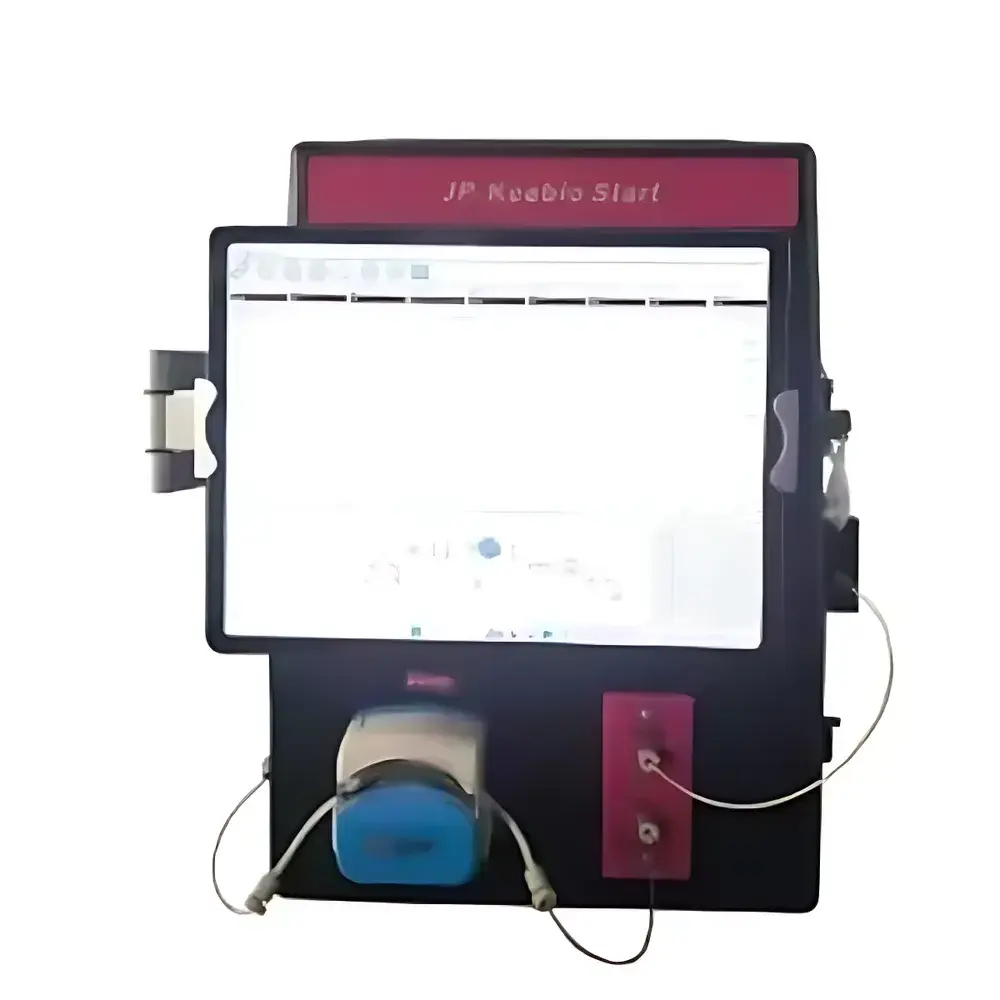
JP-KeebioStart Protein Purification System
| Brand | JiaPeng |
|---|---|
| Origin | Shanghai, China |
| Manufacturer Type | Authorized Distributor |
| Product Category | Domestic |
| Model | JP-KeebioStart |
| Price Range | USD 4,200 – 7,000 (FOB Shanghai) |
| Purification Principle | Ion Exchange Chromatography (IEX) |
| Gradient Type | Linear Gradient |
| Flow Rate Range | 0.1–10 mL/min |
| Flow Accuracy | ±1.2% |
| UV Detection Range | −6 to +6 AU (Linearity: ±1.5% within 0–2 AU) |
| Maximum Pressure | 3 MPa (30 bar) |
| Conductivity Range | 0.001–400.00 mS/cm |
| Conductivity Accuracy | ±2% |
| Temperature Detection Range | 0–100 °C (Accuracy: ±1 °C) |
| UV Wavelengths | 260 nm, 280 nm, 295 nm, 310 nm |
| UV Light Source | LED (Cold Light) |
| Wavelength Accuracy | ±1 nm |
| Sample Cell Volume | 10 µL |
| Mixer Volume | 200 µL (Static) |
| Fraction Collection | Optional JP-blupadFC collector with XY-axis positioning, peak-triggered collection (AU threshold, slope, conductivity), full-collection, and manual modes |
| Software | JP-blupad Chromatography Workstation (Registered Copyright No. 2019SR0680657) |
| Certifications | CN Utility Model Patent ZL201920802201.1, CN Design Patent ZL202130391697.0, CN Invention Patent ZL202110687106.3 |
| Operating Temperature | 4–40 °C |
| Dimensions (W×D×H) | 360 × 380 × 470 mm |
| Weight | 11 kg |
| Power Supply | 220 VAC |
Overview
The JP-KeebioStart Protein Purification System is an integrated, benchtop-scale chromatographic platform engineered for reproducible, scalable protein isolation in academic research laboratories, biopharmaceutical development units, and QC/QA environments. It operates on classical liquid chromatography principles—primarily ion exchange chromatography (IEX), but also fully supports affinity chromatography, size-exclusion chromatography (SEC), desalting, and buffer exchange workflows. The system employs a dual-wavelength UV-Vis detection architecture (260 nm, 280 nm, 295 nm, 310 nm) with high-stability LED cold-light sources and a 10 µL flow cell, enabling real-time monitoring of nucleic acid contamination (A260/A280 ratio), aromatic amino acid absorbance, and conformation-sensitive transitions. Its modular fluidic design integrates a precision constant-flow pump, static mixer (200 µL), manually actuated 6-port injection valve (with loop/cup compatibility), and parallel UV/conductivity/temperature sensors—all synchronized under a unified control interface. Designed for compliance-ready operation, the system meets foundational requirements for GLP-aligned data integrity when paired with appropriate procedural documentation.
Key Features
- 10.1-inch industrial-grade capacitive touchscreen PC with intuitive, context-aware UI—supports seamless switching between English and Chinese language modes without software restart
- High-accuracy peristaltic-free constant-flow pump delivering stable flow rates from 0.1 to 10 mL/min at up to 30 bar (3 MPa) maximum pressure; flow accuracy maintained at ±1.2% across full range
- Dual-channel fraction collection capability via optional JP-blupadFC collector: one active outlet for target fractions, one dedicated waste port; XY-axis positioning ensures precise tube alignment for 96-well or custom rack configurations
- Real-time, multi-parameter visualization: simultaneous display of UV absorbance (A260/A280), conductivity (mS/cm), gradient profile (%B), column temperature (°C), and fraction index on a single screen
- Automated data handling: all chromatograms, method parameters, and event logs saved automatically in timestamped binary format; exportable to Excel (.xlsx) with embedded metadata (method name, date, operator ID, instrument serial)
- Conductivity sensor with automatic temperature compensation (0.001–400.00 mS/cm, ±2% full-scale accuracy) enables robust buffer monitoring during gradient elution and wash steps
- No warm-up required: baseline stabilization achieved within <60 seconds post-power-on, minimizing idle time between runs
Sample Compatibility & Compliance
The JP-KeebioStart accommodates standard analytical and semi-preparative columns (ID 4.6–16 mm) packed with common resins including Ni-NTA, Protein A/G/L, Q Sepharose, SP Sepharose, and Superdex/Sephacryl matrices. It supports native and His-tagged proteins, monoclonal antibodies (mAbs), Fc-fusion constructs, and viral vectors—provided sample viscosity remains below 10 cP and particulate content is pre-filtered (0.22 µm). While not certified for GMP manufacturing use out-of-the-box, its architecture aligns with key elements of FDA 21 CFR Part 11 (audit trail, electronic signature readiness via workstation login), ISO 13485 risk management frameworks, and USP analytical instrument qualification (AIQ) guidelines. Full validation packages—including Installation Qualification (IQ), Operational Qualification (OQ), and Performance Qualification (PQ) templates—are available upon request for regulated environments.
Software & Data Management
The JP-blupad Chromatography Workstation (v3.2+, registered copyright 2019SR0680657) provides method-driven automation with editable gradient profiles, programmable collection logic (threshold-based, slope-detection, or conductivity-triggered), and real-time parameter override. All raw detector signals are acquired at ≥10 Hz sampling rate and stored with millisecond timestamp resolution. The software enforces role-based access control (admin/operator modes), maintains immutable audit trails of method changes and run executions, and generates PDF reports compliant with internal SOPs. Exported Excel files include embedded calibration coefficients, sensor diagnostics, and system configuration snapshots—facilitating traceability during regulatory review. Data backups can be scheduled to network drives or USB media; no cloud dependency is required.
Applications
- Purification of recombinant His-tagged proteins from E. coli lysates using immobilized metal affinity chromatography (IMAC)
- IgG isolation from hybridoma supernatants or CHO cell culture harvests via Protein A affinity
- Buffer exchange and endotoxin removal prior to formulation studies
- Analysis of protein aggregation states by size-exclusion chromatography (SEC-HPLC)
- Desalting of enzymatically digested peptides prior to LC-MS/MS analysis
- Process development support for early-stage bioprocess characterization (e.g., binding capacity determination, gradient optimization)
FAQ
Is the JP-KeebioStart compatible with third-party columns and resins?
Yes—the system uses standard 1/16″ PEEK tubing and universal column fittings (e.g., 10-32 UNF), supporting commercially available columns from Cytiva, Bio-Rad, Agilent, and Tosoh.
Can gradient methods be modified during an active run?
Yes—users may adjust flow rate, gradient slope, or hold time in real time without interrupting the separation; all changes are logged in the audit trail.
What level of UV sensitivity does the detector provide?
The minimum detectable concentration is 20 µg/mL for BSA at 280 nm (10 µL pathlength, 1 cm optical path equivalent); signal linearity holds from −6 to +6 AU with ±1.5% deviation in the 0–2 AU range.
Does the system support 21 CFR Part 11 compliance?
It provides foundational capabilities—including electronic signatures, audit trails, and secure user authentication—but formal Part 11 compliance requires site-specific validation and procedural controls per organizational quality systems.
Is remote monitoring possible?
Local network access is supported via Ethernet; remote desktop or VNC connections may be configured per institutional IT policy, though no built-in cloud telemetry or mobile app is included.



