
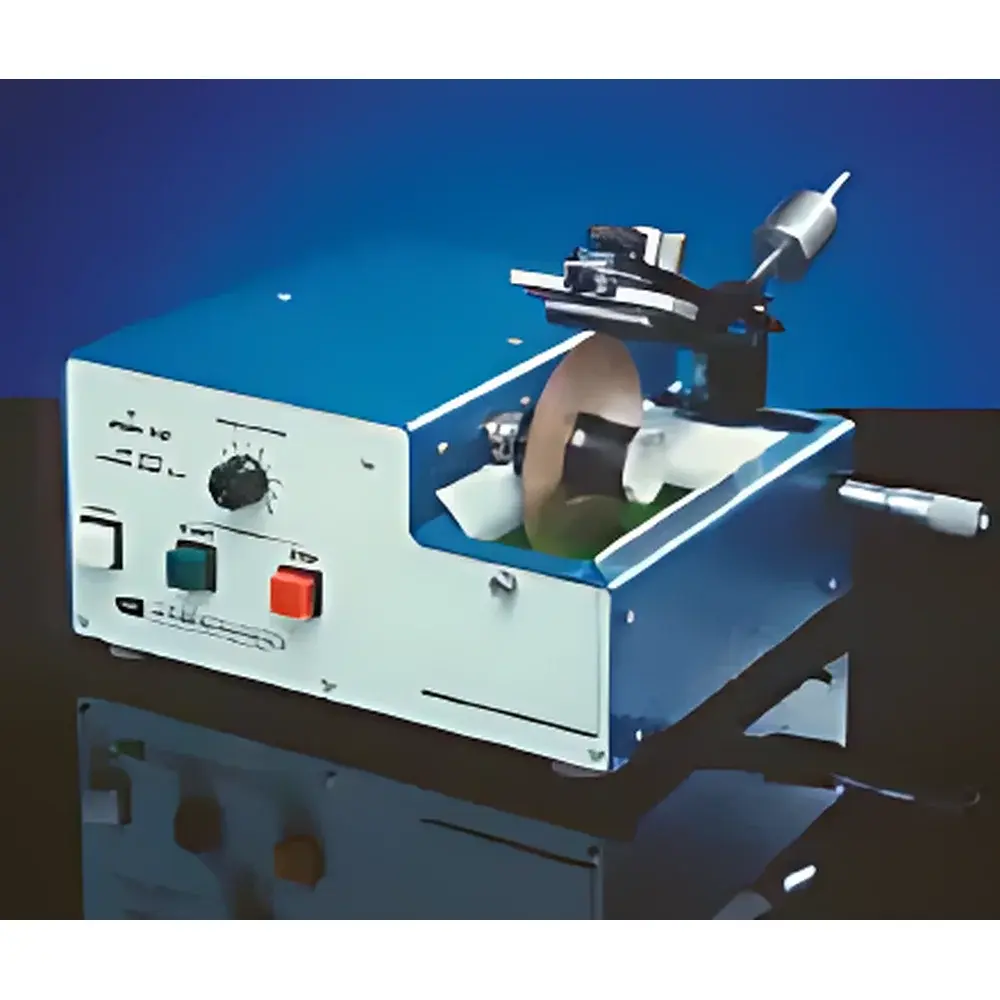
Ted Pella 650 Precision Low-Speed Diamond Wafering Saw
| Brand | Ted Pella |
|---|---|
| Origin | USA |
| Manufacturer Type | Authorized Distributor |
| Origin Category | Imported |
| Model | 650 |
| Instrument Type | Precision Low-Speed Diamond Wafering Saw |
| Blade Speed | 0–250 RPM |
| Maximum Blade Diameter | 175 mm |
| Sample Max Diameter | 70 mm |
| Sample Weight Capacity | 0–2000 g |
| Sample Mounting Diameter | 12.7 mm |
| Fine Feed Range | 0–25 mm (0.01 mm increments) |
| Coolant Reservoir Volume | 1200 mL |
| Power Supply | 220 VAC, 50/60 Hz |
| Construction | Cast Aluminum Housing |
| Drive System | Belt-Driven |
| Safety | Auto-Motor Stop on Obstruction |
| Compatible Coolants | Aqueous and Oil-Based |
| Dual Cutting Modes | Precision & Rough |
Overview
The Ted Pella 650 Precision Low-Speed Diamond Wafering Saw is an engineered solution for controlled, damage-minimized sectioning of brittle, soft, or heterogeneous materials in research and quality control laboratories. Operating on the principle of low-speed abrasive cutting—typically below 250 RPM—the instrument leverages diamond-impregnated blades to achieve clean, planar cuts with minimal thermal stress, microcracking, or plastic deformation. Unlike high-speed saws that generate excessive localized heat and mechanical shock, the 650’s belt-driven, gear-free transmission ensures smooth torque delivery and eliminates risk of gear failure during blade stall events. Its design prioritizes dimensional fidelity and repeatability in sample preparation for subsequent analysis by SEM, TEM, metallography, XRD, or mechanical testing—making it indispensable in materials science, geology, electronics packaging, and biomedical device R&D.
Key Features
- Belt-driven motor system with optical sensor feedback—prevents gear stripping and preserves sample integrity during jamming or overloading
- Precision-ground bearing-mounted cutting arm (not micrometer-based), delivering sub-10 µm positional reproducibility across repeated cuts
- Dual operational modes: “Precision” mode for final-sectioning at fine feed increments (0.01 mm), and “Rough” mode for rapid material removal
- Interchangeable diamond blades up to 175 mm diameter; multiple blades may be stacked to enable extended cut lengths up to 50.8 mm (2 inches)
- Integrated auto-shutdown circuitry halts motor rotation within <100 ms upon detection of abnormal load or obstruction—enabling unattended operation under defined protocols
- Chemically resistant polyethylene coolant reservoir (1200 mL capacity) compatible with both water-based and oil-based coolants, supporting diverse material compatibility requirements
- Rigid cast aluminum chassis with vibration-damped base plate, ensuring mechanical stability during long-duration or multi-pass cutting sequences
Sample Compatibility & Compliance
The 650 accommodates cylindrical, rectangular, or irregularly shaped specimens up to 70 mm in maximum cross-sectional dimension and 2000 g mass. It routinely processes ceramics, sintered carbides, semiconductor wafers, bone tissue, polymer composites, and geological thin sections. All mechanical and electrical subsystems conform to IEC 61000-6-2 (EMC immunity) and IEC 61000-6-4 (EMC emissions) standards. The coolant handling system meets ISO 8502-9 for residue-free surface preparation prior to microscopy. When operated with documented SOPs and calibrated feed mechanisms, the system supports GLP-compliant sample prep workflows and aligns with ASTM E3-22 (Standard Guide for Preparation of Metallographic Specimens) and ISO 14577-1 (Metallic materials — Instrumented indentation test).
Software & Data Management
While the 650 operates via intuitive front-panel controls without embedded firmware, its mechanical repeatability enables full integration into traceable laboratory informatics systems. Users may log cutting parameters—including RPM, feed rate, coolant type, blade ID, and operator ID—in LIMS or ELN platforms via manual entry or barcode-scanned protocol templates. Optional digital tachometer and linear encoder kits (sold separately) provide real-time RPM and feed displacement data for CSV export. Audit trails generated through external documentation satisfy FDA 21 CFR Part 11 requirements when paired with electronic signature-capable software environments.
Applications
- Preparation of TEM lamellae from bulk ceramics and battery electrode cross-sections
- Sectioning of fragile geological samples (e.g., shale, meteorites) without delamination
- Controlled slicing of soft biological tissues embedded in resin for histomorphometric analysis
- Dimensional reduction of additively manufactured metal parts prior to porosity quantification
- Cutting of photovoltaic cells and flexible printed circuits with minimal solder-joint distortion
- Production of standardized test coupons per ASTM D790 (flexural properties) and ISO 527 (tensile testing)
FAQ
What blade diameters are supported?
The 650 accepts standard diamond blades with diameters of 75 mm, 100 mm, 125 mm, 150 mm, and 175 mm.
Can the machine cut non-cylindrical samples?
Yes—custom fixtures and clamping plates (available as accessories) allow secure mounting of rectangular, prismatic, or irregular geometries up to 70 mm in any lateral dimension.
Is coolant flow rate adjustable?
Coolant delivery is gravity-fed and manually regulated via a needle valve; no programmable pump is integrated, but external peristaltic pumps may be connected via standard 6.35 mm tubing ports.
Does the system include calibration certification?
Each unit ships with a factory-verified mechanical calibration report covering feed accuracy (±0.005 mm), rotational speed tolerance (±2 RPM), and runout (≤0.02 mm TIR at 175 mm blade radius).
How is blade wear monitored?
Blade life is tracked empirically via cumulative cut time and feed depth; optical inspection using a 10× loupe is recommended before each high-value sample run to confirm diamond exposure and bond integrity.



