
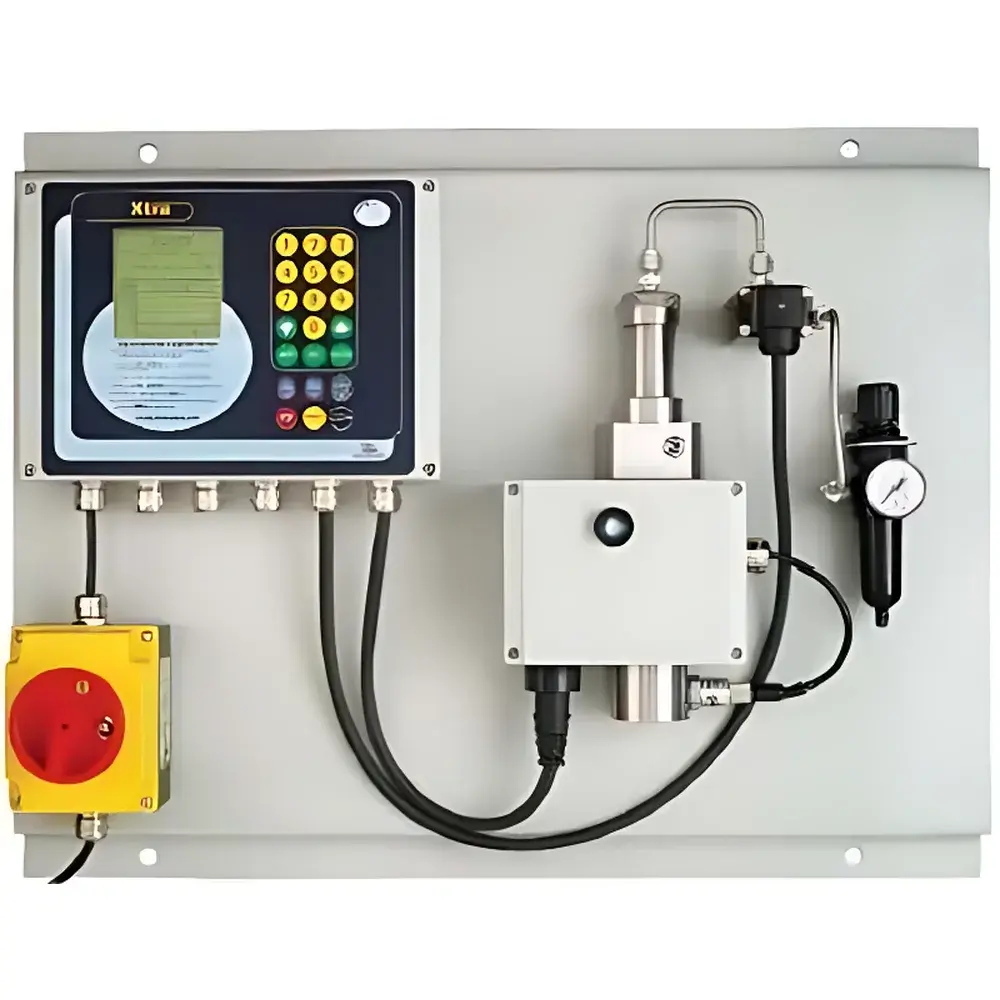
XTRA Multi-Sample Oil-in-Water Analyzer
| Origin | UK |
|---|---|
| Manufacturer Type | Authorized Distributor |
| Origin Category | Imported |
| Model | XTRA |
| Pricing | Available Upon Request |
Overview
The XTRA Multi-Sample Oil-in-Water Analyzer is a CE-certified, industrial-grade online monitoring system engineered for continuous, real-time quantification of hydrocarbon contamination in aqueous streams. It employs advanced dual-wavelength optical absorption spectroscopy—optimized for broad-spectrum oil detection across diverse hydrophobic compounds—including mineral oils, diesel, lubricants, and light crude fractions. Unlike single-point extractive methods, the XTRA integrates flow-through cell design with embedded temperature and pressure compensation algorithms, enabling stable operation under dynamic process conditions. Its core measurement principle relies on calibrated spectral response curves for up to six pre-defined oil types, each independently referenced against traceable NIST-traceable standards. The analyzer is purpose-built for compliance-critical applications in wastewater treatment plants, offshore platform discharge monitoring, cooling water circuits, and industrial effluent control systems where regulatory adherence to ISO 9377-2 (petroleum hydrocarbons in water), EPA Method 1664B (n-hexane extractable material), and EU Water Framework Directive (WFD) thresholds is mandatory.
Key Features
- Dual-parameter real-time output: simultaneous measurement of oil concentration (0–200 ppm) and turbidity (0–999 NTU), both with 1-unit resolution and integrated drift compensation
- Intelligent oil-type recognition: factory-calibrated for six distinct hydrocarbon classes; automatic spectral deconvolution minimizes cross-sensitivity from emulsified or weathered oils
- Onboard data logging: 7-day history stored in non-volatile ROM; 4-hour trend visualization directly on the backlit LCD interface with intuitive navigation via context-sensitive help menu
- Configurable alarm architecture: two independent oil-level alarms (1–200 ppm) and two turbidity alarms (1–999 NTU), each with user-defined delay (0–240 s) to suppress transient spikes
- Robust process interface: rated for sample temperatures 0–50 °C, pressures 0.1–10 bar, and flow rates 0.5 L/min; IP65-rated enclosure suitable for outdoor or semi-hazardous environments
- Comprehensive safety & EMC compliance: certified to EN 61010-1 (electrical safety) and EN 61326-1 (EMC for industrial environments); meets CE marking requirements for deployment in EU-regulated infrastructure
Sample Compatibility & Compliance
The XTRA analyzer accommodates heterogeneous aqueous matrices—including saline, low-pH, and moderately suspended solids-laden samples—without requiring chemical reagents or solvent extraction. Its optical path length and LED source stability are optimized to maintain accuracy in turbidities up to 999 NTU, mitigating interference from particulate scattering via adaptive baseline correction. Calibration validation follows GLP-aligned procedures, supporting audit-ready documentation for ISO/IEC 17025-accredited laboratories. The device satisfies functional requirements for continuous emission monitoring systems (CEMS) under UK Environment Agency MCERTS Scheme and aligns with US EPA’s WQ-AR (Water Quality Analytical Requirements) for automated oil-in-water reporting.
Software & Data Management
While the XTRA operates as a standalone analyzer with local display and relay outputs, it supports analog (4–20 mA) and digital (RS-485 Modbus RTU) communication protocols for integration into SCADA, DCS, or cloud-based asset management platforms. All alarm events, calibration timestamps, and diagnostic logs—including sensor health status and flow integrity checks—are time-stamped and exportable via serial interface. Audit trail functionality meets foundational expectations for 21 CFR Part 11 compliance when deployed with validated third-party data acquisition software; full electronic record retention requires external historian configuration.
Applications
- Monitoring produced water discharge from oil & gas facilities against OSPAR and MARPOL Annex I limits
- Real-time verification of oil removal efficiency in API separators, dissolved air flotation (DAF) units, and coalescing filters
- Early leak detection in heat exchanger cooling loops and transformer oil containment systems
- Regulatory reporting for municipal wastewater treatment plants subject to local oil-in-effluent consent conditions
- Performance validation of membrane filtration and activated carbon polishing stages
FAQ
What oil types are supported out-of-the-box?
The XTRA is factory-calibrated for six hydrocarbon categories: diesel fuel (EN 590), marine gas oil (MGO), lubricating oil (ISO VG 46), crude oil (light blend), kerosene (Jet A-1), and hydraulic oil (HLP 46). Custom calibrations require OEM service intervention.
Is field recalibration possible without sending the unit back?
Yes—zero and span adjustments can be performed using certified reference standards and the built-in calibration wizard; full multi-point calibration requires authorized service tools and firmware access.
Does the analyzer meet explosion-proof requirements for Zone 1 areas?
No—the XTRA carries IP65 ingress protection but is not ATEX or IECEx certified; it must be installed in safe zones or within pressurized enclosures for hazardous area deployment.
How frequently should maintenance be scheduled?
Optical window cleaning is recommended every 30 days in high-turbidity environments; annual verification of pressure/temperature sensor accuracy and lamp intensity decay is advised per manufacturer’s maintenance schedule.
Can historical data be exported in CSV format?
Yes—via RS-485 connection using standard Modbus register mapping; raw trend data and event logs are structured for direct ingestion into Excel or database systems.
Related Products







