
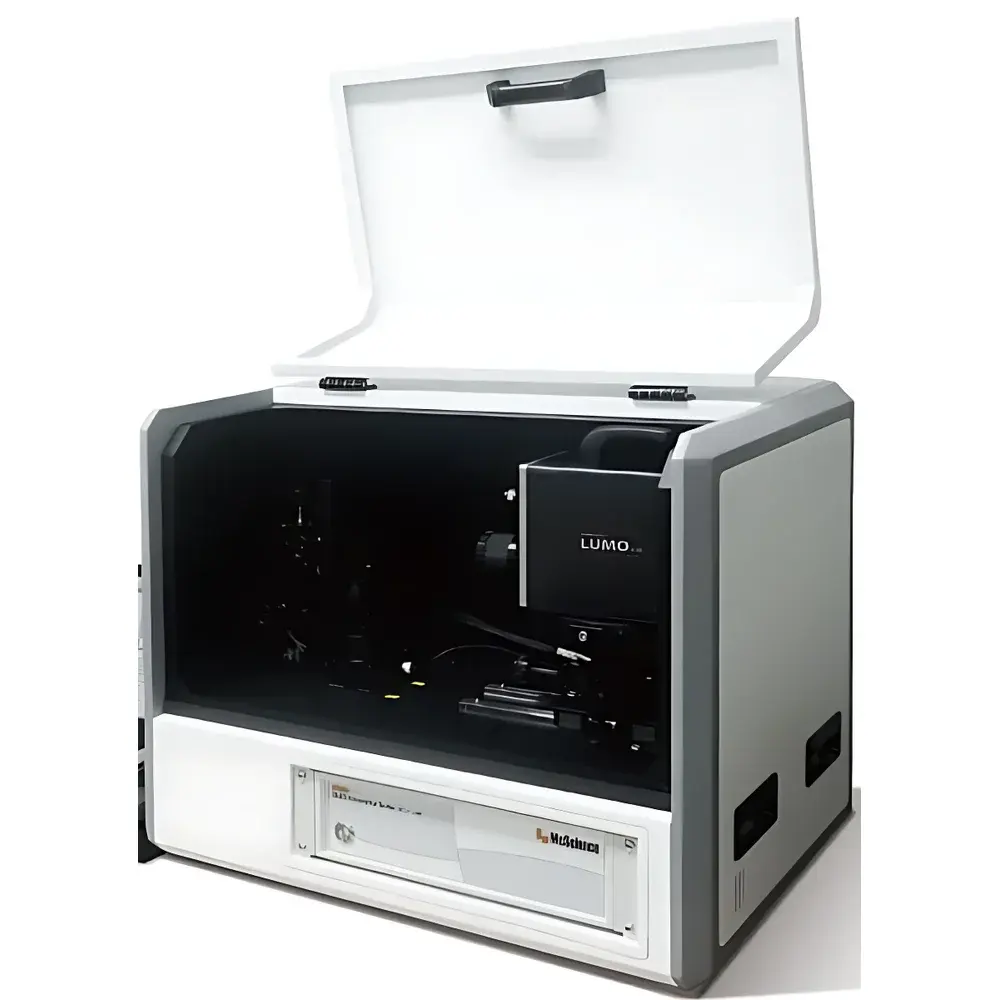
McScience M3000 Integrated OLED/Perovskite/QLED Optoelectronic Characterization System
| Brand | McScience |
|---|---|
| Origin | South Korea |
| Model | M3000 |
| Application Scope | OLED, Perovskite LED, QLED, Micro-OLED device characterization |
| Measurement Capabilities | I-V-L, C-V, spectral radiance, chromaticity coordinates (CIE 1931), viewing angle, luminance uniformity, EQE/IPCE, temperature-dependent optoelectronic profiling |
| Compliance | Designed for GLP-compliant lab environments |
Overview
The McScience M3000 Integrated OLED/Perovskite/QLED Optoelectronic Characterization System is a benchtop, modular platform engineered for comprehensive electroluminescent device evaluation. It combines a calibrated imaging spectroradiometer with a precision source-measure unit (SMU) to perform synchronized electrical and optical measurements under controlled environmental conditions. The system operates on the principle of simultaneous current–voltage–luminance (I-V-L) acquisition coupled with spatially resolved spectral radiance mapping, enabling quantitative analysis of electroluminescence efficiency, spectral stability, angular emission profiles, and degradation kinetics. Unlike standalone photometers or generic SMUs, the M3000 integrates hardware synchronization, automated stage control, and spectral calibration traceable to NIST-traceable standards—ensuring measurement reproducibility across laboratories and longitudinal studies. Its architecture supports both pulsed and DC bias protocols, making it suitable for transient electroluminescence analysis, operational lifetime assessment (LT50/LT70), and accelerated aging experiments under thermal or environmental stress.
Key Features
- Integrated imaging spectroradiometer with 0.1 nm spectral resolution (380–780 nm range) and absolute radiance calibration (W·sr⁻¹·m⁻²·nm⁻¹)
- Dual-channel high-accuracy SMU capable of ±0.02% basic accuracy in voltage sourcing and ±0.05% in current measurement (down to 100 fA resolution)
- Motorized goniometric stage for automated viewing-angle characterization (±85° horizontal/vertical sweep, 0.1° step resolution)
- Temperature-controlled sample stage (−40 °C to +120 °C) with real-time thermal feedback and programmable ramping profiles
- Automated CIE 1931 chromaticity coordinate calculation, correlated color temperature (CCT), and color rendering index (CRI) derivation
- Quantum efficiency module supporting external quantum efficiency (EQE) and power conversion efficiency (PCE) computation via calibrated reference diode integration
- Modular design allowing future expansion with optional environmental chamber, glovebox interface, or time-resolved EL add-on
Sample Compatibility & Compliance
The M3000 accommodates rigid and flexible substrates up to 150 mm × 150 mm, including glass, PET, PI, and ultrathin metal foils. It supports pixel-level probing via micro-probe station integration and full-panel macro-characterization using its wide-field imaging optics. Device architectures tested include bottom-emission and top-emission OLEDs, inverted and regular perovskite LEDs, colloidal QD-LEDs, and monolithic Micro-OLED microdisplays. All optical calibrations are performed using factory-certified standards traceable to KRISS (Korea Research Institute of Standards and Science). Software and firmware comply with ISO/IEC 17025:2017 requirements for testing laboratories and support 21 CFR Part 11-compliant electronic records—including role-based user authentication, immutable audit trails, and electronic signatures—enabling use in regulated R&D environments aligned with GLP and pre-GMP development workflows.
Software & Data Management
The proprietary McScience Characterization Suite (v4.2+) provides a unified interface for instrument control, experiment sequencing, real-time data visualization, and report generation. It features scriptable test protocols (Python API), batch processing for multi-sample campaigns, and export to HDF5, CSV, and industry-standard .mat formats. Data integrity is ensured through automatic metadata tagging (timestamp, operator ID, calibration ID, environmental log), checksum validation, and versioned project archiving. Raw spectral and I-V datasets are stored with embedded calibration coefficients, enabling traceable reprocessing without loss of metrological fidelity. The software includes built-in modules for lifetime extrapolation (Arrhenius and Eyring models), efficiency roll-off analysis, and spectral shift quantification (Δu’v’, peak wavelength drift), supporting publication-ready figure generation compliant with ACS, IEEE, and Nature Photonics formatting guidelines.
Applications
- Efficiency benchmarking of emissive layers (EMLs) and charge transport layers (HTL/ETL) in solution-processed perovskite LEDs
- Spatial non-uniformity mapping of luminance and chromaticity across active-matrix OLED backplanes
- Angular dependence modeling for microcavity OLEDs and polarized QLED architectures
- Operational stability analysis under constant-current stress, including luminance decay kinetics and spectral blue-shift quantification
- Temperature-dependent carrier injection barrier analysis via C-V profiling at variable thermal setpoints
- EQE optimization studies for tandem and hybrid OLED-perovskite structures
- Pre-fabrication screening of inkjet-printed emissive films prior to encapsulation
FAQ
Does the M3000 support lifetime testing under ambient atmosphere?
Yes—when integrated with optional inert-gas purge or glovebox docking, the system enables controlled-atmosphere lifetime testing. Without enclosure, it supports short-term operational stability assessment in dry nitrogen environments.
Can the system measure external quantum efficiency (EQE) without external calibration hardware?
Yes—the M3000 includes a factory-calibrated silicon reference photodiode and integrated optical path correction algorithms, enabling absolute EQE calculation without third-party calibration services.
Is the software compatible with Windows 11 and MATLAB R2022b or later?
Yes—the Characterization Suite runs natively on Windows 10/11 (64-bit) and provides bidirectional MATLAB interface via COM and TCP/IP protocols, supporting direct data streaming and custom algorithm deployment.
What is the minimum measurable luminance level?
With extended integration time and cooled sensor mode, the system achieves a radiance detection limit of 1×10⁻⁵ W·sr⁻¹·m⁻²·nm⁻¹ at 555 nm, corresponding to ~0.005 cd/m² for typical white OLED emission spectra.
Does McScience provide application support for academic research groups?
Yes—McScience offers dedicated technical application engineering support, including remote method development assistance, protocol customization, and co-authored publication support for peer-reviewed journals.



