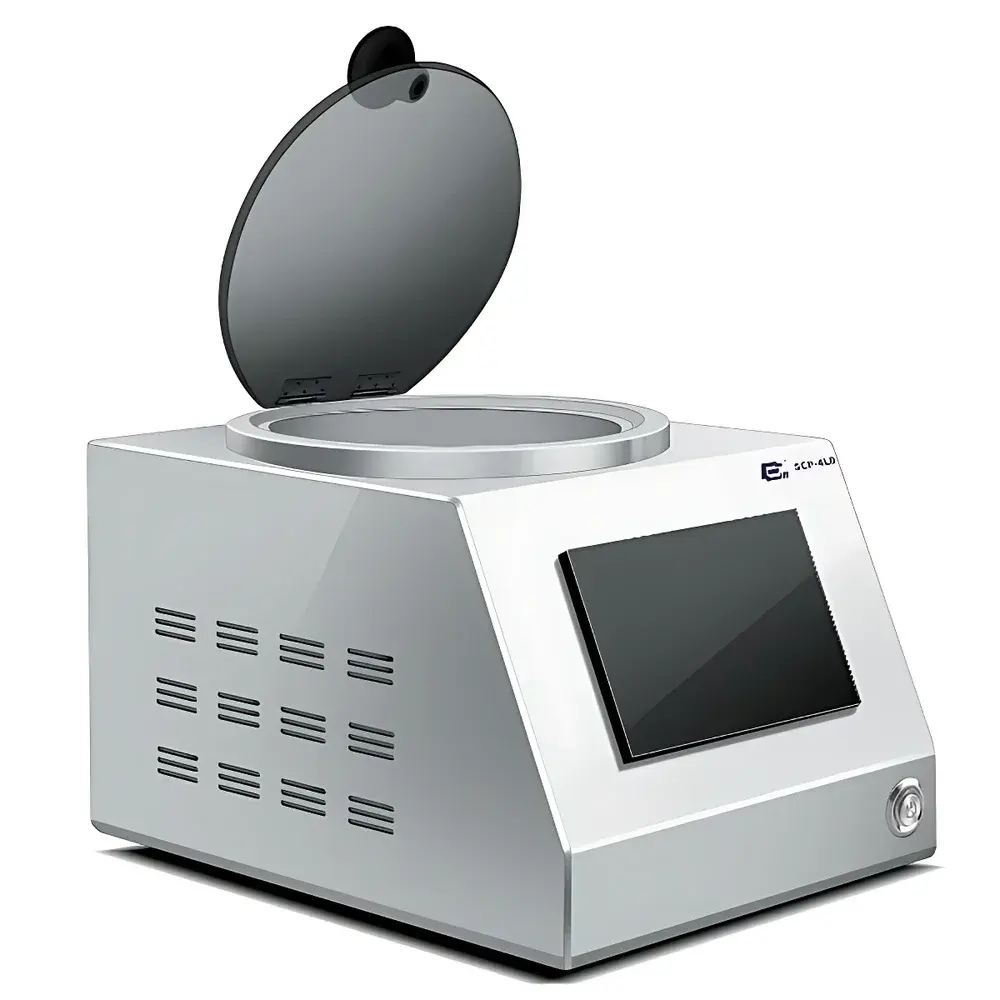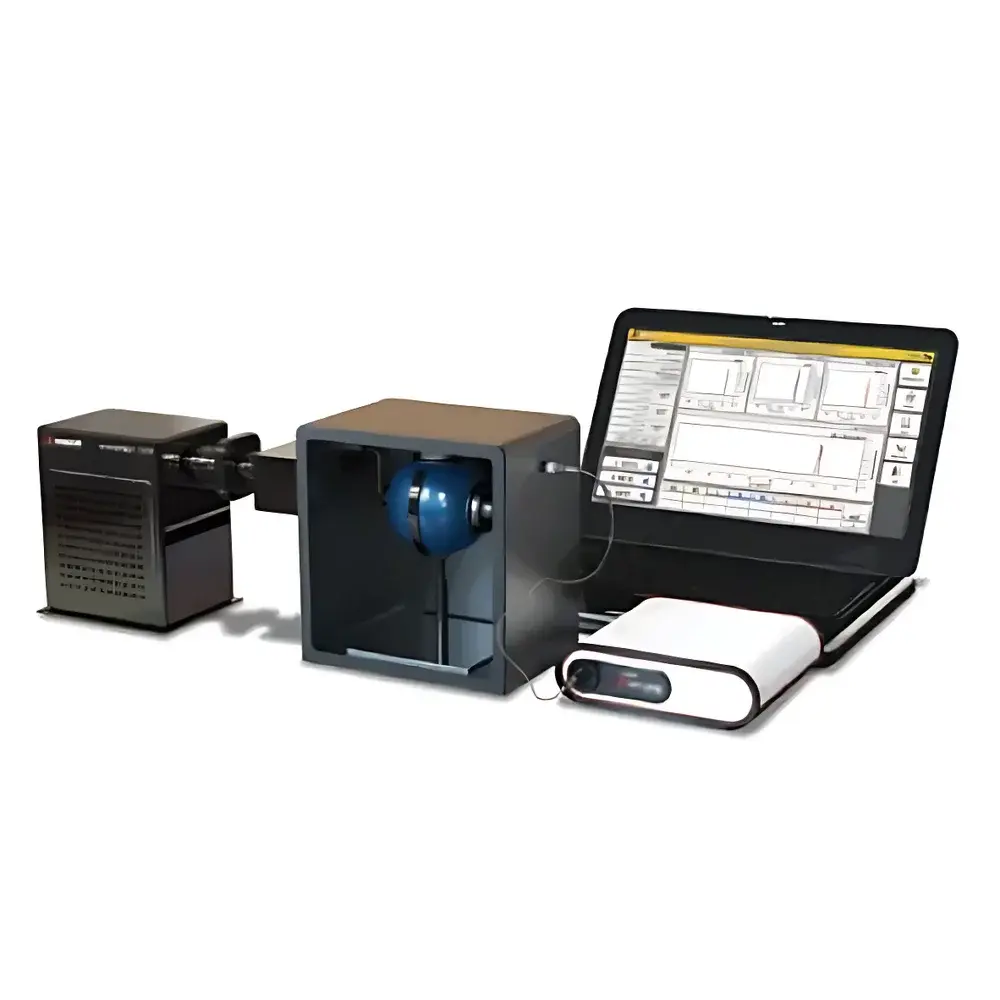
McScience L3000 Photoluminescence (PL) Measurement System
| Brand | McScience |
|---|---|
| Origin | South Korea |
| Model | L3000 |
| Type | Integrated PL/EQE/IQE/Spectral Characterization System |
| Sample Forms | Thin Films, Bulk Solids, Powders, Liquids |
| Measurement Modes | Steady-State PL, Time-Resolved PL (TRPL), External Quantum Efficiency (EQE), Internal Quantum Efficiency (IQE), Absorption Spectroscopy, Emission Spectroscopy |
| Excitation Sources | Tunable CW and Pulsed LEDs/Lasers (UV–Vis range) |
| Detection | Back-Thinned CCD or EMCCD Spectrometer (200–1100 nm) |
| Spectral Resolution | ≤ 0.1 nm (typ.) |
| Integration Time Range | 1 ms – 300 s |
| Software Control | Fully Automated via McScience PL-Studio v4.x |
Overview
The McScience L3000 Photoluminescence (PL) Measurement System is an integrated optical characterization platform engineered for quantitative, high-sensitivity photophysical analysis of semiconductor materials and optoelectronic devices. Based on the fundamental principle of photoluminescence—where incident photons excite charge carriers across the bandgap and subsequent radiative recombination emits detectable photons—the L3000 enables precise quantification of luminescent yield, spectral distribution, lifetime dynamics, and quantum efficiency metrics. Designed specifically for R&D laboratories and process development teams in compound semiconductor, perovskite, OLED, and quantum dot industries, the system supports both steady-state and time-resolved measurements under controlled environmental conditions (optional N₂ purge or cryogenic stage integration). Its modular architecture accommodates variable excitation wavelengths (265–785 nm), calibrated spectral detection (200–1100 nm), and traceable radiometric calibration—ensuring data integrity compliant with ISO/IEC 17025–aligned measurement practices.
Key Features
- Multi-mode optical characterization: Simultaneous acquisition of photoluminescence (PL), absorption, and electroluminescence (EL)-compatible emission spectra
- Quantitative quantum efficiency measurement: Integrated external quantum efficiency (EQE) and internal quantum efficiency (IQE) calculation modules, traceable to NIST-calibrated reference standards
- Time-resolved PL (TRPL) capability: Nanosecond-to-microsecond decay profiling using pulsed excitation sources and time-correlated single-photon counting (TCSPC) or gated ICCD detection
- Flexible sample handling: Motorized XYZ stage with interchangeable holders for thin films (on quartz/silicon substrates), bulk crystals, dispersed powders in cuvettes, and solution-phase samples
- Environmental control compatibility: Optional integration with liquid nitrogen cryostats (4–300 K), glovebox interfaces (O₂/H₂O < 0.1 ppm), and temperature-controlled stages (–50 °C to +150 °C)
- Modular excitation engine: Interchangeable CW and pulsed light sources—including UV LEDs (265, 365 nm), visible lasers (405, 450, 532 nm), and tunable supercontinuum sources—for selective carrier generation and defect-state probing
Sample Compatibility & Compliance
The L3000 accommodates a broad range of semiconductor material formats without requiring metallization or electrical contacting: spin-coated perovskite thin films, MBE-grown GaN epilayers, colloidal QD dispersions, sintered ceramic phosphors, and single-crystal SiC wafers. All optical paths are aligned to ISO 9001-certified manufacturing tolerances, and spectral responsivity is validated per CIE Publication 127 and JIS Z 8723. The system meets essential requirements for GLP-compliant photophysical testing—supporting audit-ready metadata logging (excitation power, integration time, grating position, detector gain), electronic signatures, and 21 CFR Part 11–compliant user access control when deployed with optional PL-Studio Secure Edition.
Software & Data Management
Controlled exclusively via McScience PL-Studio v4.x—a Windows-based, instrument-driver-integrated application—the L3000 provides scriptable automation (Python API), real-time spectral overlay, multi-dimensional mapping (X-Y-λ-t), and batch processing for statistical comparison across sample sets. Raw data is stored in HDF5 format with embedded metadata (wavelength calibration coefficients, dark current correction maps, lamp intensity drift logs). Export options include CSV, ASCII, and industry-standard JCAMP-DX for spectral interoperability with OriginLab, MATLAB, and Thermo Scientific OMNIC. Audit trails record all parameter changes, user logins, and report generations—enabling full traceability for internal QA reviews or third-party certification audits.
Applications
- Bandgap and Stokes shift determination in emerging semiconductors (e.g., CsPbBr₃, Sn-based perovskites, 2D TMDs)
- Non-radiative recombination loss analysis via IQE/EQE correlation in LED and solar cell absorber layers
- Defect state density estimation through temperature-dependent PL intensity and linewidth modeling
- Surface passivation efficacy evaluation using TRPL decay kinetics before/after ALD treatment
- Batch uniformity screening of QD ink formulations via emission FWHM and peak wavelength mapping
- Stability assessment under thermal stress or photo-oxidation by tracking PL quantum yield degradation over time
FAQ
Does the L3000 support absolute quantum yield measurement?
Yes—when configured with an integrating sphere accessory (L3000-IS-150) and calibrated reference standards, it delivers absolute EQE and IQE values with ±3% uncertainty (k = 2) across 350–950 nm.
Can the system be upgraded for time-resolved measurements after purchase?
Yes—TRPL functionality is available as a field-installable option, including pulsed laser diode module, TCSPC electronics, and extended software license.
Is spectral calibration traceable to national metrology institutes?
All spectrometer calibrations are performed using NIST-traceable Hg/Ar/Ne emission line standards; certificate of calibration is supplied with each system.
What sample preparation protocols are recommended for powder measurements?
Powders should be uniformly dispersed in low-fluorescence epoxy or pressed into pellets with KBr; reflectance correction is applied automatically during EQE calculation.
How is excitation power monitored and stabilized during long-term measurements?
Integrated photodiode feedback loop continuously monitors source output; real-time power normalization is applied to all spectral integrals in post-processing.