
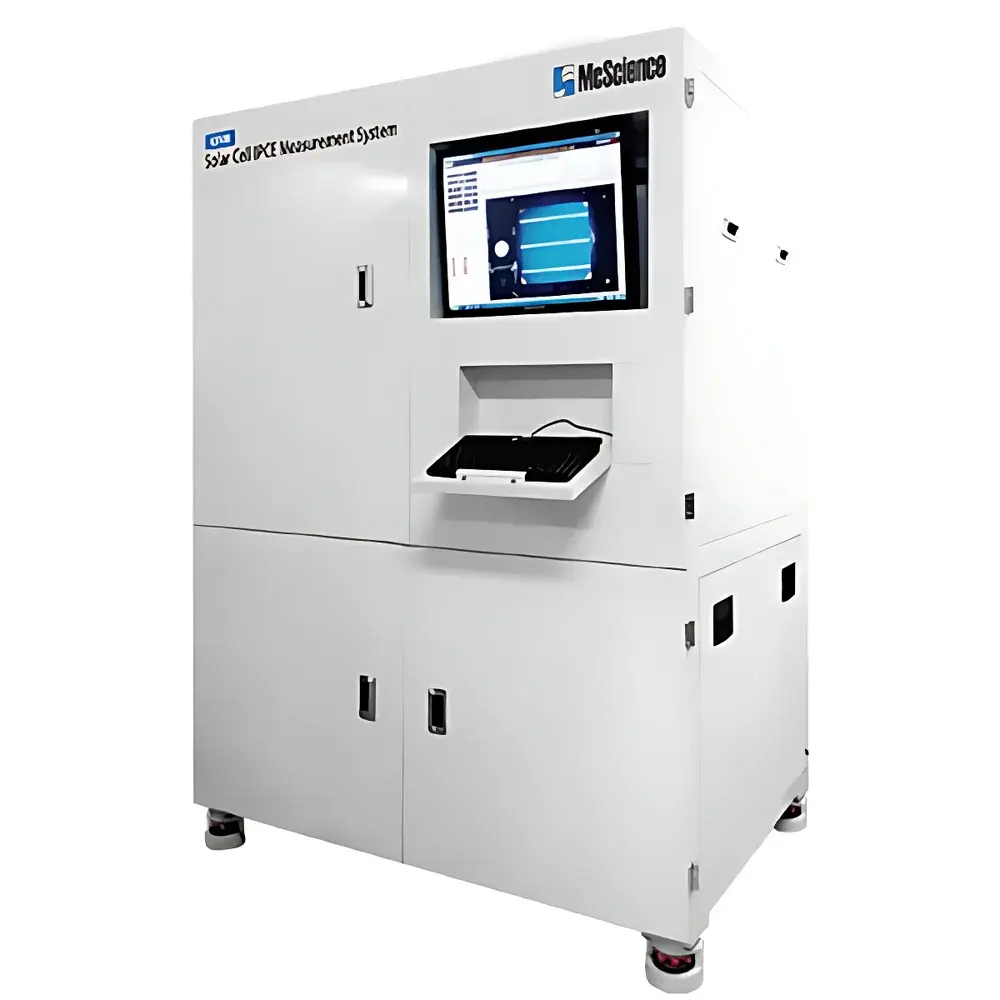
McScience K3100-EI Quantum Efficiency Measurement System
| Brand | McScience |
|---|---|
| Origin | South Korea |
| Model | K3100-EI |
| Application | Photovoltaic Device Characterization |
| Measurement Modes | Spectral Response (SR), External Quantum Efficiency (EQE), Internal Quantum Efficiency (IQE), DC/AC/NIR Photocurrent Analysis |
| Automation | Motorized Monochromator with Precision Sample Positioning |
| Compliance | Designed for ASTM E1021, IEC 60904-8, and ISO 18585 alignment |
Overview
The McScience K3100-EI Quantum Efficiency Measurement System is a research-grade, fully automated instrumentation platform engineered for high-accuracy spectral responsivity and quantum efficiency characterization of photovoltaic (PV) devices. Based on the principle of monochromatic photocurrent spectroscopy, the system measures the ratio of charge carriers collected per incident photon across a defined wavelength range—typically spanning 300 nm to 1200 nm—to determine both external quantum efficiency (EQE) and internal quantum efficiency (IQE). Unlike conventional IV curve tracers, the K3100-EI integrates calibrated broadband illumination, a high-resolution grating monochromator, low-noise current preamplification, and synchronized lock-in detection to resolve sub-picoamp photocurrent signals under modulated monochromatic excitation. Its architecture supports both DC and AC measurement protocols—including small-signal AC modulation for carrier lifetime estimation—and extends into the near-infrared (NIR) region to evaluate advanced absorber materials such as perovskites, organic PVs, and silicon heterojunctions.
Key Features
- Motorized monochromator with <1.5 nm optical bandwidth and ±0.1 nm wavelength repeatability, enabling precise spectral scanning from UV to NIR
- Dual-mode detection: DC photocurrent integration for steady-state EQE and lock-in amplifier-based AC photocurrent analysis for recombination kinetics assessment
- Integrated sample stage with programmable XYZ translation and rotational alignment—critical for spatially resolved QE mapping of large-area or textured solar cells
- Reference photodiode traceable to NIST standards, with real-time spectral irradiance correction applied during data acquisition
- Optical chopper synchronization and phase-sensitive detection to suppress 1/f noise and ambient light interference
- Modular design supporting optional accessories: bias-light LED arrays (for Voc-dependent IQE), temperature-controlled sample holders (-40°C to +85°C), and vacuum-compatible chambers
Sample Compatibility & Compliance
The K3100-EI accommodates standard PV device formats including wafer-scale Si cells (up to 210 mm), mini-modules (≤15 cm × 15 cm), thin-film substrates (glass, flexible PET, metal foil), and lab-scale perovskite or OPV devices on ITO/PEDOT substrates. All optical and electrical interfaces adhere to IEC 60904-8 Ed.3 (2022) requirements for spectral mismatch correction and calibration traceability. The system’s firmware and data logging structure support audit-ready operation in GLP-compliant laboratories; raw data files include embedded metadata (wavelength, bias voltage, chopper frequency, reference diode responsivity) compliant with ASTM E1021-21 Annex A1 for interlaboratory EQE comparison. While not FDA-certified (as it is non-clinical), its software architecture follows 21 CFR Part 11 principles for electronic records—featuring user-level access control, immutable audit trails, and electronic signatures for test reports.
Software & Data Management
Control and analysis are performed via McScience’s QEMaster v4.2 software, a Windows-based application developed in accordance with ISO/IEC 17025:2017 software validation guidelines. The interface provides real-time spectral plot overlays (EQE, IQE, SR), automatic calculation of integrated Jsc (using AM1.5G spectral weighting), and batch processing for multi-sample comparative studies. Export options include CSV, MATLAB .mat, and standardized HDF5 formats compatible with PV performance modeling tools (e.g., SCAPS, wxAMPS). All measurement sessions generate timestamped, digitally signed XML log files containing full instrument configuration, environmental conditions (ambient temperature/humidity), and calibration certificate IDs—ensuring full traceability for third-party verification or accreditation audits.
Applications
- Quantitative evaluation of charge extraction efficiency in tandem and multi-junction solar cells
- Identification of spectral losses due to parasitic absorption, reflection, or recombination at interfaces
- Correlation of IQE profiles with cross-sectional TEM/EBIC data to localize defect-rich regions
- Stability assessment via time-resolved EQE tracking under thermal cycling or light-soaking stress
- Process optimization support for ALD, sputtering, and inkjet-printed electrode fabrication
- Validation of optical simulation models (e.g., FDTD, RCWA) against empirical spectral response data
FAQ
What wavelength range does the K3100-EI cover?
The system operates from 300 nm to 1200 nm, with extended NIR capability up to 1800 nm available via optional InGaAs detector module.
Can it measure both EQE and IQE without sample preparation?
Yes—IQE derivation requires reflectance/transmittance input, which can be acquired in situ using the built-in integrating sphere option or imported from external spectrophotometer data.
Is the system compatible with glovebox integration?
The base unit supports feedthrough-enabled vacuum/gas-purged enclosures; custom flange kits and fiber-optic coupling are available upon request.
Does it support pulsed illumination for transient QE analysis?
Not natively—but the analog output interface allows synchronization with external laser drivers for time-resolved photocurrent experiments.
How is calibration maintained over time?
The system includes automated daily self-check routines; NIST-traceable recalibration of the reference diode and monochromator is recommended annually or after 500 hours of operational use.



