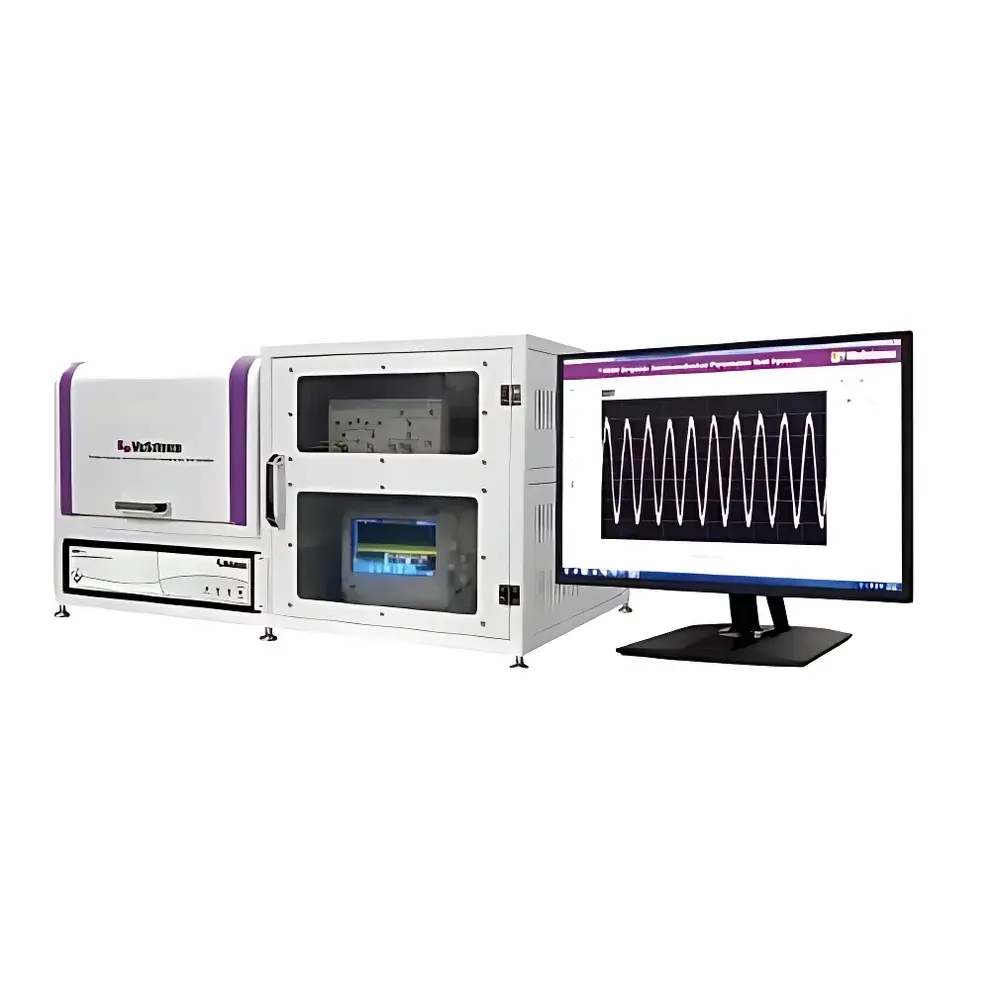
McScience T4000 Organic Semiconductor Characterization System
| Brand | McScience |
|---|---|
| Origin | South Korea |
| Model | T4000 |
| Type | Integrated Organic Semiconductor Parameter Measurement System |
| Light Source | High-Stability LED Array |
| Measurement Modes | TPV, TPC, Linear Ramp Charge Extraction (Dark & Photo), Transient Electroluminescence, DC I–V, Impedance Spectroscopy (IS), Capacitance–Voltage (C–V), IMVS, IMPS |
| Compliance | Designed for ISO/IEC 17025-aligned laboratory environments |
| Software Interface | Windows-based with automated script execution and raw data export (CSV, TXT, HDF5) |
| Data Acquisition | 16-bit ADC, up to 1 MS/s sampling rate |
| Voltage Range | ±20 V (programmable), Current Range: ±100 mA (auto-ranging) |
| Environmental Operation | 15–35 °C, <70% RH non-condensing |
Overview
The McScience T4000 Organic Semiconductor Characterization System is an integrated, benchtop platform engineered for quantitative, time-resolved electrical and optoelectronic characterization of organic semiconductor thin films and devices. It operates on fundamental solid-state physics principles—including charge carrier drift-diffusion dynamics, trap-assisted recombination kinetics, and interfacial capacitance modulation—to extract critical parameters such as hole/electron mobility, trap density distribution, recombination lifetime, built-in potential, and interface state density. Unlike generic source-measure units (SMUs), the T4000 embeds synchronized optical excitation (via calibrated, spectrally stable LED sources) with high-fidelity transient current/voltage acquisition, enabling direct correlation between photogeneration conditions and device response. Its architecture supports both steady-state and dynamic measurement paradigms essential for R&D in organic photovoltaics (OPV), organic light-emitting diodes (OLEDs), organic field-effect transistors (OFETs), and perovskite-organic hybrid systems.
Key Features
- Multi-modal transient measurement suite: Simultaneous support for Time-Resolved Photovoltage (TPV), Time-Resolved Photocurrent (TPC), Linear Ramp Charge Extraction (LR-CE) under dark and illuminated conditions, and Transient Electroluminescence (TrEL) with microsecond-scale temporal resolution.
- Integrated LED excitation system: Programmable intensity control (0–100% full scale), selectable wavelengths (365 nm, 405 nm, 450 nm, 520 nm, 630 nm), and pulse widths from 10 µs to continuous wave—enabling spectral response mapping and wavelength-dependent carrier dynamics analysis.
- High-bandwidth electrical measurement core: Dual-channel 16-bit analog-to-digital conversion with up to 1 MS/s sampling, programmable gain amplifiers, and hardware-triggered synchronization between optical pulses and voltage/current acquisition.
- Comprehensive steady-state characterization: DC current–voltage (I–V) sweeps with compliance limiting, frequency-dependent impedance spectroscopy (10 mHz–1 MHz), and capacitance–voltage (C–V) profiling with variable AC amplitude and DC bias ramping.
- Modulated illumination techniques: Intensity Modulated Photovoltage Spectroscopy (IMVS) and Intensity Modulated Photocurrent Spectroscopy (IMPS) implemented via real-time digital signal generation and lock-in compatible demodulation—providing phase-resolved carrier transport and recombination information.
Sample Compatibility & Compliance
The T4000 accommodates standard device geometries including ITO/PEDOT:PSS/Active Layer/Cathode stacks (e.g., OPV cells), glass/ITO/HIL/HTL/EML/ETL/Cathode OLED structures, and bottom-gate/top-contact OFET configurations. Sample holders feature spring-loaded gold-plated probes with adjustable pressure and low-noise triaxial cabling to minimize stray capacitance and electromagnetic interference. The system meets electromagnetic compatibility requirements per IEC 61326-1 for laboratory use and is designed to operate within ISO/IEC 17025-accredited testing environments. While not certified as a medical or safety-critical instrument, its measurement traceability aligns with NIST-traceable calibration practices for voltage, current, and optical power where applicable.
Software & Data Management
The T4000 is controlled via McScience’s proprietary Characterization Studio software (Windows 10/11, 64-bit). The application provides modular experiment sequencing—users define stimulus waveforms, acquisition windows, trigger logic, and parameter sweep ranges via intuitive graphical interfaces or Python-based scripting (API access included). All raw datasets are stored in hierarchical HDF5 format with embedded metadata (timestamp, instrument configuration, environmental conditions, operator ID), ensuring FAIR (Findable, Accessible, Interoperable, Reusable) data principles. Export options include CSV for spreadsheet analysis, TXT for legacy tools, and MATLAB-compatible .mat files. Audit trails record user actions, method changes, and calibration events—supporting GLP/GMP-aligned workflows and FDA 21 CFR Part 11 readiness when deployed with validated IT infrastructure.
Applications
- Quantifying charge carrier mobility in disordered organic semiconductors using space-charge-limited current (SCLC) analysis and time-of-flight (ToF) derived transit times.
- Evaluating recombination order and dominant loss mechanisms in OPV active layers via TPV/TPC amplitude decay fitting and IMVS/IMPS Nyquist plot interpretation.
- Mapping energy level alignment at donor–acceptor interfaces through C–V profiling and built-in potential extraction from dark J–V curves.
- Assessing operational stability of OLED emissive stacks by monitoring TrEL rise/fall kinetics and spectral shift under constant-current stress.
- Validating interfacial dipole formation and defect passivation efficacy in inverted OPV architectures using frequency-dependent capacitance dispersion analysis.
FAQ
What types of organic semiconductor devices can be tested with the T4000?
The system supports single-junction and tandem OPV cells, small-molecule and polymer OLEDs, solution-processed and vacuum-deposited OFETs, and emerging organic–inorganic hybrid photodetectors.
Does the T4000 support external light sources or third-party lasers?
Yes—optical input ports accept TTL-synchronized external illumination (e.g., pulsed lasers, xenon lamps) via fiber coupling; software allows manual or automated integration of external trigger signals.
Is calibration documentation provided with the instrument?
Each unit ships with a factory calibration report covering voltage, current, timing, and optical power channels; optional annual recalibration services are available through McScience-authorized service centers in EMEA and North America.
Can the T4000 perform low-temperature measurements?
The base system operates at ambient temperature; cryogenic compatibility requires integration with external temperature-controlled stages (e.g., Janis ST-500, Linkam LTS420), which the software supports via analog/digital I/O interface.
How is data security and user access managed?
Characterization Studio includes role-based user accounts (Administrator, Operator, Viewer), encrypted local database storage, and configurable password policies—fully compatible with enterprise Active Directory integration.