
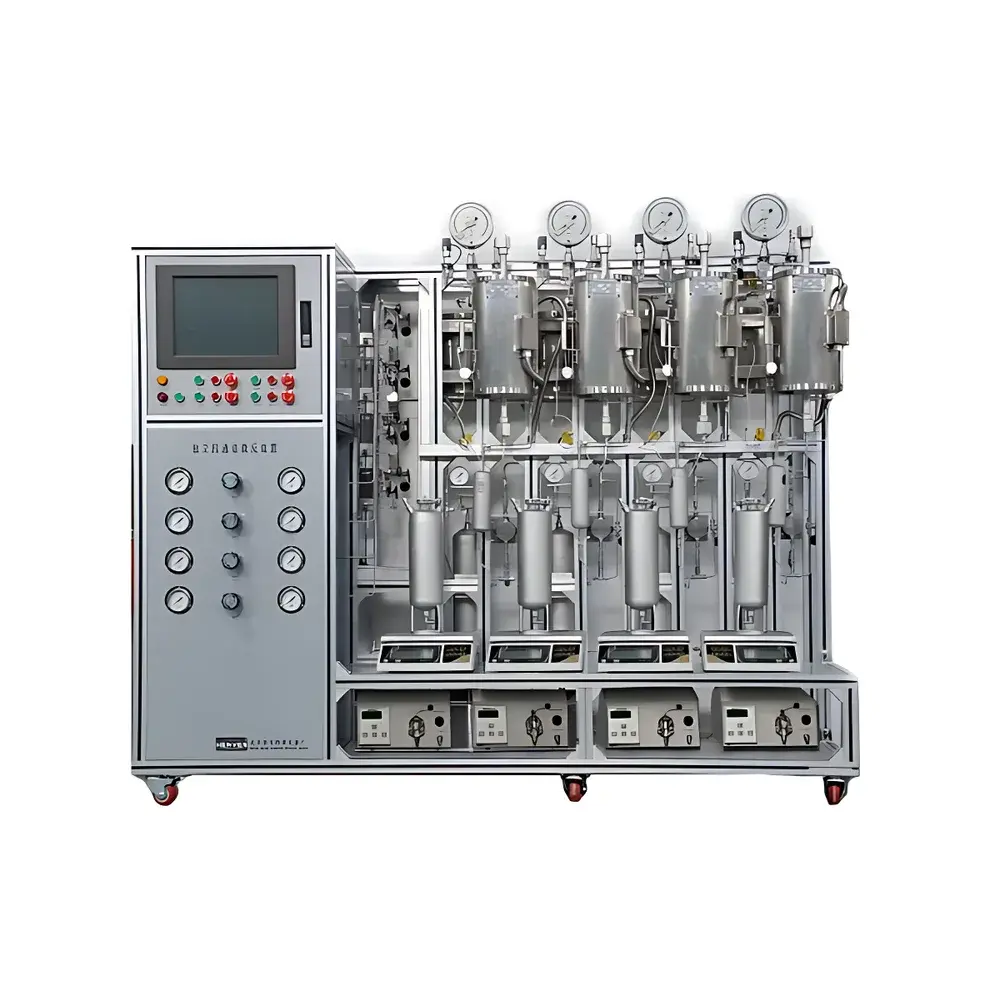
Henven HJDS Independent Four-Channel Microreactor System
| Brand | Henven |
|---|---|
| Origin | Beijing, China |
| Manufacturer Type | Direct Manufacturer |
| Region | Domestic (China) |
| Model | HJDS |
| Price Range | USD 28,000 – 42,500 (FOB Beijing) |
| Maximum Reaction Pressure | 10 MPa |
| Maximum Reaction Temperature | 500 °C |
| Catalyst Bed Volume | 5 mL |
| Reactor Dimensions | 20 mm × 4 mm × 600 mm (ID × Wall Thickness × Length) |
| Liquid Flow Rate Capacity | 150 mL/min |
| Maximum Allowable Pressure Drop Across Catalyst Bed | ≤ 0.3 MPa |
| Temperature & Pressure Control Accuracy | ±1% of setpoint |
Overview
The Henven HJDS Independent Four-Channel Microreactor System is an engineered platform for high-fidelity catalytic reaction evaluation under elevated temperature and pressure conditions. Designed around Couette-type microreactor geometry with independent thermal and hydraulic isolation per channel, the system enables parallel, comparative kinetic studies across four identical reaction zones—each operating autonomously with dedicated mass flow controllers, pressure transducers, and segmented PID-controlled heating zones. Its core architecture supports heterogeneous catalysis research involving corrosive feedstocks—including anhydrous hydrogen fluoride (HF)—through seamless integration of Hastelloy C-276 reactor tubes, fluoropolymer-sealed fittings, and chemically inert internal wetted surfaces. The system adheres to ASME B31.3 process piping design principles for high-pressure gas–liquid–solid systems and incorporates fail-safe mechanical interlocks aligned with IEC 61511 functional safety standards for laboratory-scale process equipment.
Key Features
- Four fully independent reaction channels with isolated temperature zoning (up to 500 °C), pressure regulation (0–10 MPa), and liquid/gas flow control (0–150 mL/min per channel)
- Hastelloy C-276 microtubular reactors (20 mm ID × 4 mm wall × 600 mm length) rated for continuous HF exposure and thermal cycling
- Segmented resistive heating with six independently controlled zones per reactor, enabling linear ramping or multi-step isothermal profiles with ±1% thermal accuracy
- Integrated fault detection and mitigation subsystem: real-time monitoring of 12+ critical parameters (including localized bed temperature gradients, differential pressure across catalyst bed, and inlet/outlet pressure differentials), triggering automatic shutdown and alarm logging upon threshold violation
- Touchscreen HMI based on Linux RTOS with deterministic I/O response (<10 ms loop time); supports recipe-based operation, parameter logging at 1 Hz resolution, and export in CSV/Excel-compatible format
- Renmai Fluidized Bed Control Module (FBCM): proprietary algorithm suite supporting auto-tuning of fluidization velocity, minimum fluidization determination via pressure fluctuation analysis, and dynamic adjustment of gas distribution plate backpressure
Sample Compatibility & Compliance
The HJDS system accommodates solid catalysts in powder, extrudate, or pellet form (bed volume: 5 mL per channel), and accepts liquid-phase feeds including hydrofluoric acid, chlorinated solvents, alcohols, and aqueous electrolytes. Gas-phase compatibility extends to H₂, CO, CO₂, NH₃, O₂, N₂, and syngas mixtures. All wetted components conform to ASTM A240/A479 specifications for corrosion-resistant alloys. Pressure containment complies with PED 2014/68/EU Category IV requirements. Data acquisition and control firmware meet ALCOA+ principles for data integrity and are structured to support GLP-compliant audit trails per OECD Series on Principles of Good Laboratory Practice.
Software & Data Management
The embedded Renmai Control Suite provides role-based access control (operator, engineer, administrator), electronic signature capability compliant with FDA 21 CFR Part 11 Annex 11, and timestamped event logging with SHA-256 hash verification. Raw sensor data—including thermocouple readings (Type K, Class 1), piezoresistive pressure outputs (0–15 MPa full scale), and Coriolis-based mass flow signals—are buffered locally and synchronized via IEEE 1588 Precision Time Protocol. Export options include ASCII-delimited files with metadata headers, direct OPC UA server integration for LIMS/SCADA interfacing, and optional cloud-sync via TLS 1.3-secured MQTT broker (on-premise deployment supported).
Applications
- Kinetic modeling of acid-catalyzed alkylation, fluorination, and isomerization reactions using HF or BF₃ co-catalysts
- Deactivation studies of zeolite- and metal oxide-based catalysts under cyclic thermal and chemical stress
- Screening of bifunctional catalysts for tandem reactions (e.g., dehydration–hydrogenation) under mixed-phase conditions
- Validation of computational fluid dynamics (CFD) models for packed-bed and fluidized-bed configurations
- Development of ASTM D7213-compliant protocols for low-volume catalyst lifetime assessment
FAQ
What materials are used for corrosion resistance when handling hydrogen fluoride?
Hastelloy C-276 tubing, PTFE-coated stainless steel valves, and Kalrez® 6375 O-rings constitute the primary HF-wetted material set. All flanges use spiral-wound graphite-filled gaskets meeting ASME B16.20 standards.
Can the system operate under true fluidized-bed conditions?
Yes—the Renmai FBCM supports Geldart Group A and B particle fluidization with real-time void fraction estimation via differential pressure spectral analysis and automatic adjustment of distributor plate backpressure.
Is remote monitoring and control supported?
Remote access is available via secure SSH tunnel or HTTPS-enabled web interface; however, real-time closed-loop control requires local HMI operation due to deterministic timing constraints.
How is catalyst bed temperature uniformity verified?
Each reactor integrates three calibrated Type K thermocouples at axial positions (inlet, mid-bed, outlet) with independent cold-junction compensation. Uniformity is validated per ISO 17025-accredited calibration protocol using traceable dry-block calibrators.
Does the system support automated catalyst reduction protocols?
Yes—pre-programmed H₂/N₂ ramp-and-hold sequences with integrated exotherm detection and automatic quench initiation are configurable through the HMI recipe editor.



