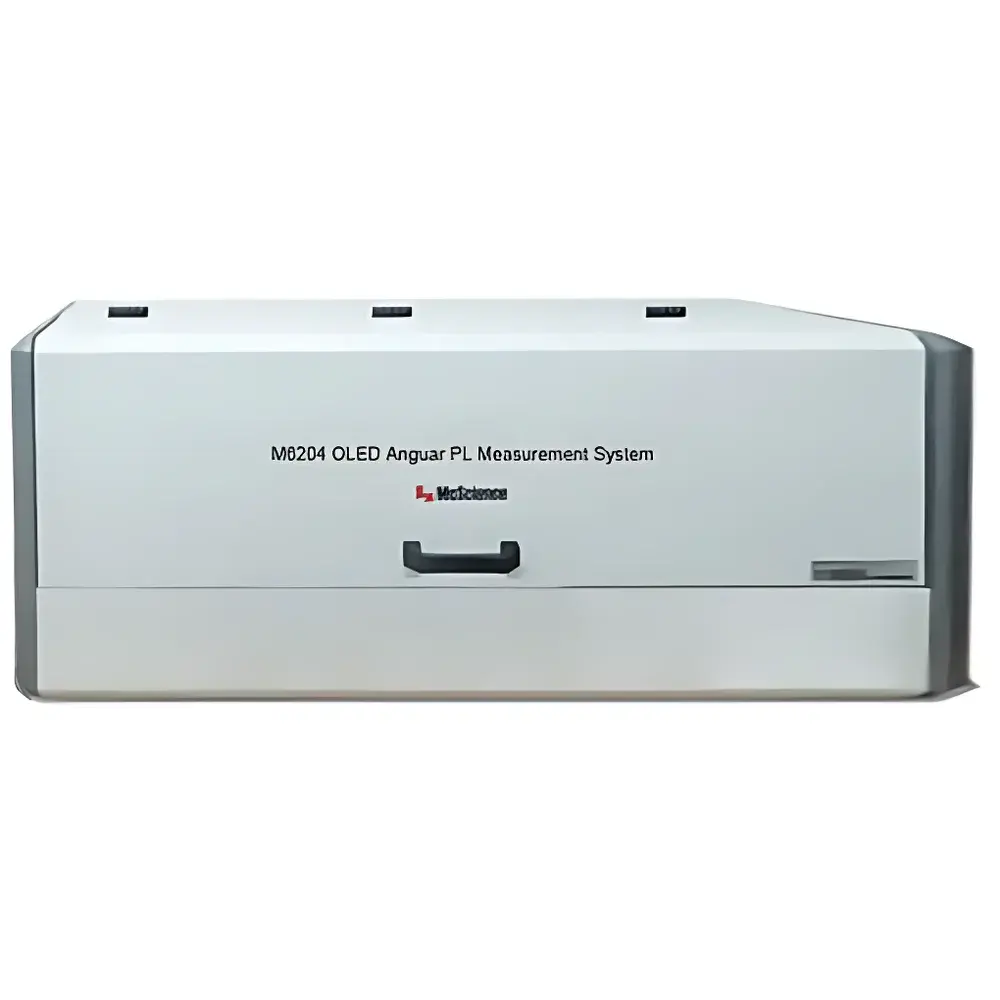
M6204 OLED/Perovskite LED Angular Photoluminescence Measurement System
| Brand | McScience |
|---|---|
| Origin | South Korea |
| Model | M6204 |
| Type | Import Instrument |
| Distribution Channel | Authorized Distributor |
| Pricing | Upon Request |
Overview
The McScience M6204 Angular Photoluminescence (PL) Measurement System is a precision-engineered platform designed for quantitative, angle-resolved photoluminescence characterization of emissive thin-film semiconductor devices—specifically organic light-emitting diodes (OLEDs) and metal-halide perovskite light-emitting diodes (PeLEDs). Built upon a goniometric optical architecture, the system enables high-fidelity spectral acquisition across polar angles (typically 0°–90° in 0.1° increments) while maintaining strict control over excitation geometry, collection solid angle, and polarization state. Unlike conventional integrating sphere-based PL setups, the M6204 implements a fixed-excitation / rotating-detector configuration with calibrated fiber-coupled spectrometers and motorized rotation stages traceable to NIST-traceable angular encoders. This design ensures reproducible measurement of emission anisotropy, outcoupling efficiency, viewing-angle-dependent electroluminescence (EL)-PL correlation, and waveguide mode extraction—critical parameters for display pixel engineering, microcavity optimization, and radiative decay pathway analysis in next-generation emissive optoelectronics.
Key Features
- Goniometric stage with ±0.05° angular positioning repeatability and <0.02° absolute accuracy, certified via interferometric calibration
- Dual-spectrometer configuration: UV-VIS (200–800 nm) and NIR (800–1700 nm), both fiber-coupled with thermoelectric cooling (−10°C) and grating resolution ≤0.3 nm (FWHM)
- Monochromatic or broadband excitation options: 375 nm, 405 nm, 450 nm laser diodes or tunable LED sources (360–780 nm), all intensity-stabilized to <±0.5% RMS over 1 hour
- Automated polarization control: motorized half-wave plates and linear polarizers enabling Stokes parameter acquisition for degree-of-polarization (DoP) mapping
- Vacuum-compatible sample stage (10⁻⁴ mbar base pressure) with temperature control from −40°C to +120°C (optional cryo- or thermal-stage integration)
- Integrated reference photodiode for real-time excitation flux normalization, eliminating drift-induced spectral artifacts
Sample Compatibility & Compliance
The M6204 accommodates standard semiconductor substrates up to 100 mm × 100 mm, including glass, quartz, silicon wafers, and flexible PET/PEN foils with active-layer thicknesses ranging from 50 nm to 2 µm. Device architectures supported include bottom-emission, top-emission, transparent, and tandem OLED/PeLED stacks. All optical components comply with ISO 9022-3 (optical instrument environmental testing) and IEC 61000-4-3 (radiated immunity). The system’s firmware and data acquisition logic are structured to support audit-ready documentation workflows aligned with GLP principles; raw spectral files embed metadata compliant with ASTM E2919-22 (Standard Practice for Digital Data Exchange in Spectroscopy) and include timestamps, instrument ID, calibration certificate IDs, and user-defined experimental tags.
Software & Data Management
Control and analysis are executed via McScience’s proprietary QuantumView™ software suite (v4.2+), a Windows-based application built on Qt/C++ with Python API extension support. The software provides synchronized multi-axis motion control, real-time spectral preview, automated dark-current subtraction, and batch processing of angular datasets into 2D intensity vs. angle vs. wavelength matrices. Export formats include HDF5 (with embedded metadata schema), CSV, and industry-standard JCAMP-DX for spectral interchange. Audit trail functionality logs all user actions—including parameter changes, calibration events, and file exports—with time stamps and operator credentials, satisfying FDA 21 CFR Part 11 requirements when deployed in regulated QC environments. Raw data integrity is preserved through SHA-256 checksum generation at acquisition time.
Applications
- Quantification of outcoupling efficiency and substrate-mode vs. waveguide-mode emission ratios in microcavity OLEDs
- Angle-resolved PL quantum yield (PLQY) mapping under controlled excitation fluence for non-radiative recombination analysis
- Polarization-resolved emission profiling to evaluate dipole orientation distribution in thermally activated delayed fluorescence (TADF) emitters
- Stability assessment of perovskite nanocrystal films under angularly resolved photoexcitation stress
- Correlation of angular PL profiles with electroluminescent viewing-angle performance for display grayscale uniformity modeling
- Validation of optical simulation models (e.g., FDTD, RCWA) using experimentally measured far-field radiation patterns
FAQ
Does the M6204 support time-resolved PL (TRPL) measurements?
No—the M6204 is optimized for steady-state angular PL spectroscopy. Time-resolved capability requires pulsed excitation and gated detection hardware not included in this configuration.
Can the system be integrated with an electrical probe station for simultaneous EL/PL angular mapping?
Yes—McScience offers optional vacuum-compatible electrical feedthrough modules and bias-controlled sample holders compatible with standard probe stations (e.g., Cascade Microtech, MPI). Integration requires custom mechanical alignment fixtures and synchronization firmware.
Is calibration traceable to national metrology institutes?
Spectral calibration uses NIST-traceable tungsten halogen and mercury-argon lamp standards. Angular calibration is verified using autocollimator-based reference measurements, with full calibration reports available upon request.
What is the minimum detectable PL intensity?
System noise-equivalent power (NEP) is 2.1 × 10⁻¹⁶ W/√Hz at 550 nm (typical), enabling reliable detection of sub-100 pW signals under optimized integration conditions.
Are software updates and technical support included post-purchase?
McScience provides 12 months of complimentary software maintenance and remote technical support with hardware purchase; extended service contracts are available.
Related Products