
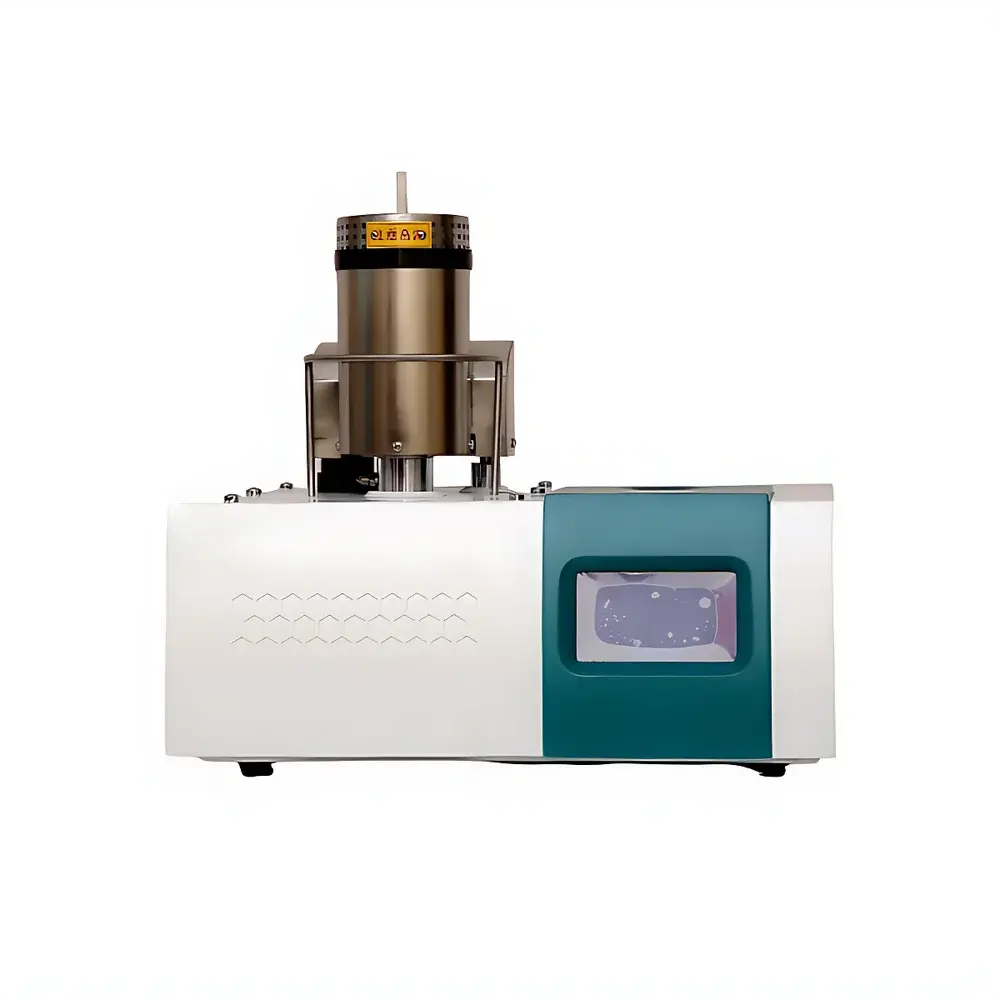
Henven HCR-1 Differential Thermal Analyzer
| Brand | Henven |
|---|---|
| Origin | Beijing, China |
| Manufacturer Type | Direct Manufacturer |
| Region of Origin | Domestic (China) |
| Model | HCR-1 |
| Sample Capacity | Single-sample |
| Instrument Type | DTA (Differential Thermal Analysis) |
| Temperature Range | Ambient to 1150 °C |
| Programmable Temperature Control | Heating and Isothermal Hold |
| Temperature Accuracy | ±0.1 °C |
| Temperature Precision | ±0.1 °C |
| Temperature Stability (Drift) | ≤0.1 °C |
| Heating/Cooling Rate | 0.1–100 K/min (user-definable) |
| Scan Modes | Dynamic heating, isothermal hold |
| DSC Measurement Range | ±1–±500 mW |
| DSC Sensitivity | ±0.1 μW |
| DTA Resolution | 0.01 μV |
| DTA Noise Level | <0.01 μV |
| Signal Range | ±10–±2000 μV (auto-ranging) |
| Vacuum Capability (optional) | 2.5×10⁻² Pa |
| Atmosphere Control | Dual-channel mass flow controller (MFC), programmable gas switching, corrosion-resistant options available |
| Standard Crucibles | Al₂O₃ (0.06 mL or 0.12 mL) |
| Optional Crucibles | Aluminum, graphite, quartz, platinum |
| Isothermal Duration | Up to 72 h at any temperature within range |
| Calibration Standards Supported | Indium, tin, lead |
Overview
The Henven HCR-1 Differential Thermal Analyzer (DTA) is a precision benchtop thermal analysis instrument engineered for quantitative measurement of temperature differentials between a sample and an inert reference material under controlled thermal programs. Operating on the fundamental principle of differential thermal analysis—where thermocouple-based detection captures ΔT (sample–reference) as a function of temperature or time—the HCR-1 delivers high-fidelity data for characterizing endothermic and exothermic transitions in solid and powdered materials. It is optimized for laboratories requiring reliable, repeatable thermal event detection across a broad operational envelope: ambient to 1150 °C, with programmable heating rates from 0.1 to 100 K/min and extended isothermal capability up to 72 hours. The system integrates dual thermocouples—one continuously monitoring furnace temperature (active or idle), the other dedicated to real-time sample temperature acquisition—ensuring traceable thermal profiling independent of thermal lag effects. Its architecture supports both standalone DTA operation and optional DSC-mode interpretation via calibrated signal conversion, enabling direct quantification of enthalpy changes (e.g., fusion enthalpy, crystallization heat) when paired with certified reference materials such as indium, tin, or lead.
Key Features
- Dual high-stability thermocouple system: Independent furnace and sample temperature monitoring with ±0.1 °C accuracy and ≤0.1 °C thermal drift over extended runs
- Programmable thermal control: Fully customizable linear heating, multi-step isothermal holds, and dynamic cooling profiles; ramp rates adjustable in 0.1 K/min increments
- Integrated atmosphere management: Dual-channel mass flow controllers (MFCs) enable precise, automated switching between two gases during a single experiment; optional corrosion-resistant MFC modules available for H₂S, Cl₂, HF, or other aggressive process gases
- Auto-ranging microvolt signal acquisition: ±10–±2000 μV input range with 0.01 μV resolution and sub-0.01 μV RMS noise floor—optimized for low-magnitude transition detection
- Modular crucible compatibility: Standard alumina crucibles (0.06 mL / 0.12 mL); field-swappable options include aluminum (for low-T DSC), graphite (high-T inert), quartz (transparency-critical), and platinum (oxidizing/corrosive environments)
- Onboard isothermal stability: Maintains target temperature within ±0.1 °C for up to 72 consecutive hours—critical for oxidation induction time (OIT) and long-term decomposition kinetics studies
- Open software architecture: Supports user-defined calculation modules—including crystallization kinetics modeling (Avrami, Ozawa), step-cooling curve generation, and comparative specific heat estimation via ASTM E1269
Sample Compatibility & Compliance
The HCR-1 accommodates solid powders, granules, thin films, and small-volume bulk solids (≤100 mg typical). Its modular furnace design and configurable gas environment meet requirements for ASTM E473 (terminology), ASTM E1131 (DTA/DSC performance verification), ISO 11357-1 (general DSC principles), and USP (thermal analysis in pharmaceutical excipient qualification). When equipped with vacuum pumping (2.5×10⁻² Pa base pressure) and inert purge, it satisfies GLP-compliant method validation for thermal stability assessment per ICH Q1A(R2). The dual-MFC atmosphere system complies with ISO 8573-1 (compressed air purity) and supports audit-ready gas flow logging for FDA 21 CFR Part 11–aligned workflows when used with validated software extensions.
Software & Data Management
The embedded control interface features a high-resolution LCD panel displaying real-time furnace status, sample ΔT, gas flow rates, and alarm conditions. Data acquisition occurs at ≥10 Hz with automatic gain adjustment and timestamped screenshot capture at user-defined intervals. Export formats include CSV, TXT, and universal .TGA/.DSC binary (compatible with TA Universal Analysis, Netzsch Proteus, and OriginLab). The included analysis suite implements ASTM E1356 (peak assignment), ASTM E1269 (specific heat), and ISO 11357-6 (crystallization kinetics) algorithms. All raw data files embed metadata (operator ID, calibration date, gas composition, crucible ID), supporting full traceability. Optional 21 CFR Part 11 compliance packages provide electronic signatures, audit trails, and role-based access control for regulated environments.
Applications
- Determination of melting point, solidus/liquidus temperatures, and latent heat of fusion (via calibration against In, Sn, Pb standards)
- Oxidation induction time (OIT) testing per ASTM D3895 for polymer stabilization evaluation
- Crystallization kinetics modeling (nucleation rate, growth exponent) in pharmaceuticals and metallurgical alloys
- Thermal stability screening of catalysts, battery cathode materials, and energetic compounds
- Glass transition (Tg) identification in amorphous polymers and metallic glasses using step-cooling protocols
- Decomposition onset and multi-stage degradation profiling in composites and flame-retardant formulations
- Reaction enthalpy quantification in solid-state synthesis (e.g., mechanochemical reactions, calcination)
FAQ
What is the difference between DTA and DSC operation on the HCR-1?
The HCR-1 is fundamentally a DTA instrument, measuring ΔT directly. However, with proper calibration using certified standards and application of the equal-area approximation, its output can be converted into quantitative DSC-like data (mW) for enthalpy calculation.
Can the HCR-1 be coupled to GC or MS systems?
Yes—optional heated transfer lines (ambient to 200 °C), GC/MS interface flanges, and thermostatically controlled connection ports are available to enable evolved gas analysis (EGA) without condensation or adsorption artifacts.
Is vacuum capability standard or optional?
Vacuum operation requires integration of an external vacuum pump unit (2.5×10⁻² Pa ultimate pressure); this is offered as a factory-configurable option, not standard equipment.
How is temperature calibration performed?
Users perform routine calibration using high-purity reference metals (In, Sn, Pb) per ASTM E967 and ISO 11357-2; the software guides multi-point offset correction for both furnace and sample thermocouples.
Does the system support regulatory compliance for pharmaceutical QC?
When deployed with validated software, electronic logbooks, and 21 CFR Part 11 add-ons, the HCR-1 meets data integrity requirements for thermal characterization in GMP-regulated pharmaceutical development and release testing.
Related Products



