
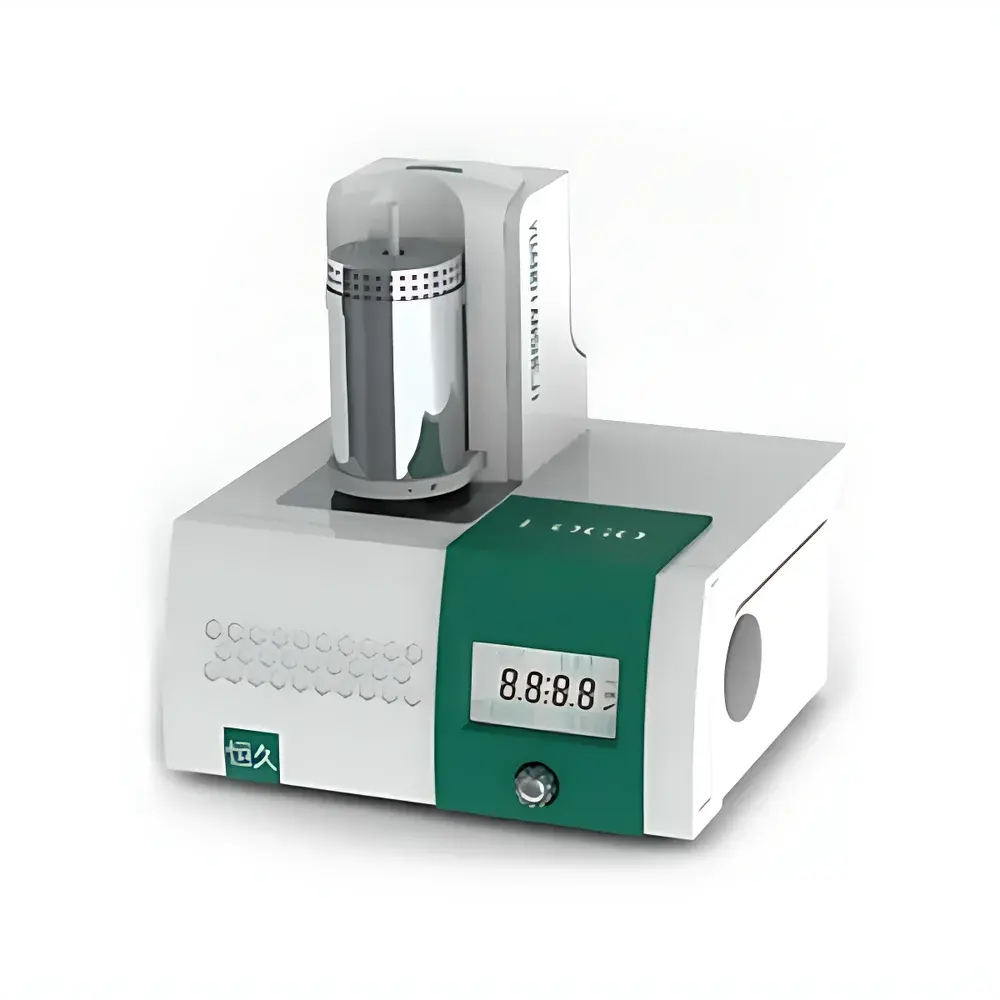
Henven HQC-1 Automated Differential Thermal Analyzer
| Brand | Henven |
|---|---|
| Origin | Beijing, China |
| Manufacturer Type | Manufacturer |
| Product Origin | Domestic |
| Model | HQC-1 |
| Sample Capacity | Single-sample |
| Instrument Type | DTA (Differential Thermal Analysis) |
| Temperature Range | Ambient to 1150 °C |
| Programmable Temperature Control | Heating & Isothermal Hold |
| Temperature Accuracy | ±0.1 °C |
| Temperature Stability | ±0.1 °C |
| Heating/Cooling Rate | 0.1–80 K/min |
| DTA Signal Range | ±1 μV to ±2000 μV (auto-ranging) |
| DTA Resolution | 0.01 μV |
| DTA Noise Level | <0.01 μV |
| DSC Measurement Range | 0 to ±500 mW |
| DSC Sensitivity | ±0.1 μW |
| Atmosphere Control | Dual-channel mass flow controller (MFC), programmable gas switching |
| Optional Vacuum Capability | 2.5×10⁻² Pa (with vacuum pump package) |
| Isothermal Duration | Up to 72 h at any temperature within range |
| Standard Crucibles | Al₂O₃ (0.06 mL or 0.12 mL) |
| Optional Crucibles | Aluminum, graphite, quartz, platinum |
Overview
The Henven HQC-1 Automated Differential Thermal Analyzer is a precision-engineered benchtop instrument designed for quantitative thermal analysis based on the differential thermal analysis (DTA) principle. It measures the temperature difference (ΔT) between a sample and an inert reference material as both are subjected to identical, computer-controlled thermal programs. Unlike DSC instruments that quantify heat flow directly, the HQC-1 delivers high-fidelity ΔT signals with microvolt-level resolution—enabling accurate detection of endothermic and exothermic transitions including melting, crystallization, solid-solid phase transformations, glass transitions, decomposition onset, and oxidation induction time (OIT). Its robust furnace architecture supports operation from ambient to 1150 °C, with programmable heating, cooling, and extended isothermal holds (up to 72 hours), making it suitable for kinetic studies, stability assessments, and materials qualification in R&D and quality control laboratories.
Key Features
- Fully automated furnace lift mechanism ensures precise, repeatable sample positioning—minimizing mechanical drift and enhancing measurement reproducibility across sequential runs.
- Dual thermocouple system: one continuously monitors furnace block temperature (active or idle), while the second measures actual sample temperature during operation—enabling real-time thermal gradient assessment and improved calibration traceability.
- Integrated atmosphere management using dual-channel mass flow controllers (MFCs) for stable, switchable gas delivery (e.g., N₂, Ar, O₂, synthetic air); optional corrosion-resistant MFC modules available for aggressive gases (e.g., HCl, SO₂, NH₃).
- Auto-ranging analog signal acquisition (±1 μV to ±2000 μV) with 0.01 μV resolution and sub-0.01 μV noise floor—optimized for detecting subtle thermal events without manual gain adjustment.
- Onboard 7-inch LCD interface displays real-time furnace status, sample temperature, gas flow rates, pressure (if vacuum option installed), and alarm conditions—reducing dependency on external PCs during routine operation.
- Modular hardware design supports optional accessories: vacuum pump unit (2.5×10⁻² Pa base pressure), GC/MS transfer line with active temperature control (RT–200 °C), and customizable crucible holders for high-temperature or reactive environments.
Sample Compatibility & Compliance
The HQC-1 accommodates standard ceramic crucibles (Al₂O₃, 0.06 mL or 0.12 mL), with optional crucibles including aluminum (for low-T screening), graphite (inert, high-T), quartz (transparency for optical coupling), and platinum (corrosion resistance, high-purity applications). The instrument meets essential design requirements for GLP-compliant thermal analysis workflows: full audit trail logging (user actions, method parameters, calibration records), electronic signature support, and data integrity safeguards aligned with FDA 21 CFR Part 11 principles when used with validated software configurations. While not certified to ISO 11357 or ASTM E794/E1269 out-of-the-box, its performance specifications—including ±0.1 °C temperature accuracy, ±0.1 μW DSC sensitivity, and programmable ramp rates—enable users to validate against these standards using certified reference materials (e.g., indium, tin, lead).
Software & Data Management
The proprietary Henven Thermal Analysis Suite provides comprehensive data acquisition, visualization, and post-processing capabilities. It supports real-time plotting, automatic peak detection, baseline correction, and multi-method comparative analysis. Advanced modules include oxidation induction time (OIT) calculation per ISO 11357-6, crystallization kinetics modeling (Avrami, Ozawa), step-cooling curve generation, and custom enthalpy integration with user-defined baselines. Software allows dynamic screenshot capture at any acquisition timestamp, auto-scaling of Y-axis based on signal amplitude, and export of raw data in ASCII or CSV formats for third-party statistical or modeling tools. Calibration routines support multi-point temperature and energy verification using NIST-traceable standards; users may submit custom calculation algorithms (e.g., activation energy via Kissinger or Friedman methods) for embedded implementation by Henven’s application engineering team.
Applications
- Thermal stability evaluation of polymers, pharmaceuticals, and battery electrode materials via oxidation induction time (OIT) under controlled oxygen partial pressures.
- Phase transition characterization—including eutectic melting, polymorphic conversion, and solid-state amorphous-to-crystalline transformation—in ceramics, metal alloys, and organic compounds.
- Decomposition kinetics analysis of catalysts, explosives, and energetic materials using variable-heating-rate DTA protocols.
- Quality control of incoming raw materials (e.g., polymer resin lot consistency, filler dispersion homogeneity) through comparative thermal fingerprinting.
- Support for hyphenated techniques: direct coupling to GC or MS via heated transfer lines enables evolved gas analysis (EGA) for reaction mechanism elucidation.
FAQ
What is the difference between DTA and DSC modes on the HQC-1?
The HQC-1 operates fundamentally as a DTA instrument—measuring ΔT between sample and reference. However, its calibrated signal path and known thermal resistance allow derived heat flow quantification (DSC-like output) with ±0.1 μW sensitivity when configured with appropriate reference standards and software modules.
Can the HQC-1 perform simultaneous TGA-DTA measurements?
No—the HQC-1 is a dedicated DTA platform without integrated mass measurement. For combined thermal-gravimetric analysis, Henven offers complementary TGA systems compatible with shared atmosphere and software ecosystems.
Is remote monitoring supported?
Yes—via Ethernet-enabled firmware and optional VNC-compatible remote desktop access; all critical operational parameters and real-time curves are viewable and controllable from networked workstations.
How is temperature calibration performed?
Using certified pure metals (In, Sn, Pb, Zn) per ASTM E967 or ISO 11357-1; the software guides multi-point calibration with automatic offset correction and uncertainty reporting.
What maintenance intervals are recommended?
Furnace insulation inspection every 12 months; thermocouple verification before each calibration cycle; MFC recalibration annually or after exposure to condensable or particulate-laden gases.



