
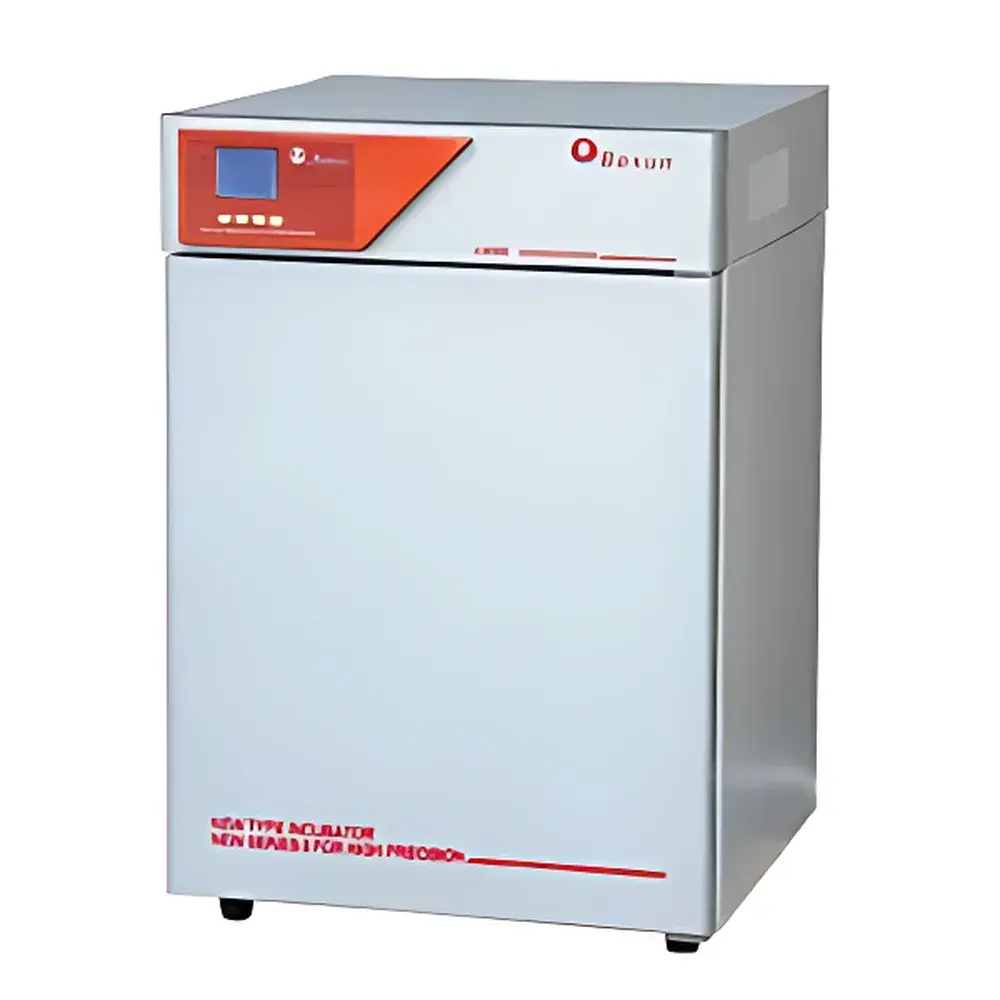
BOXUN BG-50 Water-Jacketed Constant Temperature Incubator
| Brand | BOXUN |
|---|---|
| Origin | Shanghai, China |
| Manufacturer Type | Direct Manufacturer |
| Product Origin | Domestic (China) |
| Model | BG-50 |
| Price Range | USD 140–700 (FOB) |
| Temperature Control Range | Ambient +2°C to 65°C |
| Temperature Resolution | 0.1°C |
| Temperature Fluctuation | ±0.2°C |
| Temperature Uniformity | ±0.5°C |
| Heating Method | Water Jacket |
| Power Input | 430 W |
| Interior Dimensions (W×D×H) | 310 × 380 × 450 mm |
| Exterior Dimensions (W×D×H) | 460 × 510 × 765 mm |
| Shelving | 2 adjustable stainless steel shelves |
| Display | LCD with microprocessor-based controller |
| Communication Interface | RS-485 |
| Programmable Profile | 10 segments × 100 cycles |
| Backup Function | Power-loss parameter retention and auto-recovery |
| Optional Accessories | Thermal printer (curve output), GPRS remote alarm module, PC-based monitoring software |
Overview
The BOXUN BG-50 Water-Jacketed Constant Temperature Incubator is a precision-engineered laboratory incubation system designed for stable, uniform thermal environments in life science research and quality control applications. Unlike forced-air incubators, the BG-50 employs a water-jacketed heating architecture—where temperature-regulated water circulates around the inner chamber walls—to deliver exceptional thermal inertia, minimal short-term fluctuation, and high spatial uniformity across the working volume. This principle ensures consistent conditions essential for sensitive biological processes such as mammalian cell culture, microbial growth kinetics, seed germination assays, BOD (Biochemical Oxygen Demand) testing per ASTM D5210 and ISO 5815, and long-duration developmental studies. Its robust construction—featuring cold-rolled steel exterior with electrostatic epoxy coating and a mirror-finish 304 stainless steel interior—meets standard cleanroom-compatible material requirements and supports routine decontamination protocols.
Key Features
- Water-jacketed thermal design delivering ±0.2°C temperature fluctuation and ±0.5°C uniformity across the full 310 × 380 × 450 mm chamber
- Microprocessor-based PID temperature controller with backlit LCD interface, supporting real-time display of setpoint, actual temperature, elapsed time, and remaining time
- Programmable multi-step operation: up to 10 temperature/time segments per cycle, repeatable over 100 cycles for complex incubation protocols (e.g., diurnal simulation or staged differentiation)
- Dual-layer sealing system: high-elasticity silicone gasket between tempered glass inner door and chamber frame ensures >95% humidity retention without auxiliary humidification
- Intelligent air circulation: low-noise axial fan with adaptive speed modulation maintains laminar airflow while minimizing vibration transfer to cultures
- RS-485 serial interface compliant with Modbus RTU protocol enables integration into centralized lab management systems or third-party data loggers
- Non-volatile memory retains all user settings—including profile sequences, alarms, and calibration offsets—during power interruption; automatic resumption upon restoration
Sample Compatibility & Compliance
The BG-50 accommodates standard tissue culture flasks (T25–T225), Petri dishes (up to 150 mm), multi-well plates, glass culture tubes, and BOD bottles. Its stainless steel interior and smooth, crevice-free corners support cleaning validation under GLP and ISO/IEC 17025 frameworks. While not certified to IEC 61010-1 Class II or UL 61010B out-of-the-box, the unit conforms to electromagnetic compatibility (EMC) requirements per EN 61326-1 and safety specifications aligned with GB 4793.1–2007 (Chinese national equivalent to IEC 61010-1). For regulated environments, optional GPRS alarm modules provide auditable SMS alerts on temperature deviation (>±1.0°C threshold), power failure, or door-open events—supporting 21 CFR Part 11-compliant audit trails when paired with validated PC software.
Software & Data Management
The BG-50 operates autonomously via its embedded controller but supports external supervision through optional connectivity packages. The RS-485 port allows bidirectional communication with Windows-based BOXUN LabLink software (v3.2+), enabling remote parameter adjustment, real-time graphing of chamber temperature history, and export of CSV-formatted datasets timestamped to millisecond resolution. When equipped with the thermal printer option, users may generate hard-copy temperature curves synchronized to programmable event markers (e.g., “Cycle Start”, “Segment 3 Transition”). All logged data include operator ID fields, instrument serial number, and firmware version metadata—facilitating traceability during internal audits or regulatory inspections.
Applications
- Mammalian and insect cell line maintenance under tightly controlled thermal conditions
- Biochemical oxygen demand (BOD) analysis per EPA Method 405.1 and ISO 5815-1:2019
- Plant tissue culture and seed germination studies requiring diurnal temperature cycling
- Microbiological assay incubation for pharmaceutical QC (USP , ) and food safety testing (ISO 4833-1:2013)
- Environmental toxicity screening using aquatic invertebrates (e.g., Daphnia magna) per OECD 202
- Long-term stability testing of biologics and diagnostic reagents at elevated temperatures
FAQ
Does the BG-50 require external water refilling during operation?
No—the water jacket is a sealed, passive thermal mass system filled once at installation. It does not consume water during normal operation and requires no periodic replenishment.
Can the incubator maintain humidity without an integrated humidifier?
Yes—its dual-seal door design and low air-exchange rate (<0.5 air changes per hour) retain ambient moisture effectively for most non-desiccating applications. For extended low-humidity protocols, external desiccant trays may be placed inside.
Is the RS-485 interface compatible with LabVIEW or Python-based control systems?
Yes—Modbus RTU implementation allows native integration with NI LabVIEW (using VISA or Modbus I/O libraries) and Python (via pymodbus or minimalmodbus), provided proper termination resistors and baud-rate configuration (default: 9600 bps, 8N1) are applied.
What is the maximum load capacity per shelf?
Each of the two adjustable 304 stainless steel shelves supports up to 15 kg uniformly distributed load, verified per static load testing per GB/T 2423.2-2008.
How is temperature calibration performed and documented?
A two-point calibration procedure (at 37°C and 55°C) is supported via service mode. Calibration constants are stored in EEPROM with date/time stamp and technician ID field—exportable via RS-485 for inclusion in equipment qualification records.





