
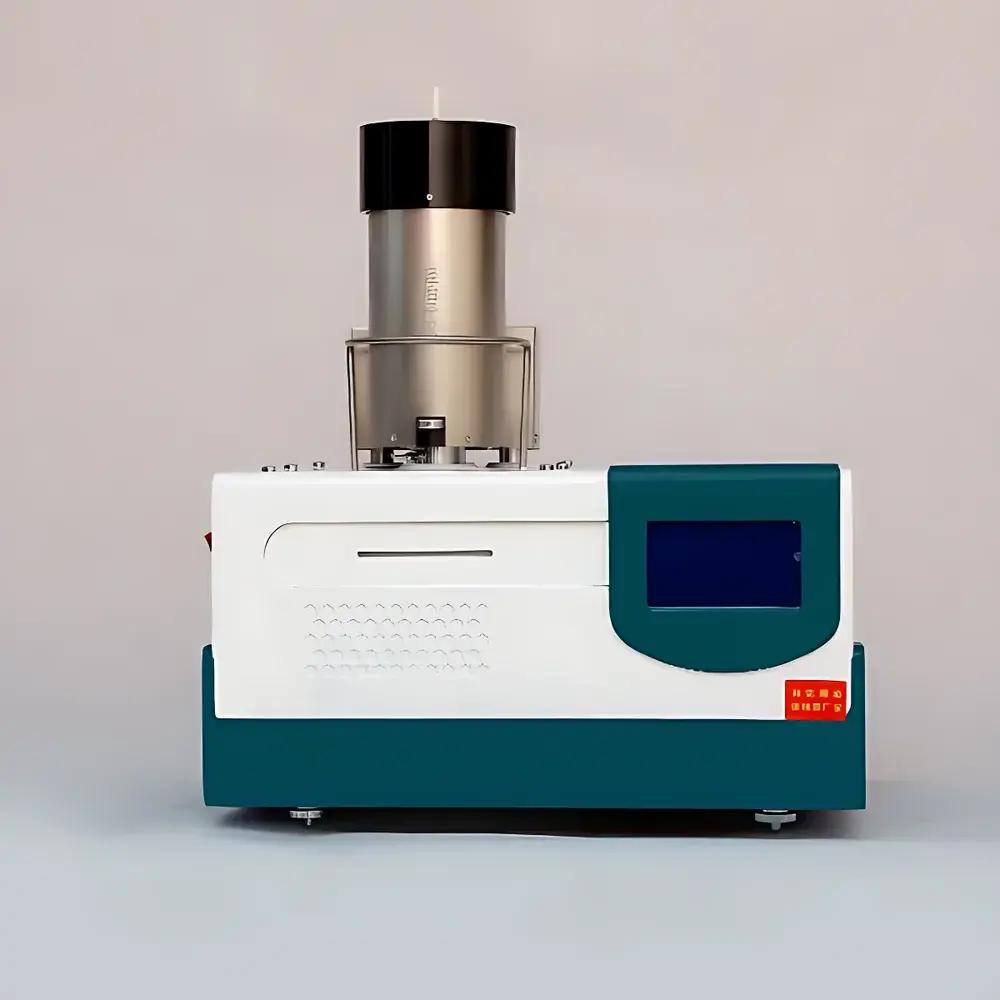
Henven HTG-2 Thermogravimetric Analyzer
| Brand | Henven |
|---|---|
| Origin | Beijing, China |
| Manufacturer Type | Direct Manufacturer |
| Regional Classification | Domestic (China) |
| Model | HTG-2 |
| Operating Environment | Ambient Pressure |
| Sample Capacity | Single Sample |
| Instrument Type | General-Purpose TGA |
| Temperature Range | Room Temperature to 1250 °C |
| Temperature Accuracy | ±0.1 °C |
| Temperature Precision | ±0.1 K |
| Dynamic Weighing Range | 0.01 mg – 5 g |
| Balance Sensitivity | 0.1 µg |
| Mass Accuracy | 0.1 µg |
| Heating/Cooling Rate | 0.1 – 100 K/min |
| Maximum Sample Mass | 5 g |
| Baseline Repeatability | 0.01 mg |
| Baseline Drift | 0.01 mg |
| Vacuum Option | Up to 2.5 × 10⁻² Pa (with optional vacuum unit) |
| Standard Crucibles | Al₂O₃ (Φ5×4 mm, Φ5×8 mm, Φ8×10 mm, Φ18×8 mm, Φ18×15 mm, Φ18×20 mm) |
| Optional Crucibles | Aluminum, Graphite, Quartz, Platinum |
| Dual Thermocouples | Furnace Temp + Sample Temp Monitoring |
| Isothermal Hold Capability | Up to 72 h at any temperature within range |
| Data Output Modes | TG, DTG, DDTG, % Mass Loss, Kinetic Parameter Derivation, Multi-Curve Overlay & Differential Analysis |
| Software Calibration Support | Temperature & Mass calibration using certified reference materials |
| Optional Accessories | Isothermal Controller, GC/MS Transfer Interface (heated, 200 °C max), Heated Transfer Line, Corrosion-Resistant MFC Atmosphere System |
Overview
The Henven HTG-2 Thermogravimetric Analyzer is a high-stability, general-purpose thermal analysis instrument engineered for precision measurement of mass change as a function of temperature or time under controlled atmospheric conditions. It operates on the fundamental principle of thermogravimetry (TGA), wherein a sample is subjected to a defined thermal program—linear heating, cooling, or isothermal hold—while its mass is continuously monitored via a high-resolution microbalance. The system integrates furnace control, inertial compensation, dual thermocouple monitoring (furnace and sample), and programmable gas delivery into a single robust architecture. Designed for rigorous laboratory environments, the HTG-2 supports applications ranging from polymer degradation kinetics and pharmaceutical excipient stability assessment to catalyst deactivation profiling and inorganic oxide phase transition analysis. Its operational envelope spans ambient temperature to 1250 °C, with programmable heating rates from 0.1 to 100 K/min and mass resolution down to 0.1 µg—enabling detection of subtle mass losses associated with adsorbed moisture, solvent residues, or low-yield decomposition steps.
Key Features
- High-fidelity dual-sensor temperature monitoring: Separate thermocouples independently track furnace setpoint and actual sample temperature, ensuring traceable thermal input during kinetic analysis.
- Modular atmosphere control system based on mass flow controllers (MFCs): Supports two independent gas lines with fast-switching capability; optional corrosion-resistant MFC variants available for H₂S, Cl₂, NH₃, or HF environments.
- Configurable crucible support: Interchangeable rods accommodate standard ceramic crucibles (Φ5×4 mm to Φ18×20 mm) and optional metal/ceramic variants—including Pt, graphite, and quartz—for aggressive or high-temperature applications.
- Extended isothermal stability: Capable of maintaining constant temperature for up to 72 hours with drift <0.01 mg, critical for long-duration oxidation or aging studies per ASTM E1131 and ISO 11358.
- Auto-ranging microbalance with active noise suppression: Real-time signal optimization ensures consistent resolution across the full 0.01 mg–5 g dynamic range without manual gain adjustment.
- Integrated hardware-software calibration framework: Users may perform routine verification using NIST-traceable standards (e.g., NiO for mass, Y₂O₃ for temperature) and generate audit-ready calibration reports compliant with GLP and FDA 21 CFR Part 11 requirements.
Sample Compatibility & Compliance
The HTG-2 accommodates diverse sample forms—including powders, granules, thin films, fibers, and bulk solids—within its configurable crucible system. Its wide mass range (0.01 mg to 5 g) enables both trace-level residue quantification and macro-scale thermal stability screening. The instrument meets essential design and performance criteria outlined in international thermal analysis standards, including ISO 11358-1 (general TGA principles), ASTM E1131 (mass-loss determination), and USP <467> (residual solvents). When equipped with vacuum and corrosion-resistant gas handling modules, it supports testing under non-ambient conditions required for reactive material characterization (e.g., metal hydride decomposition, battery cathode evolution). All firmware and data acquisition modules are architected to support electronic signature, audit trail, and data integrity protocols aligned with GMP and regulated QC workflows.
Software & Data Management
The proprietary HTG-2 software suite provides comprehensive data acquisition, visualization, and post-processing functionality. Raw TG, DTG, and DDTG curves are generated in real time, with user-selectable axes (temperature/time; absolute mass/% mass loss). Advanced analytical tools include multi-step kinetic modeling (Friedman, Ozawa-Flynn-Wall), comparative overlay of up to 16 datasets, derivative smoothing with adjustable Savitzky-Golay parameters, and customizable report generation (PDF/CSV/XLSX export). The software supports method templates, automated baseline correction, and user-defined formula entry for custom calculations (e.g., char yield, filler content, hydration stoichiometry). All raw and processed data files are timestamped, versioned, and stored with immutable metadata—ensuring full traceability for regulatory submissions and internal quality audits.
Applications
- Quantitative determination of moisture, volatiles, fillers, and ash content in polymers and composites (ASTM D6370, ISO 3451).
- Thermal stability evaluation of active pharmaceutical ingredients (APIs) and excipients under ICH Q1A(R2) guidelines.
- Decomposition pathway mapping for catalysts, battery materials, and metal-organic frameworks (MOFs).
- Oxidation onset temperature (OOT) and oxidative induction time (OIT) measurements per ASTM D3895 and ISO 11357-6.
- Reaction enthalpy estimation via coupling with differential scanning calorimetry (DSC) or evolved gas analysis (EGA) using optional heated transfer interfaces to GC/MS or FTIR.
- Quality control of inorganic pigments, ceramics, and refractory materials through phase transition and sintering behavior analysis.
FAQ
What is the maximum allowable sample mass for high-temperature operation above 1000 °C?
For optimal thermal uniformity and balance stability at temperatures >1000 °C, we recommend limiting sample mass to ≤1 g when using ceramic or platinum crucibles.
Can the HTG-2 be integrated with a quadrupole mass spectrometer for evolved gas analysis?
Yes—the optional heated transfer interface (up to 200 °C) and vacuum-compatible flange enable direct coupling to most benchtop QMS systems; full EGA method development support is available upon request.
Is firmware update capability included, and how is version control managed?
Firmware updates are delivered via secure USB media with SHA-256 checksum verification; each release includes a revision log and impact assessment for validated methods.
Does the system support automated calibration verification per ISO/IEC 17025 requirements?
Yes—calibration templates, reference material databases, and certificate-of-conformance generation are embedded in the software to support accredited laboratory compliance.
What maintenance intervals are recommended for the microbalance and furnace assembly?
We recommend quarterly balance sensitivity verification and annual furnace insulation inspection; full preventive maintenance kits and service contracts are available directly from Henven Technical Support.



