
XRSIM Industrial X-ray Simulation Software
| Origin | USA |
|---|---|
| Manufacturer Type | Authorized Distributor |
| Origin Category | Imported |
| Model | XRSIM (v1) |
| Pricing | Available Upon Request |
Overview
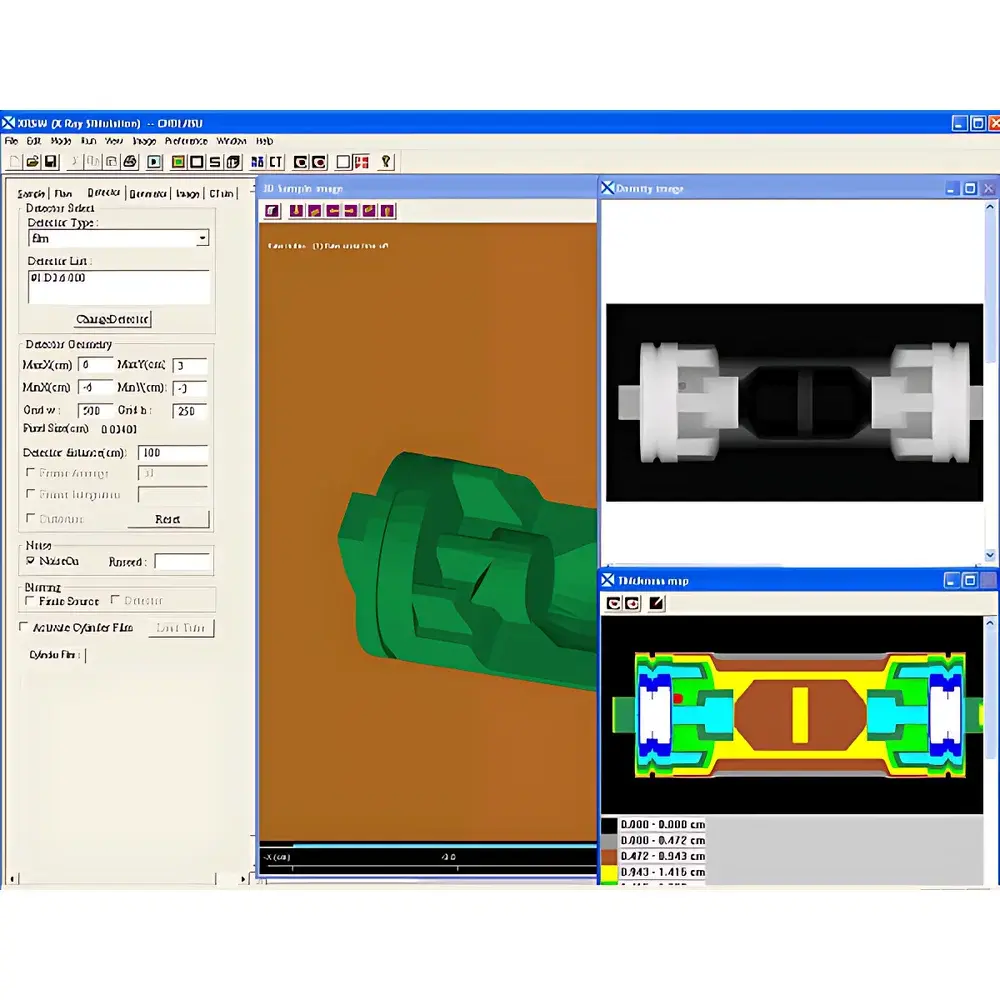
XRSIM is a physics-based industrial X-ray simulation software developed over 23 years by the Center for Nondestructive Evaluation (CNDE) at Iowa State University, USA. Engineered for high-fidelity digital radiography (DR) and computed tomography (CT) process modeling, XRSIM implements first-principles radiation transport physics—including Beer–Lambert attenuation, Compton scattering, photoelectric absorption, and pair production—to simulate X-ray interactions with complex 3D geometries. Unlike empirical or Monte Carlo–heavy alternatives, XRSIM employs deterministic ray-tracing algorithms optimized for speed without compromising physical accuracy, enabling rapid virtual inspection of multi-part assemblies on standard desktop workstations. It serves as a validated computational platform for pre-inspection planning, NDT method qualification, and regulatory-compliant process optimization in aerospace, nuclear, defense, and advanced manufacturing sectors.
Key Features
- Physics-driven simulation engine grounded in fundamental radiation interaction models
- Native support for STL-based 3D part geometry import; handles assemblies of up to 20 components
- Defect modeling capability: up to four discrete volumetric flaws per component (e.g., voids, inclusions, cracks)
- Configurable X-ray source parameters: focal spot size, anode material, tube voltage (kVp), filtration, and target-window geometry
- Detector modeling options: film response curves, amorphous silicon (a-Si) flat panels, image intensifiers, and dose deposition maps
- Real-time thickness mapping visualization derived directly from CAD geometry
- Low hardware dependency: runs efficiently on Windows-based systems with ≥8 GB RAM and integrated graphics
- Open API architecture supporting user-defined material libraries and custom post-processing workflows
Sample Compatibility & Compliance
XRSIM accepts industry-standard STL files for part representation and supports user-defined material composition databases aligned with NIST XCOM cross-section data. The software enables full traceability of simulated exposure conditions—source-to-detector geometry, kVp/mA settings, filtration, and detector response—required for ASTM E2737 (Standard Practice for Digital Radiographic Testing), ISO 17636-2 (Radiographic testing of welds), and ASME BPVC Section V, Article 2. While not a certified QA/QC tool per se, XRSIM-generated reports are routinely used in GxP environments to justify inspection parameter selection prior to physical validation, supporting GLP-aligned documentation practices and FDA 21 CFR Part 11–compliant audit trails when integrated with enterprise LIMS or document management systems.
Software & Data Management
XRSIM provides a modular graphical interface with dedicated modules for source configuration, part assembly, defect placement, projection generation, and quantitative image analysis. All simulation parameters—including beam hardening corrections, scatter estimation thresholds, and detector quantum efficiency settings—are stored in human-readable XML project files. Output includes DICOM-compliant projection images, thickness maps (in pseudo-color PNG/TIFF), and metadata-rich log files containing exposure time, air kerma estimates, and geometric magnification factors. Batch processing and scriptable automation via Python bindings allow integration into CI/CD pipelines for automated NDT process verification across product variants.
Applications
- Optimization of radiographic technique charts (kVp, mA, exposure time, FFD)
- Evaluation of detectability limits for subsurface discontinuities under varying geometric configurations
- Virtual qualification of new detector technologies prior to hardware procurement
- Training and competency assessment for Level II/III NDT personnel using realistic synthetic radiographs
- Supporting AS9100-compliant first-article inspection (FAI) planning in aerospace OEM supply chains
- Feasibility studies for micro-CT system design and resolution trade-off analysis
- Pre-validation of inspection coverage for complex castings, additively manufactured parts, and composite laminates
FAQ
Is XRSIM validated against experimental radiographic data?
Yes—XRSIM has undergone extensive benchmarking against physical radiographs acquired at Los Alamos National Laboratory, Sandia National Laboratories, and NASA Glenn Research Center using industrial X-ray systems and reference phantoms.
Does XRSIM support CT reconstruction?
No—XRSIM simulates individual projection views only. Reconstruction must be performed externally using third-party tools such as ImageJ/Fiji, Avizo, or commercial CT software.
Can users extend the built-in material database?
Yes—users may import custom mass attenuation coefficients and density values via CSV or XML to model proprietary alloys, composites, or additive manufacturing powders.
What are the licensing terms for academic institutions?
Academic licenses are available under annual subscription with classroom deployment rights and access to CNDE-maintained tutorial datasets and instructor guides.
Is technical support included with purchase?
All commercial licenses include direct email support from CNDE-affiliated application engineers and quarterly software updates covering new detector models and physics enhancements.
Related Products



