
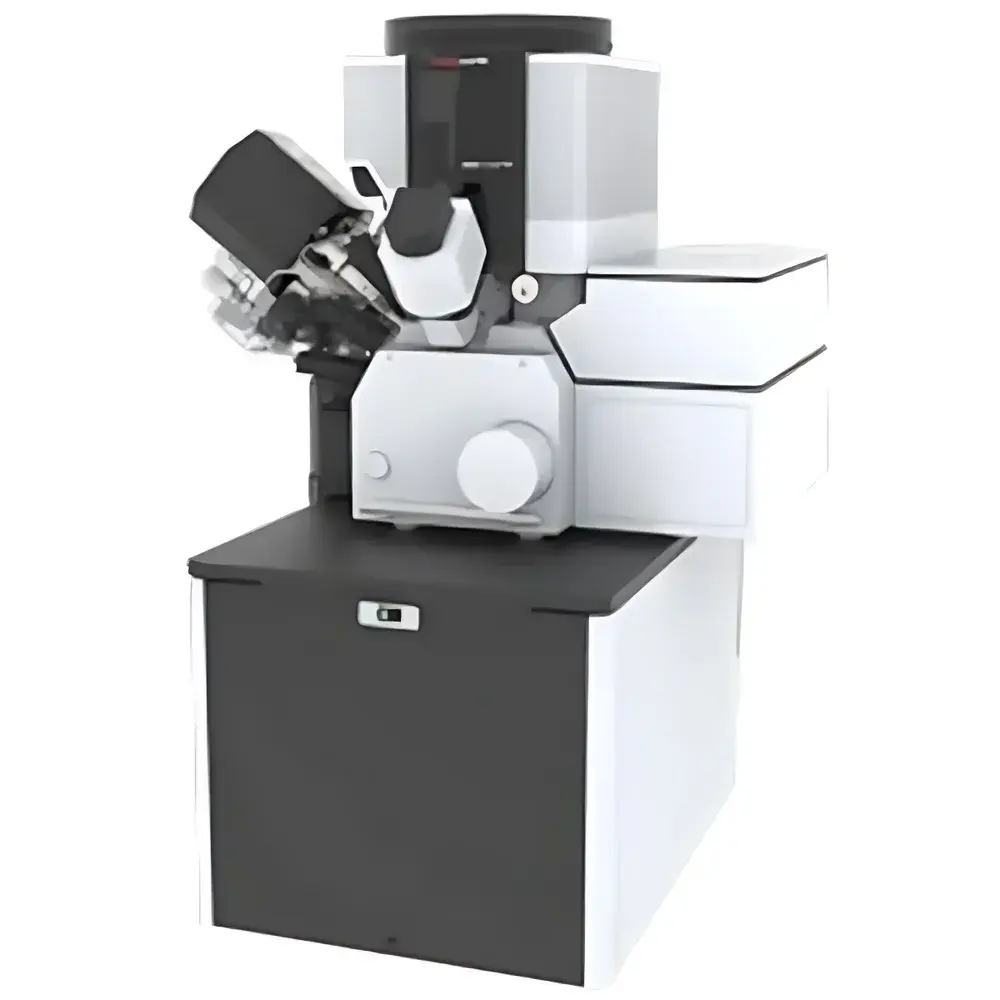
Thermo Scientific Helios 5 Laser PFIB Dual-Beam Scanning Electron Microscope
| Brand | Thermo Fisher Scientific |
|---|---|
| Origin | Czech Republic |
| Model | Helios 5 Laser PFIB |
| Integrated Beams | SEM + Plasma FIB (Xe⁺) + Femtosecond Laser (1030 nm / 515 nm) |
| Laser Pulse Width | <280 fs (1ω), <300 fs (2ω) |
| Laser Repetition Rate | 1 kHz – 1 MHz |
| Laser Spot Size | 15 µm |
| Maximum 3D Volume | 2000 × 2000 × 1000 µm³ |
| Plasma FIB Beam Current | ~1 mA (equivalent), Cutting Current: 74 µA |
| Beam Co-location Accuracy | <250 nm at WD = 4 mm |
| Laser Safety Class | Class 1 Enclosed System |
| Software | Integrated Laser Control, Automated 3D Serial Sectioning Workflow, EBSD-Coupled 3D Reconstruction Module, Scriptable Laser Programming Interface |
Overview
The Thermo Scientific Helios 5 Laser PFIB is a tri-beam dual-column platform engineered for high-throughput, large-volume, sub-surface and three-dimensional structural analysis at nanoscale resolution. Unlike conventional Ga⁺ focused ion beam (FIB) systems, this instrument integrates a plasma FIB (Xe⁺), a high-resolution field-emission scanning electron microscope (SEM), and a fully synchronized femtosecond laser—co-located at a single point on the sample with sub-250 nm positional repeatability. The laser operates at fundamental (1030 nm, IR) and second-harmonic (515 nm, green) wavelengths, delivering ultrashort pulses (<280 fs) with tunable repetition rates from 1 kHz to 1 MHz. This architecture enables non-destructive, gallium-free material ablation across millimeter-scale volumes while preserving crystallographic integrity—critical for correlative microscopy, TEM lamella extraction, and tomographic reconstruction of heterogeneous or beam-sensitive materials.
Key Features
- Fully integrated tri-beam architecture: SEM, plasma FIB (Xe⁺), and femtosecond laser share identical working distance (4 mm) and co-location point—eliminating registration drift between modalities.
- Gallium-free, high-rate volumetric removal: Achieves material ablation rates up to 15,000× faster than conventional Ga⁺ FIB, enabling rapid cross-sectioning of volumes up to 2000 × 2000 × 1000 µm³ without ion-induced damage or implantation.
- Sub-250 nm laser beam positioning accuracy ensures reproducible, metrology-grade sectioning—essential for statistical 3D microstructural quantification and serial sectioning workflows.
- Automated laser control software with scriptable interface supports custom ablation protocols, including depth-resolved trenching, selective layer removal, and multi-step TEM lamella lift-out sequences.
- Class 1 enclosed laser safety system complies with IEC 60825-1:2014, integrating interlocked shielding and real-time beam path monitoring for unattended operation in regulated laboratory environments.
- Electrically adjustable objective lens and horizontal/vertical polarization control optimize signal-to-noise ratio for both secondary electron (SE) and backscattered electron (BSE) imaging under variable landing energies.
Sample Compatibility & Compliance
The Helios 5 Laser PFIB accommodates a broad range of challenging specimens—including insulating ceramics, polymer composites, battery electrode architectures, air-sensitive battery cathodes (e.g., NMC, Li-metal), and cryo-preserved biological tissues—without requiring conductive coating or transfer between instruments. Its gallium-free ablation eliminates ion channeling artifacts and surface amorphization, supporting direct correlation between laser-sectioned surfaces and subsequent EBSD, EDX, or cathodoluminescence mapping. The platform conforms to ISO/IEC 17025 requirements for analytical instrument qualification and supports audit-ready documentation for GLP and GMP-regulated workflows. All laser operations are traceable via timestamped log files compliant with FDA 21 CFR Part 11 electronic record and signature standards.
Software & Data Management
The native software suite includes dedicated modules for laser parameter orchestration, automated serial sectioning, and EBSD-integrated 3D reconstruction. Users define slicing parameters—including slice thickness (10 nm–5 µm), step interval, dwell time, and Z-stack alignment tolerance—through a graphical workflow editor. Raw laser ablation logs, SEM image stacks, and EBSD orientation maps are stored in vendor-neutral HDF5 format with embedded metadata (acquisition date, beam conditions, stage coordinates). Integration with Thermo Scientific Velox™ and TEAM™ software enables batch processing of terabyte-scale 3D datasets, including grain boundary network analysis, phase fraction quantification, and porosity mapping. All user actions—including laser firing events and stage movements—are recorded in an immutable audit trail.
Applications
- Rapid 3D characterization of porous electrodes, solid-electrolyte interphases (SEI), and dendritic lithium structures in next-generation batteries.
- High-fidelity TEM lamella preparation from bulk semiconductor devices, MEMS structures, and metal–organic frameworks without Ga contamination.
- Correlative volume electron microscopy (VEM) combining laser serial sectioning with high-angle annular dark-field (HAADF) STEM and energy-dispersive X-ray spectroscopy (EDS).
- Statistical analysis of inclusion distributions, fatigue crack networks, and phase segregation in aerospace superalloys and additively manufactured components.
- In situ laser-assisted micromachining and prototyping of photonic crystals, plasmonic metasurfaces, and microfluidic channels with sub-micron edge fidelity.
FAQ
What is the primary advantage of the femtosecond laser over conventional plasma FIB alone?
The laser enables ultrafast, thermal-diffusion-limited ablation with negligible subsurface damage—complementing plasma FIB’s precision milling capability to achieve both speed and surface quality unattainable by either beam alone.
Can the system perform automated 3D EBSD reconstruction?
Yes—integrated EBSD acquisition synchronized with laser sectioning allows voxel-by-voxel crystallographic mapping across millimeter-scale volumes, with post-processing support for grain topology and texture evolution analysis.
Is the laser compatible with cryo-workflows?
The system supports cryo-transfer stages and low-temperature operation; however, laser ablation is performed at ambient temperature—requiring ex situ cryo-transfer of pre-ablated blocks for cryo-TEM analysis.
How is beam alignment maintained during long-duration serial sectioning?
Real-time beam position monitoring and closed-loop stage correction ensure 10-hour acquisitions, validated using fiducial-based drift compensation algorithms.
Does the software support third-party data import/export for AI-driven segmentation?
Yes—HDF5 exports include spatial metadata and pixel calibration, enabling seamless ingestion into Python-based toolchains (e.g., scikit-image, PyTorch, Dragonfly) for supervised and unsupervised 3D segmentation and feature extraction.




