
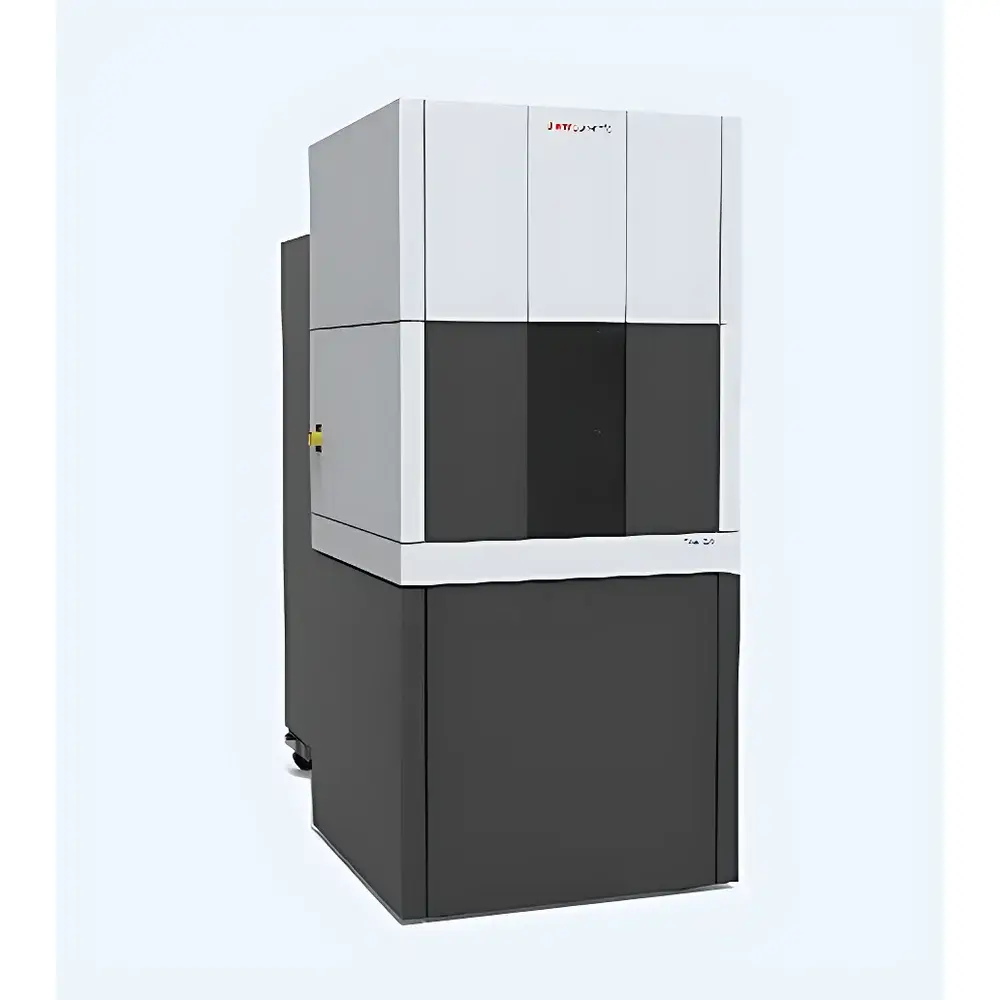
Thermo Fisher Talos F200i S/TEM Scanning/Transmission Electron Microscope
| Brand | Thermo Fisher |
|---|---|
| Origin | Czech Republic |
| Model | Talos F200i S/TEM |
| Accelerating Voltage | 20–200 kV |
| TEM Line Resolution | ≤0.10 nm |
| TEM Information Resolution | ≤0.12 nm |
| STEM Resolution | ≤0.16 nm |
| LACBED Convergence Angle | ≥100 mrad |
| Diffraction Angle | up to 24° |
| EDS Configuration | Side-mounted, retractable |
| Electron Source | High-brightness field emission gun (FEG) |
| Specimen Stage Z-Travel (standard holder) | ±0.375 mm |
| Tilt Range (3D tomography holder) | ±90° |
| Specimen Drift | ≤0.5 nm/min |
| Camera | 4k × 4k Ceta 16M CMOS |
Overview
The Thermo Fisher Talos F200i S/TEM is a high-performance 20–200 kV field-emission scanning/transmission electron microscope engineered for quantitative structural and compositional analysis across advanced materials science disciplines. Operating on the principles of both coherent transmission imaging (TEM) and incoherent high-angle annular dark-field (HAADF) scanning transmission electron microscopy (STEM), the system delivers atomic-scale spatial resolution with simultaneous nanoscale elemental mapping. Its X-TWIN objective lens pole-piece design provides a generous 100 mm working distance and large specimen tilt capability—enabling robust 3D electron tomography, in situ heating/cooling/strain experiments, and convergent-beam electron diffraction (CBED) without compromising optical stability or signal fidelity. The instrument’s mechanical and thermal stability—achieved through an ultra-rigid column architecture, active vibration damping, and constant-power objective lens operation—ensures sub-nanometer repeatability over extended acquisition sessions, meeting stringent requirements for GLP-compliant materials characterization workflows.
Key Features
- High-brightness Schottky field-emission electron source delivering stable probe current and long-term emission consistency across the full accelerating voltage range (20–200 kV).
- X-TWIN objective lens configuration with symmetrical pole-piece geometry, enabling dual-EDS detector integration (e.g., Dual-X 100 mm² silicon drift detectors) for high-collection-efficiency, low-dose, or high-throughput elemental quantification.
- 4k × 4k Ceta 16M CMOS camera optimized for rapid, low-noise imaging across all voltages—supporting real-time focus evaluation, automated alignment routines, and dynamic in situ data capture at frame rates exceeding 30 fps in full-frame mode.
- SmartCam-enabled remote operation with automated alignment sequences—including eucentric height adjustment, stigmator correction, beam tilt/rotation center calibration, and condenser aperture centering—ensuring reproducible setup conditions across multi-user environments.
- Modular sample stage architecture accommodating standard, high-tilt (±90°), and specialized in situ holders (electrical biasing, heating, liquid cell, gas environmental)—all maintaining mechanical stability and minimal drift (≤0.5 nm/min under vacuum).
- Integrated Velox software platform with embedded EDS absorption correction algorithms, spectral deconvolution tools, and 3D reconstruction pipelines compliant with ASTM E3128 and ISO 21363 standards for electron tomography reporting.
Sample Compatibility & Compliance
The Talos F200i accommodates a broad spectrum of solid-state specimens—including nanoparticles, thin-film heterostructures, battery electrode cross-sections, catalyst supports, and metallurgical alloys—within standardized 3 mm diameter TEM grids. Its large pole-piece gap facilitates insertion of complex in situ stages while preserving optimal probe convergence and diffraction pattern fidelity. The system conforms to IEC 61000-6-3 (EMC emissions) and IEC 61000-6-2 (immunity) standards. Data acquisition and processing workflows support audit-trail generation per FDA 21 CFR Part 11 when deployed in regulated QA/QC laboratories, and Velox metadata embedding complies with MIAME/MINSEQE guidelines for publication-ready dataset archiving.
Software & Data Management
Velox serves as the unified acquisition, processing, and reporting interface—featuring intuitive drag-and-drop experiment templates, scriptable automation via Python API, and native support for HDF5-based data storage. All image series, diffraction patterns, EDS hypermaps, and tomographic reconstructions are stored with embedded calibration metadata (pixel size, dwell time, acceleration voltage, detector solid angle). Time-resolved acquisitions include hardware-synchronized timestamping aligned to external stimuli (e.g., temperature ramp signals, electrical pulses). Raw datasets are exportable in open formats (TIFF, MRC, EMDB-compatible HDF5) and interoperable with third-party platforms including DigitalMicrograph, HyperSpy, and TomoJ.
Applications
- Atomic-resolution imaging of crystallographic defects (dislocations, stacking faults, grain boundaries) in semiconductor devices and aerospace alloys.
- Quantitative phase mapping via integrated EDS and electron energy-loss spectroscopy (EELS) correlation, supporting ISO 16173-compliant composition profiling of coated medical implants.
- In situ 4D-STEM strain mapping during mechanical loading, calibrated against NIST-traceable reference standards.
- 3D nanostructural reconstruction of porous battery cathodes using iterative weighted back-projection (WBP) and SART algorithms, validated per ASTM E3128 Annex A2.
- Low-dose cryo-STEM of beam-sensitive organic-inorganic hybrid perovskites, leveraging dose-fractionation protocols and motion correction.
- Automated particle analysis (APA) for nanoparticle size distribution, shape factor, and crystallinity assessment in pharmaceutical nanocarriers (USP <1088> compliant workflows).
FAQ
What is the maximum usable tilt angle for 3D tomography?
The high-tilt tomography holder supports ±90° mechanical tilt, enabling full 180° angular coverage with bidirectional acquisition to minimize missing wedge artifacts.
Is the system compatible with third-party EELS spectrometers?
Yes—the column features standardized flange interfaces and vacuum-compatible optical ports for integration with Gatan Imaging Filter (GIF) systems or Quantum ENA spectrometers.
How does the Dual-X EDS configuration improve quantification accuracy?
Dual 100 mm² SDD detectors provide >3× higher solid angle collection than single-detector configurations, reducing statistical counting uncertainty and enabling reliable quantification at beam currents below 50 pA.
Can Velox software generate GLP-compliant reports?
Yes—Velox supports electronic signatures, user-access logging, version-controlled protocol templates, and immutable audit trails required for GLP audits per OECD Principles of Good Laboratory Practice.
What vacuum specifications ensure long-term gun stability?
The FEG column maintains base pressure <5×10⁻⁹ mbar in the gun region and <1×10⁻⁷ mbar in the specimen chamber, achieved via differential pumping and non-evaporable getter (NEG) pump arrays.





