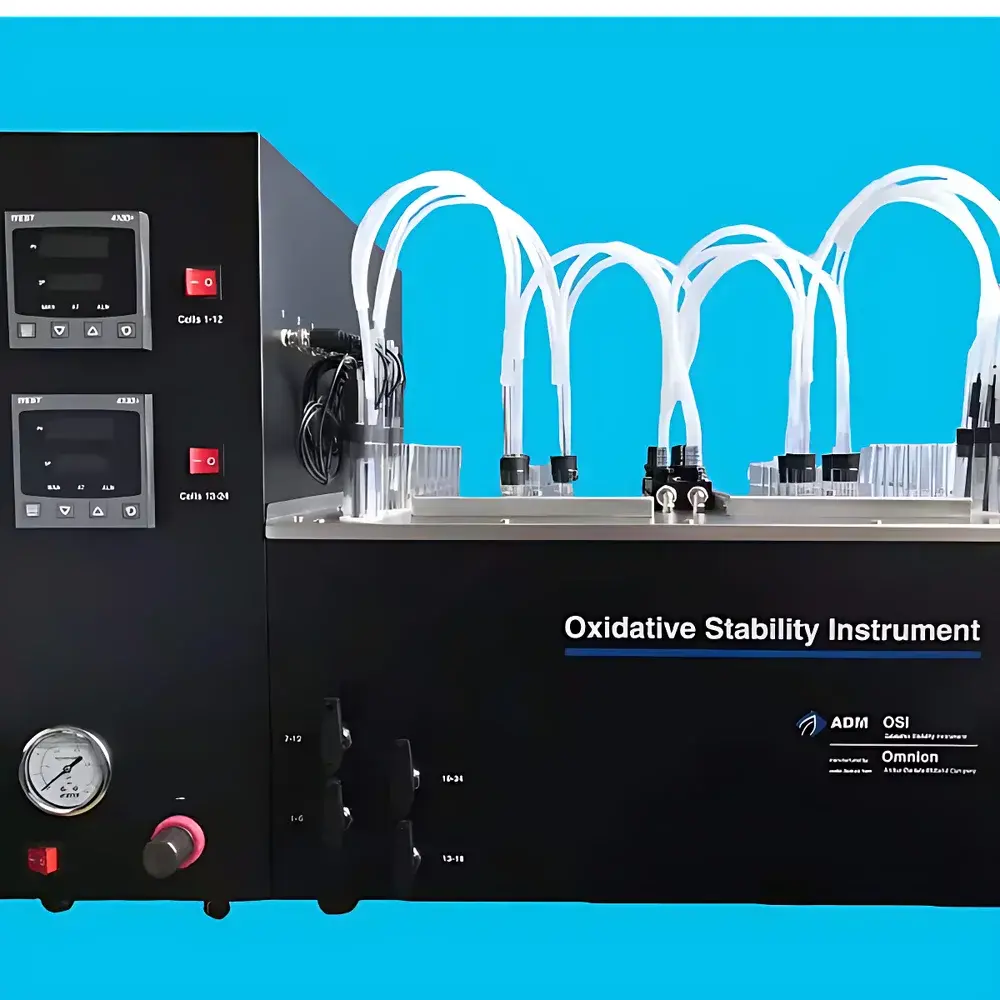
OMNION OSI-24 Oil Oxidation Stability Analyzer
| Brand | OMNION |
|---|---|
| Origin | USA |
| Model | OSI-24 |
| Temperature Range | 40–220 °C |
| Sample Capacity | 24 positions |
| Compliance | AOCS Cd 12b-92, ISO 6886:2006, EN 14112, JOCS, GB/T 21121 |
| Temperature Accuracy | ±0.1 °C |
Overview
The OMNION OSI-24 Oil Oxidation Stability Analyzer is an engineered platform for accelerated oxidative stability assessment of lipids and lipid-containing materials using the standardized Oxygen Stability Index (OSI) method. Based on the principle of accelerated oxidation under controlled airflow and precise thermal conditions, the instrument measures the induction period—the time elapsed until rapid peroxide formation initiates—by continuously monitoring electrical conductivity changes in the sample headspace. This method supersedes the outdated Active Oxygen Method (AOM), offering superior reproducibility, reduced operator dependency, and elimination of hazardous titration reagents. As the original developer of commercial OSI instrumentation, OMNION’s technology remains the global reference standard adopted by AOCS, ISO, EN, JOCS, and GB/T regulatory frameworks. The OSI-24 operates across a thermally stable range of 40–220 °C with ±0.1 °C setpoint accuracy and inter-channel thermal uniformity <0.1 °C—critical parameters directly governing kinetic validity and inter-laboratory comparability of OSI values.
Key Features
- 24-position parallel sample analysis with independent dual-zone temperature control—enabling simultaneous experiments at two distinct temperatures (e.g., 110 °C and 130 °C per AOCS Cd 12b-92)
- High-fidelity thermal architecture: aluminum heating blocks with optimized thermal mass, precision-machined sample well geometry, and low-conductivity insulation to minimize thermal lag and gradient deviation
- Real-time, multi-channel conductivity detection system—24 synchronized analog inputs with 16-bit resolution, sampling at 1 Hz, eliminating endpoint detection ambiguity inherent in manual titration
- Automated endpoint determination via first-derivative threshold algorithm, configurable per sample or group, compliant with AOCS-defined inflection criteria
- Thermal ramp performance: 30 minutes from ambient to 110 °C; 40 minutes to 130 °C—optimized for throughput without compromising thermal equilibrium integrity
- Minimal sample requirement: 2–5 g (solid) or 3–8 mL (liquid), compatible with undiluted native matrices including viscous fats, emulsions, and polymer blends
Sample Compatibility & Compliance
The OSI-24 accommodates a broad spectrum of lipid-based and oxidation-sensitive matrices, including but not limited to: edible oils (soybean, palm, sunflower, canola), animal fats (tallow, lard, butterfat), specialty lipids (cocoa butter, coconut oil), food products (chips, crackers, baked goods, pet food, dehydrated meats), biofuels (biodiesel, FAME), polymer additives (PVC stabilizers), cosmetic emollients, and feed ingredients. All measurements adhere strictly to internationally harmonized protocols: AOCS Cd 12b-92 (primary reference), ISO 6886:2006 (animal and vegetable fats and oils), EN 14112 (oxidation stability of biodiesel), JOCS (Japan Oil Chemists’ Society Standard), and GB/T 21121–2007 (China National Standard). Instrument validation documentation supports GLP and GMP audit readiness, with traceable calibration against NIST-traceable temperature standards and certified reference oils.
Software & Data Management
The proprietary OMNION OSI Control Suite provides full experimental lifecycle management: method setup, real-time visualization of all 24 channels, automated curve fitting, and customizable reporting. Raw conductivity vs. time datasets are stored in vendor-neutral CSV and HDF5 formats, ensuring long-term archival integrity and third-party analysis compatibility. Audit trail functionality complies with FDA 21 CFR Part 11 requirements—including electronic signatures, user access levels, and immutable event logging for all parameter modifications, run executions, and data exports. Batch processing tools enable comparative statistical analysis (ANOVA, regression, outlier detection) across multiple test series, supporting formulation optimization, antioxidant efficacy screening, and shelf-life modeling workflows.
Applications
- Shelf-life prediction: Quantifies induction periods under accelerated oxidative stress, enabling predictive modeling of product stability prior to sensory or chemical failure—critical for R&D, QC release testing, and supplier qualification
- Frying oil monitoring: Tracks degradation kinetics of cooking oils during repeated thermal cycling, supporting evidence-based oil replacement scheduling in commercial foodservice operations
- Antioxidant evaluation: Enables dose–response profiling of synthetic (BHA, BHT, TBHQ) and natural (tocopherols, rosemary extract) antioxidants, including synergistic interaction studies (e.g., metal chelator + radical scavenger combinations)
- Process troubleshooting: Identifies destabilizing contaminants (e.g., pro-oxidant metals at ppb levels), refining inefficiencies, or packaging-related oxygen ingress pathways
- Regulatory compliance testing: Generates data packages required for AOCS-certified product claims, ISO 22000 food safety systems, and EU REACH substance registration dossiers
- Academic & mechanistic research: Supports kinetic modeling of lipid oxidation pathways, activation energy calculations (via Arrhenius plots across ≥3 temperatures), and structure–activity relationship studies of lipid derivatives
FAQ
What standards does the OSI-24 validate against?
The instrument is fully compliant with AOCS Cd 12b-92 (primary), ISO 6886:2006, EN 14112, JOCS, and GB/T 21121–2007. Full validation reports and SOP templates are provided.
Can the OSI-24 run samples at different temperatures simultaneously?
Yes—dual independent heating zones allow concurrent operation at two user-defined temperatures within the 40–220 °C range, each with ±0.1 °C accuracy and <0.1 °C inter-well deviation.
Is manual titration required?
No. The system uses continuous, non-invasive conductivity monitoring to detect the onset of rapid peroxide accumulation—eliminating subjective endpoint judgment and hazardous reagent handling.
How is data integrity ensured for regulated environments?
The software includes 21 CFR Part 11-compliant audit trails, role-based access control, electronic signatures, and immutable raw data export—fully aligned with GLP, GMP, and ISO/IEC 17025 laboratory accreditation requirements.
What sample volume is needed per test?
Typical requirements are 2–5 g for solids or 3–8 mL for liquids; no dilution or pre-treatment is necessary for most native food-grade or industrial lipid matrices.
Related Products