
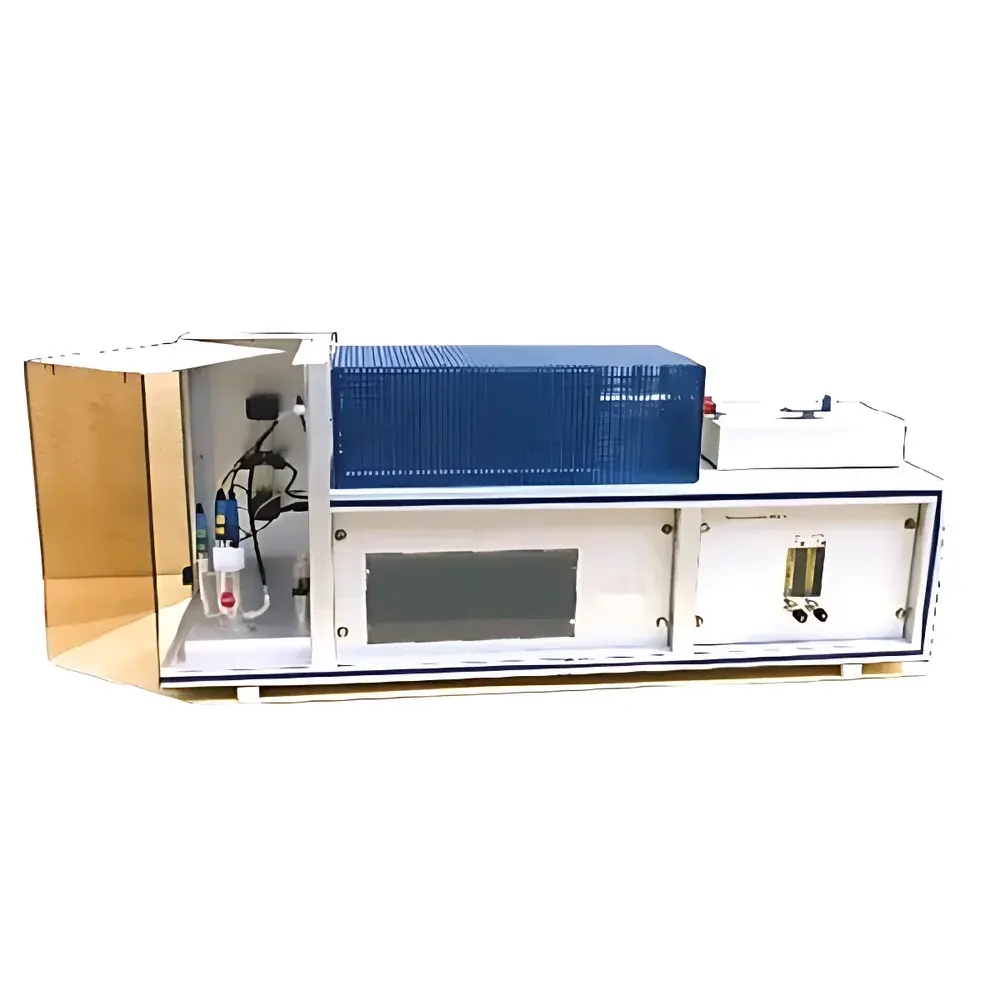
MIPO5 Coulometric Potentiometric Sulfur Analyzer (ASTM D4929-99 Compliant)
| Origin | France |
|---|---|
| Manufacturer Type | Authorized Distributor |
| Origin Category | Imported |
| Model | MIPO5 |
| Pricing | Upon Request |
Overview
The MIPO5 Coulometric Potentiometric Sulfur Analyzer is a fully automated, high-precision elemental analyzer engineered for trace-to-major-level quantification of sulfur and halogens—including chlorine, bromine, and iodine—in solid, liquid, and gaseous samples. Based on the fundamental principle of microcoulometric titration, the instrument oxidizes samples in a high-temperature combustion furnace (up to 1000 °C), converting all bound sulfur and halogen species into their respective hydrogen halides or sulfur dioxide. These gaseous products are then swept into a single-cell coulometric titration vessel, where electrochemical generation of silver ions (Ag⁺) enables real-time, stoichiometric determination of halide concentration; for sulfur, the generated SO₂ is absorbed and titrated via iodometric coulometry. This method eliminates reliance on standard calibration solutions or volumetric titrants—ensuring intrinsic accuracy, long-term stability, and minimal reagent consumption. Designed for regulatory compliance and laboratory routine use, the MIPO5 delivers reproducible results across diverse matrices without hardware recalibration, making it suitable for QC/QA labs operating under GLP, ISO/IEC 17025, and ASTM-defined protocols.
Key Features
- True microcoulometric detection with dual-mode capability: dedicated sulfur analysis (per ASTM D4929-99, D3120, D3246) and halogen analysis (AOX, POX, EOX per ISO 9562, NF EN 1485, GB/T 15959)
- Two independent programmable combustion furnaces: F1 (gas-atmosphere compatible, e.g., He or O₂) and F2 (fixed 1000 °C quartz-tube furnace), ensuring complete oxidative decomposition of refractory organohalogens and sulfur compounds
- Integrated sample introduction system: precision syringe pump for controlled liquid injection; optional adsorption modules for AOX pre-concentration using ultra-low-chlorine activated carbon (certified <0.1 µg Cl/g)
- Single-cell coulometric titration module with Ag/AgCl reference electrode and HgS indicator electrode; real-time charge integration ensures NIST-traceable mass-based quantification
- Automatic reagent management: on-board sulfuric acid adsorbent replacement triggered by system diagnostics; dry gas purification integrated upstream of the titration cell
- No manual calibration required—method validation performed via certified reference materials (CRMs); built-in quality assessment routines support audit-ready documentation
Sample Compatibility & Compliance
The MIPO5 accepts heterogeneous samples spanning petrochemicals (crude oil, naphtha, LPG, catalysts), environmental matrices (wastewater, sludge, soil extracts), industrial chemicals (methanol, toluene, polycarbonates, acetic acid), and energy materials (coal, coke, cement, lubricants). It complies with ASTM D4929-99 (sulfur in aromatic hydrocarbons), ISO 9562 (AOX in water), NF EN 1485 (AOX in aqueous effluents), US EPA Method 1650 (modified), and SH/T 0222 (Chinese standard for sulfur in petroleum products). All measurement procedures satisfy data integrity requirements under FDA 21 CFR Part 11 when paired with validated software configuration—supporting electronic signatures, audit trails, and secure user access control.
Software & Data Management
The MIPO5 operates via embedded firmware with configurable method templates and intuitive touchscreen interface. Raw coulometric charge (µC), calculated mass (ng–mg), and normalized concentration (ppm, % w/w) are logged with timestamp, operator ID, and instrument status metadata. Export formats include CSV and PDF reports compliant with ISO/IEC 17025 clause 7.8. Optional PC-based software enables advanced statistical review (RSD%, recovery %, control charts), batch reporting, and integration with LIMS via ASTM E1394-compliant data exchange. All analytical sequences retain full traceability for GLP/GMP audits—including automatic logging of electrode potential drift, furnace temperature profiles, and titration endpoint stability.
Applications
- Regulatory sulfur testing in fuels and feedstocks per ASTM D4929, D3120, and D3246
- Adsorbable Organic Halogens (AOX) monitoring in wastewater discharge per ISO 9562 and EU Directive 2013/39/EU
- Halogen screening in polymers, pharmaceutical excipients, and electronic-grade solvents
- Chlorine speciation in catalysts, coal, and cement raw materials (0.2–5000 ppm Cl)
- Trace sulfur quantification in high-purity aromatics and refinery intermediates (1–5000 ppm S)
- Research applications: charcoal adsorption kinetics, column breakthrough studies, and thermal degradation profiling of halogenated organics
FAQ
Does the MIPO5 require daily calibration with standard solutions?
No. The coulometric principle is inherently absolute—quantification is based on Faraday’s law and measured charge, eliminating dependence on external standards.
Can the same system analyze both sulfur and halogens without hardware modification?
Yes. The instrument switches between sulfur and halogen modes via software-selectable reaction chemistry and gas routing—no physical reconfiguration is needed.
What is the minimum detectable AOX level, and how is sensitivity enhanced?
The system achieves ≤1 µg Cl⁻ with ±10% accuracy per ISO 9562; sensitivity may be extended 5× or 10× using certified enrichment factors applied during data reduction.
Is the MIPO5 suitable for volatile liquid samples such as LPG or ethylene?
Yes—equipped with pressure-regulated vaporization modules and inert carrier gas handling, enabling direct analysis of gaseous and highly volatile matrices.
How does the system ensure complete combustion of complex, high-carbon samples like coal or焦油?
Dual-stage combustion (F1 + F2 furnaces), oxygen-enriched airflow, and quartz-lined reaction zones guarantee >99.9% conversion efficiency—even for thermally stable heterocyclic sulfur compounds and polyhalogenated aromatics.





