
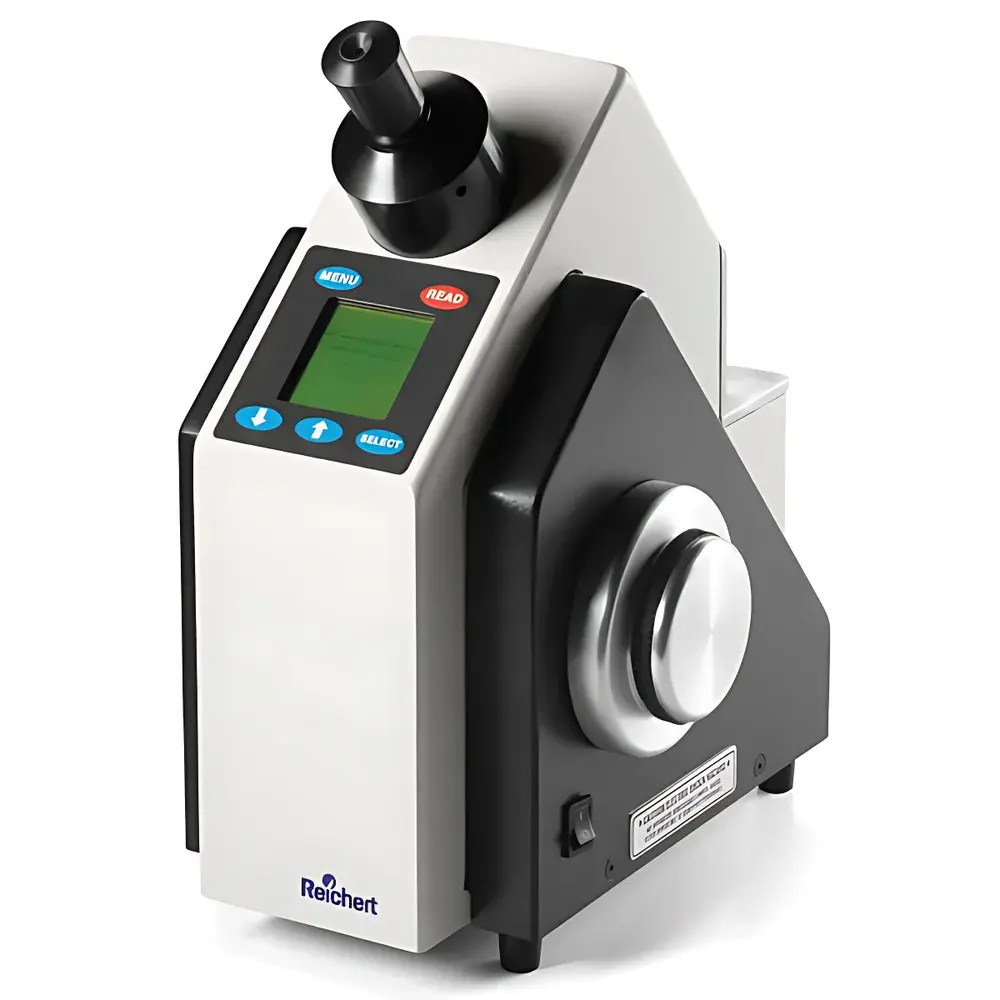
Reichert ARIAS 500 Transmission-Mode Abbe Refractometer
| Brand | Reichert |
|---|---|
| Origin | USA |
| Model | ARIAS 500 |
| Type | Benchtop Refractometer |
| Temperature Control | Yes |
| Digital Display | Yes |
| Refractive Index (RI) Range | 1.30000–1.70000 |
| RI Accuracy | ±0.00005 |
| Brix Range | 0.00–95.00% |
| Brix Accuracy | ±0.03% |
| Light Source | 589 nm LED |
| Temperature Control Range | 10–80 °C |
| Temperature Stability | ±0.01 °C |
| Detection Method | Dual-channel linear CCD array |
| Prism Material | Optical glass sealed with epoxy and 416 stainless steel sample well |
Overview
The Reichert ARIAS 500 is a high-precision, transmission-mode Abbe refractometer engineered for rigorous laboratory and industrial quality control environments. Unlike traditional prism-contact (total internal reflection) refractometers, the ARIAS 500 employs a collimated transmission optical path combined with dual-channel linear CCD array detection to quantify refractive index (RI) based on the angular deviation of light passing through the sample. This design eliminates parallax error and enables reliable measurement of transparent, translucent, deeply colored, and even semi-solid samples—without requiring direct prism contact or solvent rinsing between runs. The instrument operates at the sodium D-line wavelength (589 nm), ensuring traceability to internationally accepted optical reference standards. Its integrated Peltier temperature control system maintains sample thermal equilibrium within ±0.01 °C across a 10–80 °C range, enabling precise temperature-compensated RI and Brix reporting per ASTM D1218, ISO 21747, and ICUMSA Method GS7/8-1.
Key Features
- Dual-channel linear CCD array detector for real-time shadow-edge analysis and automatic critical angle determination—eliminating subjective visual interpolation and operator-dependent variability.
- Simultaneous display of up to five independent RI values across user-defined spatial zones, plus two Brix concentration zones, supporting heterogeneous sample assessment and gradient analysis.
- Integrated 589 nm high-stability LED illumination with >50,000-hour lifetime—no warm-up delay, no spectral drift, and full compliance with CIE photometric reference conditions.
- Peltier-based thermostatic control (10–80 °C) with active feedback regulation—no external water bath required, reducing footprint, maintenance, and contamination risk.
- Optically isolated glass prism assembly sealed with UV-resistant epoxy and 416 stainless steel sample well—designed for chemical resistance against aggressive solvents, acids, and caustics encountered in petrochemical and pharmaceutical manufacturing.
- Multi-mode calibration architecture: preloaded ICUMSA-compliant Brix mode (Mode 1), plus 14 customizable modes for proprietary concentration scales (e.g., % w/w NaCl, % v/v ethanol, API-specific formulations).
Sample Compatibility & Compliance
The ARIAS 500 accommodates liquid, viscous, turbid, and semi-solid samples—including dyed polymer melts, dark hydrocarbon fractions, concentrated syrups, and opaque cosmetic emulsions—without dilution or filtration. Its transmission geometry avoids surface scattering artifacts common in reflectance-mode instruments when measuring pigmented or particulate-laden media. All measurements adhere to Good Laboratory Practice (GLP) and Good Manufacturing Practice (GMP) requirements: audit-trail-enabled data logging, user-access controls, electronic signature support, and full compliance with FDA 21 CFR Part 11 for regulated pharmaceutical and clinical applications. Instrument validation documentation supports IQ/OQ/PQ protocols aligned with ISO/IEC 17025 and ASTM E2656.
Software & Data Management
The ARIAS 500 interfaces via USB 2.0 or optional Ethernet to Reichert’s validated RefraLink™ PC software (v4.2+), which provides automated report generation compliant with ISO 17025 Annex A.2, configurable pass/fail limits, statistical process control (SPC) charting (X̄-R, Cpk), and export to LIMS-compatible CSV, PDF/A-1b, or XML formats. Raw CCD intensity profiles are stored alongside metadata (operator ID, timestamp, temperature, calibration history), ensuring full data integrity and forensic traceability. Software modules support multi-instrument fleet management, remote calibration verification, and secure cloud backup with AES-256 encryption.
Applications
- Chemical & Petrochemical: Real-time monitoring of polymerization degree in resins, solvent purity verification (e.g., acetone, THF), freeze-point depression analysis of deicing fluids, and hydrocarbon fraction characterization in distillation units.
- Food & Beverage: Brix quantification in fruit concentrates per ICUMSA GS7/8-1, sugar-to-acid ratio tracking in juice processing, alcohol content estimation in fermented beverages (via empirical RI–ethanol correlations), and fat-phase concentration in dairy emulsions.
- Pharmaceutical & Clinical: Osmolality proxy measurement in IV solutions, protein concentration screening in serum/plasma (via RI–protein correlation models), excipient uniformity testing in semi-solid dosage forms, and urine specific gravity assessment for renal function diagnostics.
- Personal Care & Cosmetics: Surfactant concentration control in shampoos, glycerin/water ratio verification in lotions, and preservative loading validation in anhydrous formulations.
FAQ
What optical principle does the ARIAS 500 use to determine refractive index?
It applies Snell’s law via collimated transmission beam deflection across a temperature-stabilized sample cell, detecting the critical angle shift using a dual-channel CCD array—not total internal reflection at a prism interface.
Can the ARIAS 500 measure opaque or highly pigmented samples?
Yes—its transmission-mode architecture allows quantification of deeply colored liquids (e.g., asphaltene fractions, caramelized syrups) and suspensions where conventional Abbe refractometers fail due to insufficient light penetration.
Is temperature compensation applied automatically during measurement?
Yes—real-time Peltier-controlled thermal equilibration ensures all RI and Brix values are reported at user-specified reference temperatures (e.g., 20 °C or 25 °C), with built-in algorithms per ISO 21747 Annex B.
Does the instrument support regulatory compliance for pharmaceutical QC?
Yes—it meets FDA 21 CFR Part 11 requirements for electronic records and signatures when used with RefraLink™ software and configured with role-based access control and audit-trail activation.
What maintenance is required for long-term accuracy?
Annual calibration verification using NIST-traceable sucrose standards and periodic prism cleaning with spectroscopic-grade isopropanol—no optical alignment or lamp replacement needed over the instrument’s service life.




