
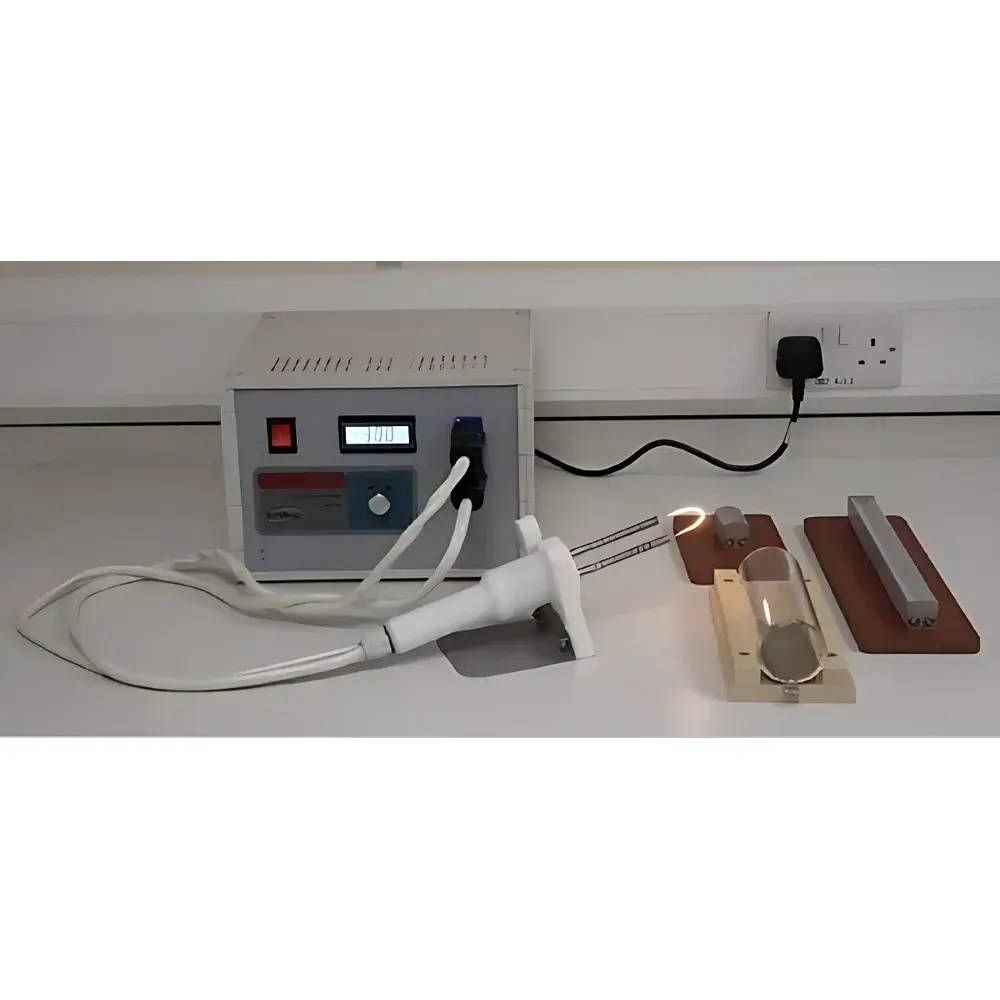
BA-12 Combustibility Analyzer by Anko Poland
| Origin | Poland |
|---|---|
| Manufacturer Type | Authorized Distributor |
| Origin Category | Imported Instrument |
| Model | BA-12 |
| Pricing | Available Upon Request |
Overview
The BA-12 Combustibility Analyzer is a precision-engineered laboratory instrument designed for the quantitative assessment of combustibility and ignition propensity of powdered or granular solid materials under controlled thermal initiation. Developed by Anko, a Polish manufacturer specializing in explosion safety instrumentation, the BA-12 implements the standardized hot-wire ignition method as defined in VDI 2263 Part 1, Method 1.2 and UN Recommendations on the Transport of Dangerous Goods, Manual of Tests and Criteria, Test N.1. It operates on the principle of resistive heating of a calibrated platinum wire (Ø1 mm) embedded within a standardized triangular trough mold, enabling reproducible thermal energy delivery to the sample bed. The system evaluates whether a material sustains self-propagating flame propagation upon localized ignition — a critical parameter for classifying combustible dusts per ATEX, IEC 60079-10-2, and OSHA 1910.399 hazard identification protocols.
Key Features
- Platinum ignition wire (Ø1 mm) with high-temperature stability up to 1000 °C, ensuring consistent thermal input and resistance to oxidation during repeated testing.
- Manually adjustable current supply (0–30.5 A DC), precisely calibrated to deliver 30 A nominal test current — optimized for reliable ignition of low-sensitivity dusts per VDI 2263 requirements.
- Triangular cross-section mold manufactured to exact dimensional tolerances specified in VDI 2263 Part 1, ensuring uniform sample geometry, packing density, and heat transfer characteristics across tests.
- Rugged, benchtop-integrated architecture with thermally insulated housing and fail-safe current cutoff to prevent overheating or unintended ignition during setup or idle states.
- Compliance-ready design: All mechanical and operational parameters align with the procedural constraints and reporting requirements of UN Test N.1 and VDI 2263 Method 1.2, facilitating direct integration into hazard classification dossiers.
Sample Compatibility & Compliance
The BA-12 is validated for use with dry, free-flowing powders and granules exhibiting particle sizes typically ranging from 10 µm to 500 µm — including metal powders (e.g., aluminum, magnesium), organic dusts (e.g., sugar, flour, cellulose), and polymer-based particulates. Sample moisture content must remain below 1 wt% to avoid false-negative outcomes. The instrument supports compliance documentation for regulatory submissions under EU CLP Regulation (EC No. 1272/2008), OSHA Hazard Communication Standard (29 CFR 1910.1200), and transport classification per IMDG Code and IATA Dangerous Goods Regulations. While the BA-12 itself does not generate digital audit trails, its test procedure is fully compatible with GLP-aligned manual recordkeeping systems when paired with standardized test logs and operator sign-offs.
Software & Data Management
The BA-12 operates as a standalone hardware platform without embedded microprocessor control or proprietary software. All operational parameters — including applied current, observed ignition behavior (yes/no propagation), flame duration, and visual confirmation notes — are recorded manually in accordance with ISO/IEC 17025:2017 Clause 7.7 (Reporting of Results). Users may integrate test records into LIMS or ELN platforms via structured CSV templates provided in the instrument’s technical manual. Though no native data export interface is included, the device’s deterministic test protocol ensures full traceability when combined with timestamped video documentation (recommended for QA/QC audits) and signed test reports compliant with FDA 21 CFR Part 11 requirements for paper-based systems.
Applications
- Determination of combustibility classification (combustible vs. non-combustible) for raw materials entering chemical, pharmaceutical, food, and additive manufacturing facilities.
- Pre-screening of novel powder formulations prior to large-scale processing to assess explosion risk in milling, pneumatic conveying, or drying operations.
- Supporting DSEAR (UK) and NFPA 652 Fundamental Principles of Combustible Dust Safety assessments through documented ignition testing.
- Verification of dust inertization efficacy following surface treatment or moisture conditioning interventions.
- Training and demonstration of fundamental dust fire dynamics in occupational health and safety certification programs.
FAQ
What standards does the BA-12 explicitly comply with?
The BA-12 is engineered and verified for strict adherence to VDI 2263 Part 1, Method 1.2 and UN Manual of Tests and Criteria, Test N.1. It does not perform tests referenced in ASTM E1226 or EN 14034, which require different apparatus configurations.
Is calibration required before each test?
No routine calibration is mandated between tests; however, periodic verification of the platinum wire integrity and current meter accuracy (annually or after 100 tests) is recommended per ISO/IEC 17025 Clause 6.5.
Can the BA-12 be used for wet or agglomerated samples?
No — the test method requires homogeneous, dry, and de-agglomerated powder beds. Moisture or caking alters thermal conductivity and ignition threshold, invalidating results per VDI 2263 procedural constraints.
Does the system include temperature monitoring during ignition?
No. Temperature is inferred indirectly via calibrated current-to-resistance conversion; direct thermocouple measurement at the wire-sample interface is excluded per the scope of Test N.1 and VDI 2263 Method 1.2.
Is technical support available outside Poland?
Yes — authorized distributors provide installation verification, operator training, and application support in English, German, and French, with documentation supplied in all three languages.



