
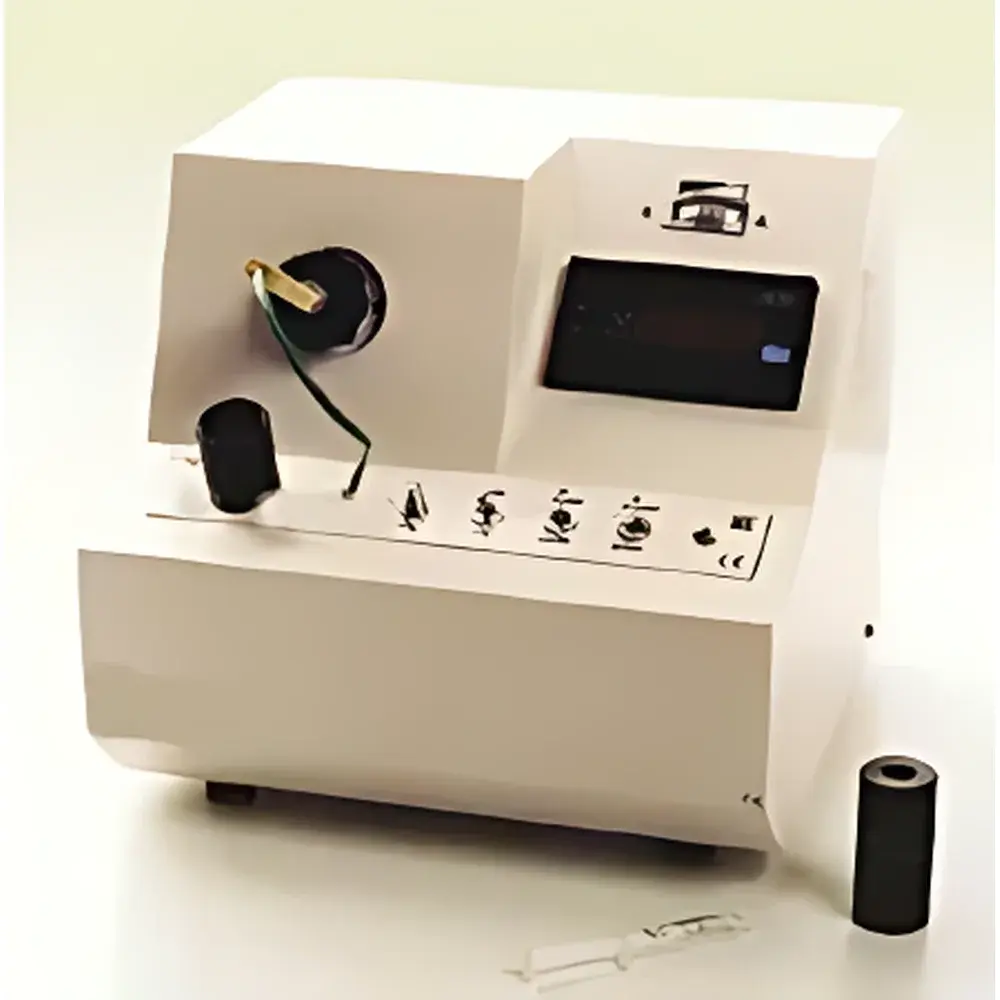
Aniline Point Tester D611 (Swiss-imported, ASTM D611 Compliant)
| Origin | Switzerland |
|---|---|
| Manufacturer Type | Authorized Distributor |
| Origin Category | Imported |
| Model | D611 |
| Pricing | Available Upon Request |
Overview
The Aniline Point Tester D611 is a precision-engineered, benchtop analytical instrument designed for the accurate determination of aniline point — a critical thermodynamic parameter indicating the aromatic content and solvency characteristics of petroleum products and hydrocarbon solvents. Based on the principle of liquid–liquid phase transition, the instrument measures the minimum temperature at which equal volumes of aniline and the test sample become completely miscible, forming a single homogeneous phase. This measurement follows the fundamental thermodynamic behavior governed by the Flory–Huggins solution theory and serves as a key quality control indicator in refinery operations, lubricant formulation, and solvent compatibility assessment. The D611 complies fully with ASTM D611 (Standard Test Method for Aniline Point of Petroleum Products), ISO 2977, IP 2, and NF M 07-021, ensuring metrological traceability and regulatory acceptability across global refining and testing laboratories.
Key Features
- Multi-method capability supporting ASTM D611 Method A (transparent samples), Method B (dark or opaque samples), Methods C & D (volatile products), and Method E (low-aniline-point hydrocarbons), enabling broad applicability across diverse feedstocks and finished products.
- Infrared (IR) detection system integrated with optical fiber transmission, delivering consistent phase-transition detection regardless of sample color, turbidity, or opacity — eliminating subjective visual interpretation errors inherent in manual methods.
- Triple-range programmable temperature control: −30 °C to 20 °C, 20 °C to 50 °C, and 50 °C to 150 °C — optimized for precise thermal ramping and isothermal stabilization required for reproducible endpoint detection.
- Sealed 2 mL borosilicate glass sample tube minimizes operator exposure to aniline vapor and prevents cross-contamination; eliminates need for open handling or fume hood dependency.
- Integrated aluminum heating block with active thermal insulation, Peltier-assisted cooling (where applicable), precision RTD temperature probe, and real-time digital PID control ensure ±0.1 °C thermal stability during phase-equilibrium observation.
- Dual safety architecture: independent high-temperature cutoff (155 °C) and low-temperature lockout (−35 °C), plus LED status indicators and audible alerts for fault conditions.
Sample Compatibility & Compliance
The D611 accommodates a wide range of hydrocarbon-based materials including naphthas, kerosenes, diesel fuels, base oils, white spirits, and synthetic solvents. Its IR-based detection enables reliable analysis of highly colored or carbon-black–containing samples (e.g., cracked distillates, heavy fuel oils) without dilution or filtration. Instrument validation and operational protocols align with TOTAL S.A.’s internal certification requirements for aniline point testing equipment. All calibration and verification procedures support GLP-compliant documentation, and the system architecture permits integration into LIMS environments via analog output (0–10 V or 4–20 mA) for audit-ready data capture.
Software & Data Management
While the D611 operates as a standalone instrument with embedded digital display and manual endpoint confirmation, it provides analog output signals compatible with third-party data acquisition systems (e.g., LabVIEW, DeltaV, or custom SCADA platforms). Temperature profiles and final aniline point values can be logged externally with timestamping and operator ID tagging — facilitating compliance with FDA 21 CFR Part 11 when paired with validated electronic record systems. Optional firmware upgrades support enhanced thermal ramp rate programming and multi-step hold sequences for method development and interlaboratory comparison studies.
Applications
- Refinery process control: Monitoring aromatic saturation levels in hydrotreated streams and predicting elastomer swell behavior in fuel systems.
- Lubricant R&D: Correlating aniline point with base oil classification (API Group I–III) and additive solubility limits.
- Fuel specification compliance: Verifying conformance to ASTM D975 (diesel), D3699 (kerosene), and EN 590 (automotive diesel) requirements.
- Environmental testing labs: Assessing hydrocarbon fingerprinting and weathering effects in soil and water extracts.
- Contract testing facilities: Supporting ISO/IEC 17025 accreditation through documented method validation, uncertainty estimation, and participation in proficiency testing schemes (e.g., NIST SRM 2721).
FAQ
Does the D611 require calibration with certified reference materials?
Yes — initial calibration and periodic verification must be performed using NIST-traceable aniline (CAS 62-53-3, purity ≥99.5%) and reference petroleum samples with certified aniline points (e.g., NIST SRM 2721 series).
Can the instrument be used for biodiesel or bio-blend analysis?
It is suitable for FAME-based biodiesel (ASTM D6751) and low-level blends (<5% v/v); however, high ester content may alter phase behavior — method validation per ASTM D7467 is recommended.
Is cleaning validation required between samples?
Yes — each 2 mL tube is single-use per ASTM D611 Section 7.3; reusable tubes are not permitted due to residual aniline carryover risk and potential degradation of optical path integrity.
What electrical and environmental specifications apply?
Operating ambient: 15–30 °C, <80% RH non-condensing; power supply: 100–240 V AC, 50/60 Hz, 300 W max; footprint: 280 × 220 × 310 mm (W × D × H).





