
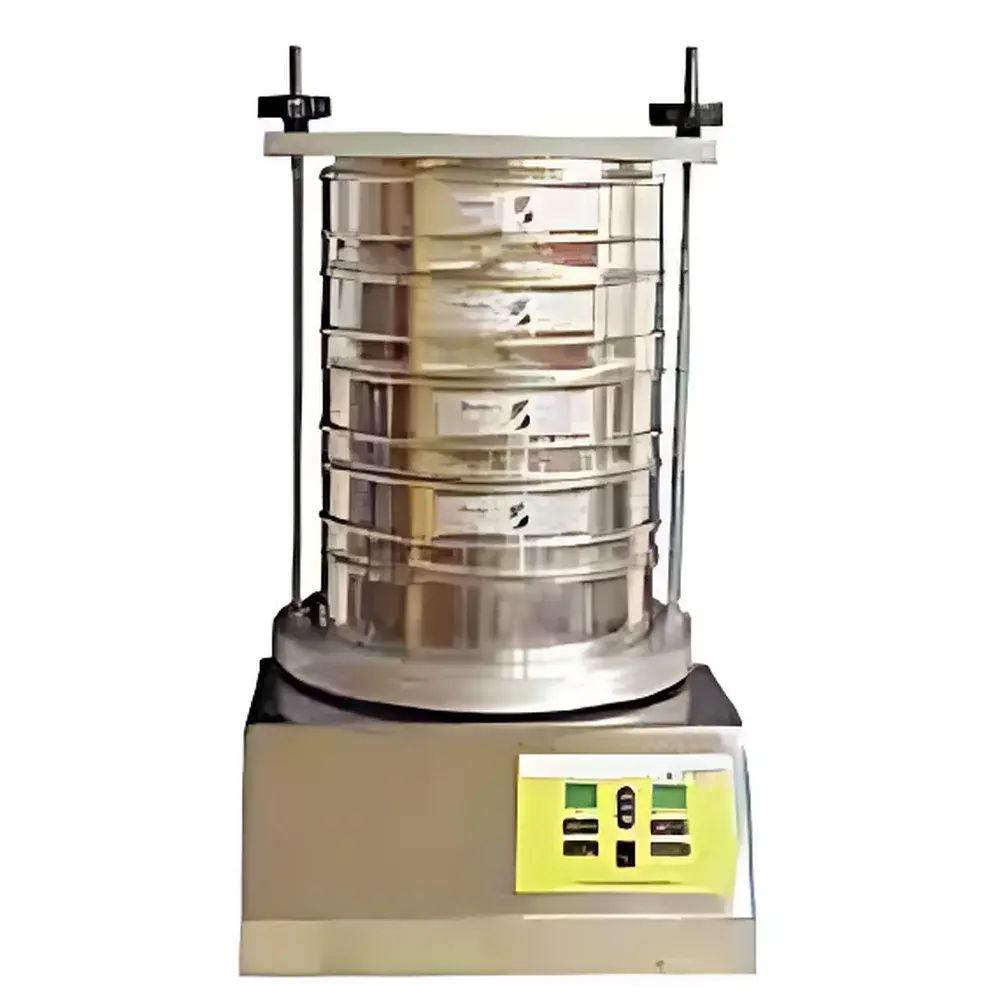
RP10 Electromagnetic Digital Sieve Shaker
| Origin | Spain |
|---|---|
| Manufacturer Type | Authorized Distributor |
| Origin Category | Imported |
| Model | RP10 |
| Pricing | Upon Request |
Overview
The RP10 Electromagnetic Digital Sieve Shaker is a precision-engineered laboratory and industrial particle sizing instrument designed for standardized dry-sieving analysis of granular and powdered materials. Unlike conventional mechanical or eccentric-drive shakers, the RP10 employs electromagnetic resonance actuation to generate controlled, reproducible three-dimensional motion—comprising simultaneous circular and vertical oscillations—ensuring uniform energy distribution across the entire sieve stack. This principle enables high-fidelity particle separation in accordance with international sieving standards including ISO 2591-1, ASTM E11, and EN 933-1. The system is optimized for robust performance in quality control laboratories, mining R&D facilities, metallurgical processing plants, and mechanical engineering testing environments where dry, free-flowing, and moderately cohesive powders require reliable size distribution characterization.
Key Features
- Electromagnetic resonance drive system delivering consistent amplitude and frequency without mechanical wear—eliminating the need for routine lubrication or belt replacement.
- Digital control interface with real-time display of operating time, vibration frequency (adjustable within standard range), and cycle count—enabling full traceability and method repeatability.
- Three-axis motion profile (circular + vertical + slight torsional component) enhances particle stratification and prevents blinding of mesh apertures.
- CISA-PRESS rapid clamping mechanism ensures secure, tool-free fixation of stainless steel sieve frames (200 mm or 300 mm diameter), lid, and base—reducing setup time and minimizing operator variability.
- Integrated vibration damping base with elastomeric isolation mounts reduces transmission to supporting surfaces and maintains stability during extended operation.
- CE-certified safety architecture compliant with IEC 61000-6-2 (EMC immunity) and IEC 61000-6-4 (EMC emissions), suitable for ISO/IEC 17025-accredited laboratories.
- Noise emission ≤75 dB(A) under defined load conditions (four 300 mm sieves, 500 g total sample mass), meeting occupational health requirements per EU Directive 2003/10/EC.
Sample Compatibility & Compliance
The RP10 is validated for dry-sieving applications involving non-hygroscopic, free-flowing, or slightly agglomerated particulates with bulk density ≥0.8 g/cm³. Recommended sample mass ranges are 100–250 g for 200 mm sieves and 250–2500 g for 300 mm sieves—scaling proportionally with particle density and stack height to ensure optimal bed depth and segregation efficiency. It accommodates standard test sieves conforming to ISO 3310-1 (woven wire mesh) and ISO 3310-2 (perforated plate), including stainless steel and brass variants. The instrument supports compliance workflows aligned with GLP, GMP, and FDA 21 CFR Part 11 when integrated with validated LIMS or electronic lab notebook systems—audit trails for run parameters, timestamps, and user authentication can be exported in CSV or PDF format.
Software & Data Management
While the RP10 operates as a stand-alone electromechanical unit with embedded digital timer and status indicators, its operational parameters—including start/stop time, duration, and cycle completion—are logged internally with timestamped records retained for ≥1000 runs. Optional RS-232 or USB-to-serial interface enables integration with third-party data acquisition platforms (e.g., LabVIEW, MATLAB, or custom QC software) for automated reporting, statistical process control (SPC), and long-term trend analysis. All firmware updates follow ISO/IEC 17025 change control protocols, and calibration verification procedures are documented in the supplied technical manual per ISO/IEC 17025 Clause 6.5.
Applications
- Particle size distribution analysis of crushed ores, slag, and metallurgical feedstocks in mining and extractive metallurgy.
- Quality assurance of metal powders (e.g., atomized Fe, Al, Ti alloys) used in additive manufacturing pre-processing.
- Granulometric evaluation of foundry sands, refractory aggregates, and ceramic raw materials.
- Batch release testing of pharmaceutical excipients and food-grade starches under dry-sieving protocols.
- R&D screening of catalyst supports, battery electrode materials, and polymer granules prior to compaction or extrusion.
FAQ
What sieve diameters are supported by the RP10?
The RP10 accepts standard test sieves with nominal diameters of 200 mm or 300 mm, compatible with ISO 3310-1 and ASTM E11 specifications.
Is the RP10 suitable for wet sieving?
No—the RP10 is engineered exclusively for dry-sieving applications; it lacks liquid containment, drainage, or corrosion-resistant wet-seal components.
Does the RP10 require periodic calibration?
While no field calibration is required due to its solid-state electromagnetic drive, users must perform periodic verification using certified reference standards (e.g., NIST-traceable glass beads or calibrated sieve sets) as part of laboratory quality assurance programs.
Can multiple RP10 units be networked for centralized monitoring?
Yes—via optional serial-to-Ethernet gateways and middleware, up to 16 units may be monitored through a central dashboard supporting real-time status, maintenance alerts, and aggregated sieve analysis reports.
What is the expected service life under continuous operation?
With proper environmental conditioning (temperature 15–30°C, humidity <70% RH non-condensing), the RP10 demonstrates >15 years of operational reliability based on accelerated life testing per IEC 60068-2-64.



