
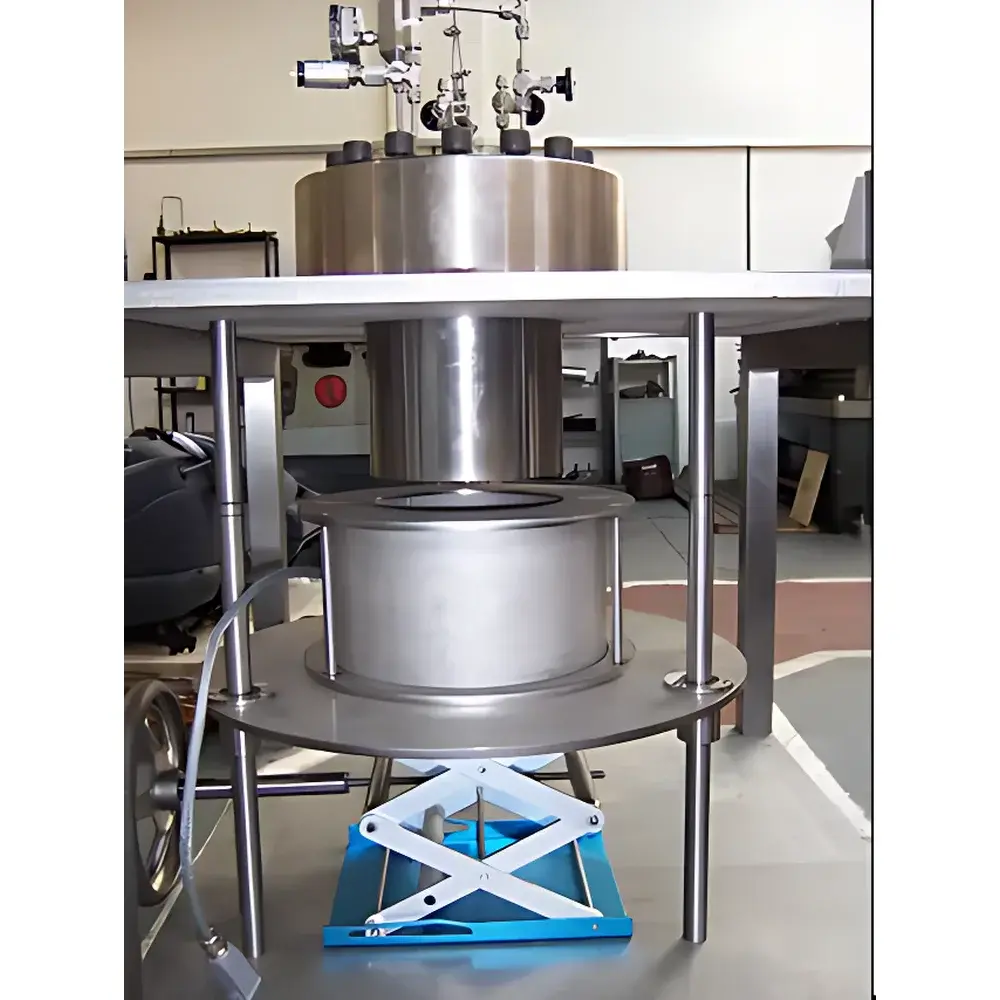
Baskerville BV-5 Hydrogen Permeation High-Pressure Autoclave
| Origin | UK |
|---|---|
| Manufacturer Type | Authorized Distributor |
| Origin Category | Imported |
| Model | BV-5 |
| Price Range | USD 135,000 – 270,000 (FOB) |
| Internal Volume | 5 L |
| Vessel Diameter × Height | Ø180 mm × 200 mm |
| Maximum Working Pressure | 20 MPa (200 barg) |
| Design Pressure | 25 MPa (250 barg) |
| Maximum Working Temperature | 500 °C |
| Design Temperature | 650 °C |
| Construction Material | ASTM A479 UNS S31603/S31603L (EN 10204 3.1.B certified) |
| Sealing System | Solid silver gasket with ASME B16.5 Class 2500 flanged closure |
| Structural Compliance | ASME BPVC Section VIII, Div. 1 (NCS Stamp), BS EN 13445-1:2002, PED 97/23/EC |
| Control System | Eurotherm 2216E PID controller (K-type thermocouple in immersion well), Eurotherm 2132i independent safety limiter, Eurotherm 32H8I digital pressure transducer (RS232 interface), IP55-rated control cabinet (RAL 7032, 240 V AC, 50 Hz, 32 A) |
Overview
The Baskerville BV-5 Hydrogen Permeation High-Pressure Autoclave is an engineered solution for controlled catalytic hydrogenation, metal hydride formation, hydrogen embrittlement studies, and high-temperature/pressure gas–liquid–solid reaction kinetics under inert or reducing atmospheres. Designed specifically for hydrogen permeation research—where precise control of H₂ partial pressure, temperature stability, and long-term vessel integrity are critical—the BV-5 operates on a robust monolithic forged steel architecture compliant with ASME Section VIII, Div. 1 and EU Pressure Equipment Directive (PED 97/23/EC). Its sealed, electropolished 316/316L stainless-steel vessel minimizes surface reactivity and enables reproducible hydrogen diffusion measurements across metallic membranes or powder compacts. The system integrates dual-redundant thermal monitoring (process + safety), real-time pressure telemetry, and programmable ramp-hold profiles—enabling compliance with ASTM G129 (standard practice for slow strain rate testing in hydrogen environments) and ISO 17081 (hydrogen permeation measurement in metals).
Key Features
- Monobloc forged vessel construction from ASTM A479 UNS S31603L, certified to EN 10204 3.1.B; internal surface finish Ra ≤ 0.4 µm for corrosion resistance and reduced catalytic residue adhesion
- Hinged, IP55-rated control cabinet (RAL 7032) housing Eurotherm 2216E digital PID controller with auto-tuning, ramp-soak programming, and dual-setpoint alarm logic
- Independent safety circuit with Eurotherm 2132i limiter and redundant K-type thermocouples—one immersed in process fluid via thermowell, the other monitoring heater block temperature
- Digital pressure monitoring via Eurotherm 32H8I transducer (0–25 MPa range), featuring RS232 communication, overpressure lockout relay, and configurable alarm thresholds
- Flanged closure with solid silver gasket (ASTM B307 Grade Ag-1) and ASME B16.5 Class 2500 bolting (SA193 B8M / SA194 8M), rated for cyclic operation up to 20 MPa at 500 °C
- Modular cabling architecture: power and signal lines terminate in industrial-grade plug/socket interfaces for rapid reactor detachment and maintenance
Sample Compatibility & Compliance
The BV-5 accommodates heterogeneous catalytic systems—including supported noble-metal catalysts (Pd/C, Pt/Al₂O₃), transition-metal powders (Ni, Fe, Ti), and electrochemical membrane assemblies—for hydrogen uptake, desorption, and permeation flux quantification. Its 5 L working volume supports batch-mode experiments with liquid-phase solvents (e.g., methanol, THF, DMF) and gaseous H₂ at partial pressures up to 20 MPa. All wetted components meet material traceability requirements per EN 10204 3.1.B, with full documentation provided for audit readiness. The system satisfies design verification criteria under ASME BPVC Section VIII, Div. 1 (NCS stamp), BS EN 13445-1:2002, and PED 97/23/EC Annex I essential safety requirements. It supports GLP-compliant data acquisition when paired with validated software configurations meeting FDA 21 CFR Part 11 electronic record and signature criteria.
Software & Data Management
Baskerville provides proprietary acquisition software compatible with Windows-based host systems (customer-supplied PC required). The application delivers synchronized, timestamped logging of temperature (±0.5 °C), pressure (±0.1% FS), and elapsed time at user-defined intervals (100 ms to 60 s). Real-time graphical overlays enable concurrent visualization of multiple parameters, while historical datasets export to CSV or MATLAB-compatible formats. Audit trails record operator login events, parameter modifications, alarm triggers, and manual override actions—supporting traceability for ISO/IEC 17025 accreditation and internal QA/QC protocols. Optional OPC UA integration allows seamless linkage with laboratory information management systems (LIMS) or distributed control environments.
Applications
- Quantitative hydrogen permeation rate measurement in pipeline steels, austenitic alloys, and coated substrates per ASTM F1113 and ISO 17081
- Catalytic hydrogenation screening under supercritical H₂ conditions for pharmaceutical intermediate synthesis
- Thermal stability assessment of metal hydrides (e.g., MgH₂, NaAlH₄) under dynamic pressure–temperature cycling
- Hydrogen-induced cracking (HIC) and sulfide stress cracking (SSC) susceptibility testing per NACE TM0177 and ISO 15156
- In-situ XRD or Raman-compatible high-pressure cell adaptation (requires custom viewport integration)
- Accelerated aging studies of hydrogen storage materials under cyclic loading
FAQ
What certification documentation accompanies the BV-5 upon delivery?
Full EN 10204 3.1.B material test reports for all pressure-retaining components, ASME U-1A data report with NCS stamp, PED 97/23/EC Declaration of Conformity, and CE marking dossier—including risk assessment, design calculations, and non-destructive examination records.
Can the BV-5 be operated with gases other than hydrogen?
Yes—the vessel is rated for any non-corrosive or mildly corrosive process gas (e.g., N₂, Ar, CO₂, CH₄) up to 20 MPa and 500 °C; however, hydrogen-specific sealing and leak-testing protocols must be followed for H₂ service per ISO 15848-1.
Is remote monitoring supported?
The Eurotherm controllers support Modbus RTU over RS485 (optional module); Ethernet/IP or PROFINET gateways can be integrated externally for SCADA-level supervision.
What maintenance intervals are recommended for long-term reliability?
Silver gaskets require replacement after each 10 thermal cycles above 400 °C; pressure transducers and thermocouples should undergo annual calibration traceable to NIST standards; full hydrostatic retest is mandated every 5 years per ASME Section VIII requirements.
Does the system include validation documentation for GMP environments?
IQ/OQ documentation templates are supplied; PQ execution requires site-specific protocol development aligned with USP , ASTM E2500, and Annex 15 of the EU GMP Guidelines.



