
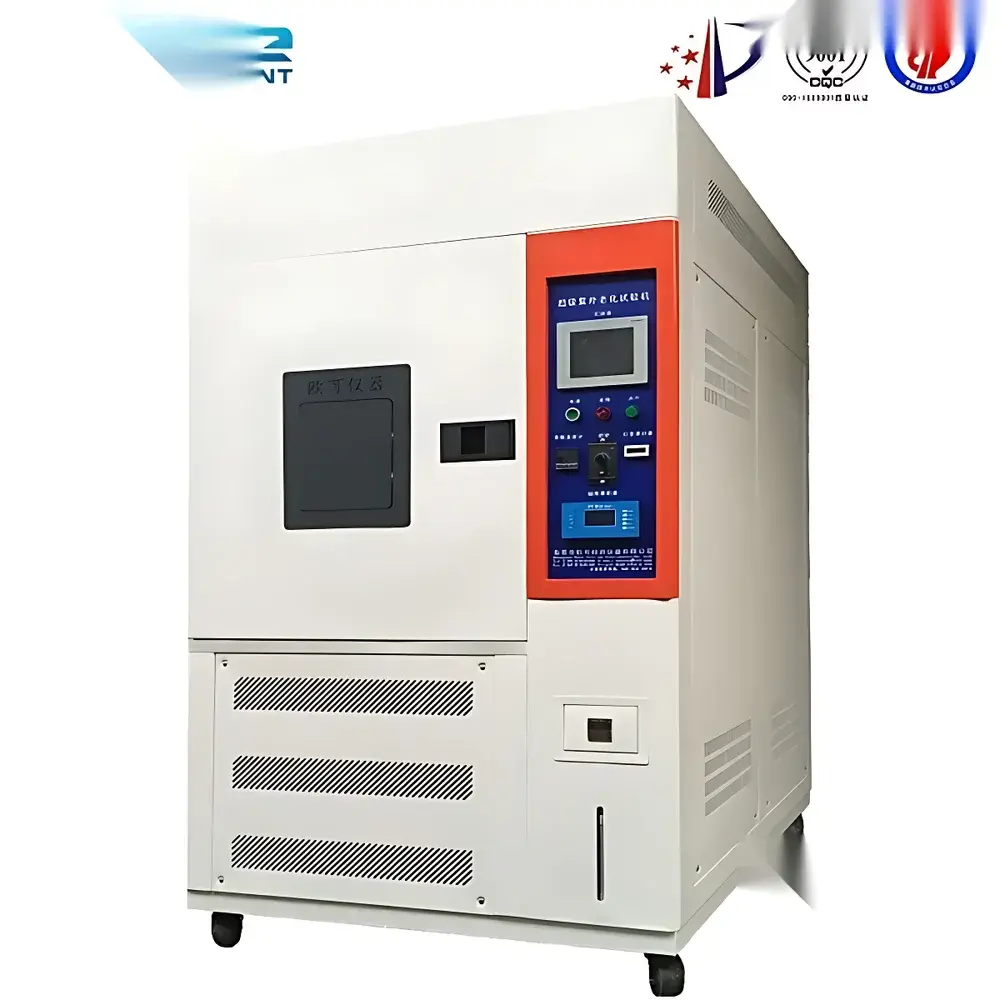
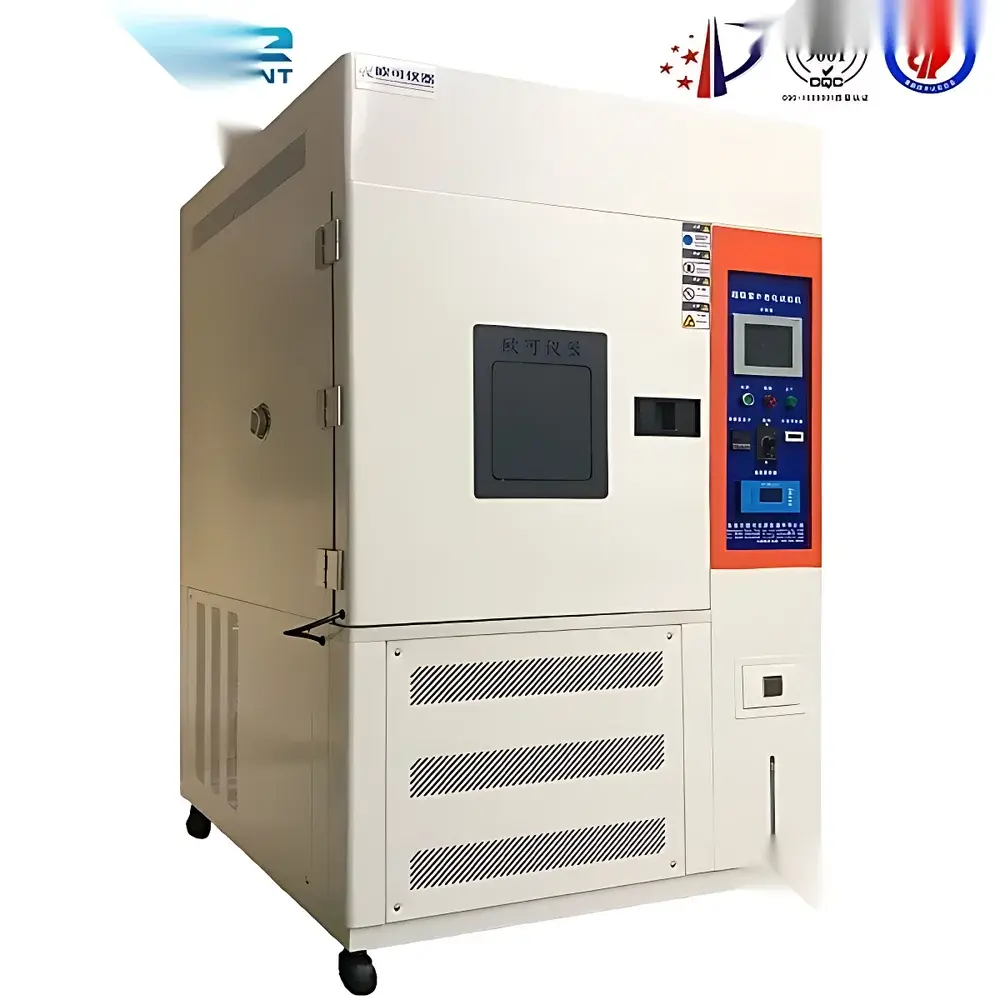
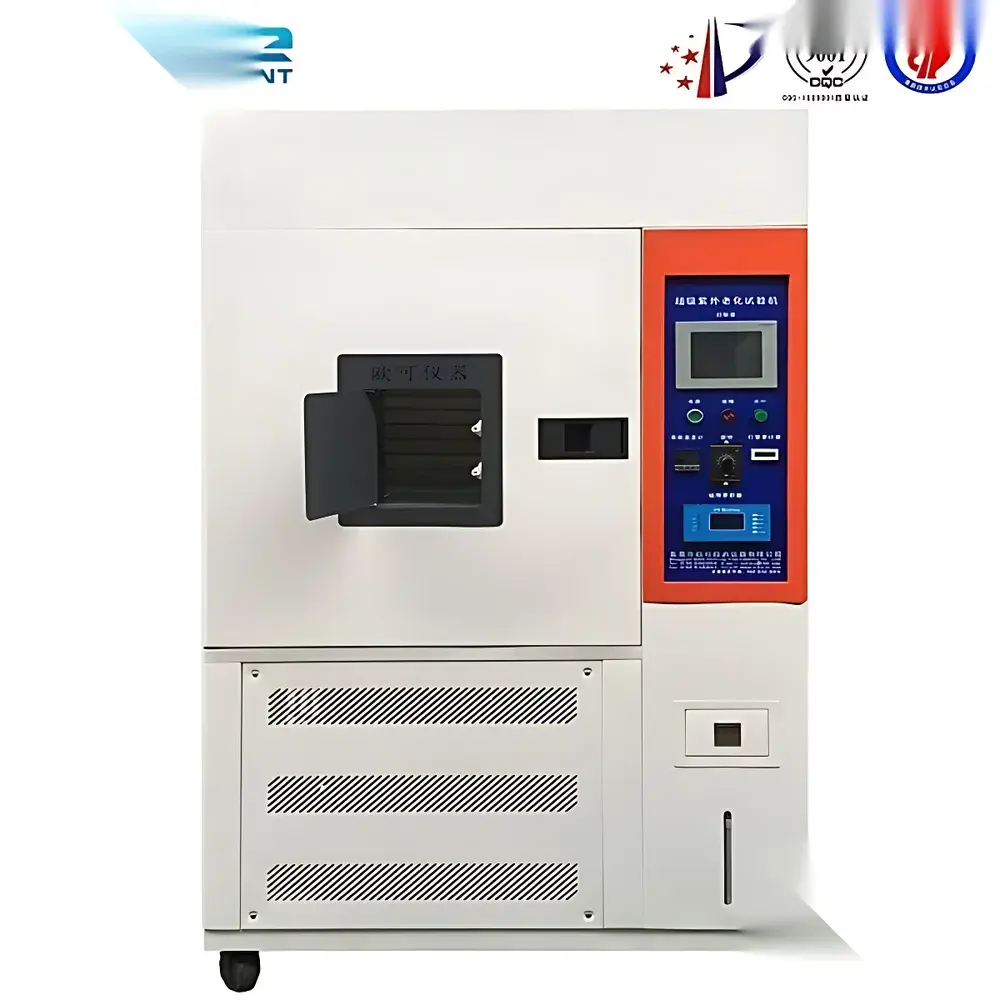
UV Aging Test Chamber – Metal Halide Lamp-Based Accelerated Weathering Chamber
| Key Specifications | Temperature Range: RT to 85 °C (operational test range: 50 °C ±10 °C) |
|---|---|
| Humidity Range | 40–70 % RH during irradiation |
| Temperature Control Accuracy | ±0.5 °C |
| Humidity Control Accuracy | ±2.0 % RH |
| Temperature Uniformity | ±2.0 °C |
| Humidity Uniformity | ±3.0 % RH |
| Heating Rate | ≤25 min (RT → 85 °C) |
| Radiation Source | Single 2.5 kW air-cooled metal halide lamp |
| Spectral Output | 295–450 nm, filtered to match terrestrial solar UV + visible irradiance through 3 mm borosilicate glass |
| Sample Tray Dimensions | 500 × 400 mm |
Overview
The UV Aging Test Chamber – Metal Halide Lamp-Based Accelerated Weathering Chamber is an engineered environmental simulation system designed for accelerated photochemical degradation testing of materials under controlled solar-spectrum irradiation, thermal stress, and cyclic humidity exposure. Unlike fluorescent UV lamps (e.g., UVA-340 or UVB-313), this chamber employs high-intensity air-cooled metal halide lamps to generate a continuous, broadband spectral output spanning 295–450 nm — closely replicating the terrestrial solar irradiance profile transmitted through standard 3 mm borosilicate glazing. This spectral fidelity enables realistic simulation of both direct and diffuse solar exposure, making it especially suitable for evaluating long-term outdoor durability of automotive exteriors, photovoltaic modules, polymer composites, coated substrates, and electronic enclosures. The chamber integrates precise temperature regulation (RT to 85 °C), programmable relative humidity control (40–90 % RH), and optional water spray/cold condensation cycles to reproduce synergistic aging mechanisms — including photooxidation, hydrolysis, thermal embrittlement, and moisture-induced delamination.
Key Features
- High-fidelity solar-spectrum simulation using a single 2.5 kW air-cooled metal halide lamp with optical filtering to match ASTM G155 and ISO 4892-2 spectral requirements for xenon-arc–equivalent irradiance distribution;
- Independent dual-loop climate control: PID-regulated heating system with ±0.5 °C accuracy and capacitive humidity sensing with ±2.0 % RH accuracy across defined operational ranges;
- Uniform exposure field: ±2.0 °C temperature uniformity and ±3.0 % RH uniformity across the 500 × 400 mm sample plane, validated per IEC 60068-3-5 and ASTM D7869;
- Programmable irradiance control via digital ballast and real-time UV radiometer feedback (optional integrated sensor);
- Configurable exposure cycles: simultaneous or sequential combination of light/heat, dark/condensation, and water spray phases — supporting ASTM D4329, ISO 11341, and SAE J2527 protocols;
- Rugged stainless-steel interior with corrosion-resistant insulation, double-wall construction, and safety interlocks compliant with IEC 61000-6-4 EMC standards.
Sample Compatibility & Compliance
This chamber accommodates flat-panel and three-dimensional samples up to 500 × 400 mm footprint and moderate height (standard tray depth: 50 mm). It supports full-size automotive trim pieces, PV module frames, painted metal panels, and encapsulated electronics without requiring sample segmentation. The system is engineered to meet functional compliance with key international weathering standards: ASTM G155 (metal halide method), ISO 4892-2 (Method B), SAE J2412/J2527 (automotive), and IEC 61215-2 (photovoltaic qualification). All control parameters — setpoints, ramp rates, dwell times, irradiance levels, and cycle sequences — are fully traceable and auditable, enabling adherence to GLP and GMP documentation requirements. Optional data logging modules support 21 CFR Part 11-compliant electronic records when paired with validated software.
Software & Data Management
The chamber operates via an embedded industrial touchscreen controller running deterministic real-time firmware. Users define multi-step test profiles with up to 99 segments, each specifying irradiance level (W/m²), black panel temperature, chamber air temperature, relative humidity, spray duration/frequency, and condensation dwell time. All operational data — including lamp voltage/current, chamber thermohygrometric readings, and real-time irradiance (if equipped) — are logged at user-selectable intervals (1 s to 60 min) and exportable via USB or Ethernet in CSV format. For enterprise integration, optional OPC UA or Modbus TCP interfaces enable connection to LIMS or MES platforms. Audit trails record operator login, parameter changes, alarm events, and calibration actions — satisfying FDA 21 CFR Part 11 and ISO/IEC 17025 traceability mandates.
Applications
- Automotive OEMs and Tier-1 suppliers validating paint chip resistance, headlamp lens yellowing, bumper UV stability, and sealant adhesion loss;
- Photovoltaic manufacturers assessing EVA encapsulant browning, backsheet cracking, and solder bond degradation under combined UV/humidity stress;
- Aerospace component developers evaluating composite matrix photooxidation and coating delamination on radomes and fairings;
- Architectural product certifiers testing silicone sealants, PVC cladding, and fluoropolymer membranes per EN 15657 and AAMA 2605;
- Research institutions conducting mechanistic studies on polymer chain scission kinetics, antioxidant depletion rates, and photocatalytic TiO₂ surface activation.
FAQ
What spectral standard does the metal halide lamp follow?
The lamp’s unfiltered output (295–450 nm) is spectrally conditioned using a calibrated borosilicate filter to approximate the global solar irradiance spectrum incident on horizontal surfaces after transmission through 3 mm glass — consistent with ASTM G155 Method A and ISO 4892-2 Class 1 requirements.
Can the chamber perform condensation-only cycles without irradiation?
Yes. The system supports independent control of temperature and humidity, enabling dark condensation phases (e.g., 50 °C / 90 % RH for 4 h) as defined in ASTM D7869 and ISO 11341 Annex B.
Is lamp spectral output monitored in real time?
A calibrated broadband UV radiometer (290–400 nm) is available as an optional add-on, providing closed-loop irradiance control and automated lamp aging compensation.
What maintenance intervals are recommended for the metal halide lamp?
Lamp life is rated at ≥1,500 hours at nominal power; replacement is advised after 1,200 hours of cumulative operation or upon observed irradiance drift exceeding ±5 % of setpoint.
Does the chamber support remote monitoring and alarm notification?
Via optional Ethernet interface and web-enabled controller firmware, users can access live status, download logs, and configure email/SMS alerts for critical faults (e.g., lamp failure, temperature excursion, door open).



