
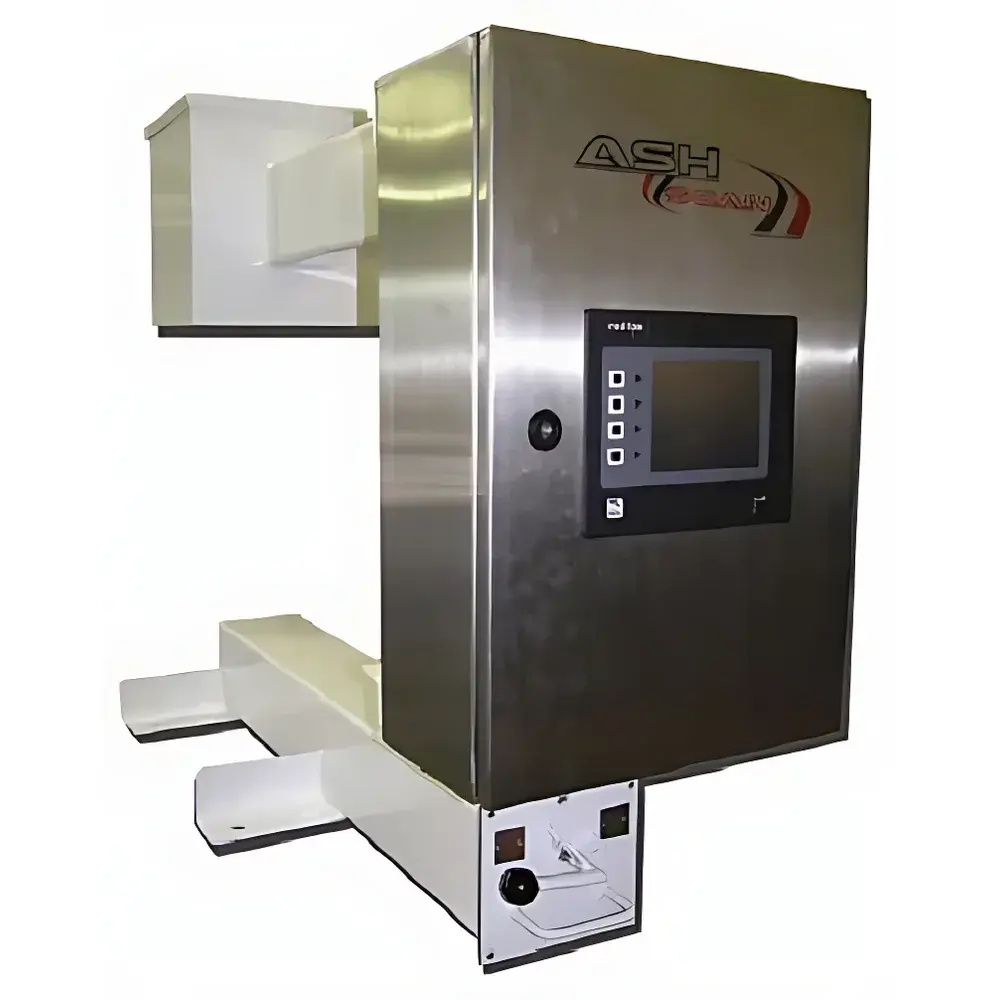
ASHSCAN Online Coal Ash Analyzer
| Origin | Imported |
|---|---|
| Manufacturer Type | Authorized Distributor |
| Model | ASHSCAN |
| Pricing | Available Upon Request |
| Conveyor Belt Width | Up to 1400 mm |
| Belt Speed | Unlimited |
| Sample Height | Up to 400 mm (standard) |
| Bottom Width | 100–400 mm |
| Ash Content Range | 0–100% |
| Measurement Interval | User-Configurable Real-Time Sampling |
| Typical Accuracy | ±0.9% for raw coal, ±0.6% for washed coal, ±0.3% for pulverized single-layer coal |
| Power Supply | 240 V, 50 Hz, 2 A |
| Output Signals | Dual 4–20 mA — instantaneous ash % and mass-normalized ash % (tonnage-based) |
| Operating Temperature | 0–45 °C (indoor installation, no direct sunlight or rain exposure) |
| Relative Humidity | 0–95% RH (non-condensing) |
Overview
The ASHSCAN Online Coal Ash Analyzer is an industrial-grade, non-contact gamma-ray transmission analyzer engineered for continuous, real-time quantification of ash content in bulk coal streams on conveyor belts. It operates on the principle of dual-energy gamma-ray attenuation—utilizing low-energy 241Am (59.5 keV) and high-energy 137Cs (662 keV) isotopic sources—to independently resolve ash concentration and coal layer thickness. The low-energy beam is highly sensitive to atomic number (Z), enabling discrimination of high-Z ash minerals (e.g., SiO2, Al2O3, Fe2O3) from low-Z organic coal matrix; the high-energy beam provides a thickness-correction signal based on mass per unit area, minimizing errors caused by belt loading variation. This dual-beam architecture ensures robust measurement integrity across heterogeneous feed conditions—including varying particle size distribution, moisture content, and stratified layering—without physical sampling, grinding, or combustion. Designed for integration into plant DCS/SCADA systems, the ASHSCAN delivers traceable, auditable ash data compliant with ISO 1171, ASTM D3174, and IEC 61508 functional safety guidelines for continuous emission monitoring support.
Key Features
- True online, non-intrusive measurement—no sample extraction, no downtime, no consumables
- Dual-isotope gamma source configuration (241Am + 137Cs) with automatic thickness compensation algorithm
- C-frame mechanical housing optimized for rigid mounting on standard conveyor structures (up to 1400 mm belt width)
- Two independent 4–20 mA analog outputs: one for real-time instantaneous ash %, one for mass-weighted average ash % over user-defined tonnage intervals
- Onboard alarm management module with configurable thresholds and relay-based fault signaling (e.g., source shielding status, detector saturation, belt stoppage)
- IP65-rated electronics enclosure; operational within 0–45 °C ambient temperature and up to 95% RH (non-condensing)
- Compliant with IAEA Safety Standards Series No. SSG-29 for sealed radioactive sources in industrial gauges
Sample Compatibility & Compliance
The ASHSCAN accommodates a wide range of coal types—including raw run-of-mine (ROM), washed bituminous, anthracite, lignite, and pulverized fuel (PF)—with particle sizes from fines (<1 mm) to lumps (up to 300 mm). Its measurement stability is validated across variable moisture contents (5–25 wt%) and bulk densities (0.6–1.2 g/cm³), provided material flow remains continuous and evenly distributed across the belt cross-section. Regulatory compliance includes adherence to ISO/IEC 17025 for measurement uncertainty estimation, alignment with EU Directive 2013/59/Euratom for radiation protection in workplaces, and compatibility with GLP/GMP documentation workflows for coal quality reporting in power generation and metallurgical applications. Source licensing, transport, and disposal follow national regulatory frameworks (e.g., NRC 10 CFR Part 34, UK IRR17).
Software & Data Management
The ASHSCAN interfaces via Modbus RTU/TCP or OPC UA to central process historians (e.g., OSIsoft PI, Emerson DeltaV, Honeywell Experion). Local HMI displays real-time ash trend plots, calibration logs, source activity decay compensation history, and diagnostic event timestamps. All measurement records include embedded metadata: UTC timestamp, belt speed (if integrated), source-to-detector geometry status, and signal-to-noise ratio (SNR) per channel. Audit trails meet FDA 21 CFR Part 11 requirements for electronic records and signatures when deployed in regulated coal blending or emissions reporting environments. Firmware updates are performed remotely via secure SSH session; configuration changes require dual-role authentication (operator + engineer).
Applications
- Real-time coal blending control at power plant receiving hoppers to maintain target ash and calorific value
- Quality gate monitoring prior to coal washing or thermal drying processes
- Feed-forward adjustment of pulverizer settings based on incoming ash variability
- Automated rejection of high-ash batches in export coal terminals (aligned with ISO 1988 sampling protocols)
- Supporting carbon accounting and NOx/SO2 emission forecasting models via ash-correlated mineral matter estimation
- Long-term trend analysis of mine face variability for geological resource modeling
FAQ
Does the ASHSCAN require periodic recalibration with reference coal standards?
Yes—initial factory calibration is traceable to NIST SRM 1632c (Coal Ash Standard). Field recalibration is recommended every 6 months using site-specific certified reference materials (CRMs) or paired lab ash results (ASTM D3174) with statistical control charting (X-bar/R charts).
Can it operate safely in explosive atmospheres (ATEX/IECEx zones)?
The base unit is rated for Zone 2 / Class I Div 2. For Zone 1 or mining-specific hazardous areas, optional ATEX-certified detector housings and intrinsically safe barrier kits are available upon request.
How is radiation safety ensured during routine maintenance?
All gamma sources are housed in fully shielded, mechanically interlocked C-frames. Source exposure is physically blocked unless the maintenance access door is opened, which automatically de-energizes detectors and triggers audible/visual alarms per IEC 61511 SIL 2 requirements.
Is the system compatible with legacy DCS platforms lacking modern fieldbus support?
Yes—4–20 mA analog outputs provide seamless integration with analog input cards in legacy systems (e.g., Yokogawa CENTUM CS3000, Siemens SIMATIC PCS 7), with configurable scaling and linearization tables.
What is the typical measurement update latency from belt transit to ash value output?
The minimum reporting interval is 1 second; default averaging window is 10 seconds. Latency between coal passage under the beam and stable analog output is ≤200 ms, verified per IEC 61508-2 Annex F timing validation protocol.




