
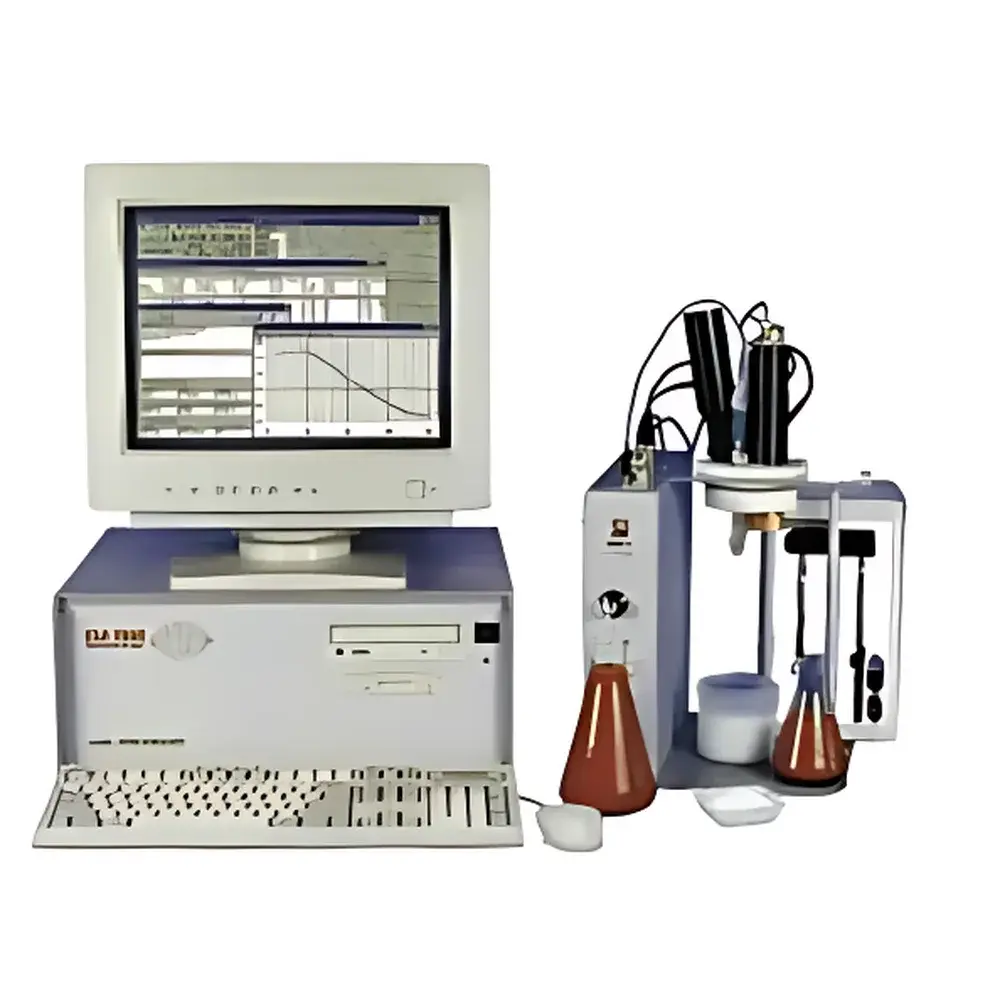
Brookfield 9800 Zeta Potential Analyzer
| Origin | USA |
|---|---|
| Manufacturer Type | Authorized Distributor |
| Origin Category | Imported |
| Model | 9800 |
| Pricing | Available Upon Request |
Overview
The Brookfield 9800 Zeta Potential Analyzer is an advanced electroacoustic instrument engineered for direct, non-invasive measurement of electrophoretic mobility and zeta potential in concentrated, opaque, or highly viscous colloidal dispersions. Unlike conventional optical techniques—such as laser Doppler electrophoresis or phase analysis light scattering (PALS)—the 9800 employs patented electroacoustic spectroscopy (EAS), where a high-frequency alternating electric field induces particle motion in suspension, generating detectable colloid vibration current (CVI) or electrokinetic sonic amplitude (ESA). This principle enables real-time, in-situ characterization without sample dilution, optical alignment, or electrode polarization artifacts. The system operates under true process-relevant conditions: measurements are performed at native concentration (0.5–50% v/v), across aqueous and non-aqueous media, and over a broad particle size range up to 30 µm. Its robust architecture eliminates the need for capillary cells, focusing optics, or low-conductivity buffers—making it uniquely suited for QC labs, formulation development, and industrial R&D environments requiring GLP-compliant, reproducible electrokinetic data.
Key Features
- Electroacoustic measurement principle enabling direct zeta potential analysis in undiluted, turbid, or high-viscosity samples
- Integrated multi-parameter acquisition: simultaneous real-time monitoring of zeta potential, pH, conductivity, temperature, and electrophoretic mobility
- Gold- or stainless-steel handheld sensor probe with high signal-to-noise ratio and long-term calibration stability
- Minimum sample volume: 10 mL; no upper volume limit—compatible with batch reactors, inline sampling loops, and benchtop beakers
- Chemically inert PTFE titration cell for acid/base or surfactant titrations during dynamic zeta potential profiling
- DSP-based hardware platform supporting rapid spectral acquisition (<10 s per measurement) and high-frequency pulse excitation (avoiding Joule heating or pH drift)
- Microsoft Windows–compatible software with audit-trail functionality compliant with FDA 21 CFR Part 11 requirements
- Full support for stirred, flowing, or static dispersions—no sedimentation bias due to continuous mixing capability
- No optical alignment required; insensitive to particle opacity, color, or air bubbles
Sample Compatibility & Compliance
The 9800 accommodates a wide spectrum of industrial and academic sample types—including polymer lattices, ceramic slurries, pharmaceutical nanosuspensions, inkjet inks, battery electrode slurries, and oil-in-water emulsions. It meets ASTM D7826–17 (Standard Test Method for Zeta Potential of Nanoparticles in Aqueous Media by Electroacoustic Measurement) and aligns with ISO 13099-3 for electrokinetic characterization. Its design supports GMP/GLP workflows through secure user access control, electronic signature validation, and automated metadata tagging (operator ID, timestamp, instrument ID, environmental parameters). All firmware and software updates are traceable and version-controlled, ensuring regulatory readiness for audits conducted by FDA, EMA, or notified bodies.
Software & Data Management
The bundled PC software provides intuitive instrument control, method scripting, and comprehensive data visualization. Users can define multi-step titration protocols (e.g., pH ramp + surfactant addition), generate zeta potential vs. pH isotherms, export time-series datasets to CSV or Excel, and apply statistical filters for outlier detection. Raw ESA spectra are stored alongside processed results, enabling retrospective re-analysis. Built-in reporting templates comply with internal SOPs and external submission standards (e.g., ICH M4Q). Data integrity is enforced via automatic backup, encrypted local storage, and optional network server synchronization with role-based permissions.
Applications
The 9800 serves critical functions across materials science, pharmaceutical development, and industrial process optimization. In drug delivery, it quantifies surface charge stability of liposomes and polymeric nanoparticles under physiological ionic strength—without dilution-induced aggregation artifacts. In coatings and adhesives R&D, it correlates zeta potential shifts with dispersant efficacy and shelf-life prediction. For battery manufacturers, it monitors zeta potential evolution during slurry aging and solvent exchange—directly informing electrode homogeneity and coating uniformity. Additionally, it supports catalyst characterization, wastewater treatment optimization (coagulant dosing), and food colloid stabilization studies—all while preserving native dispersion state.
FAQ
Does the 9800 require sample dilution?
No. It measures zeta potential directly in undiluted dispersions—eliminating dilution-induced aggregation, surface rearrangement, or ionic strength artifacts.
Can it analyze non-aqueous systems?
Yes. It supports organic solvents including ethanol, acetone, toluene, and ethyl acetate, provided the medium permits sufficient electroacoustic coupling.
Is calibration traceable to NIST standards?
Yes. Primary calibration uses certified reference materials with known CVI response; secondary verification employs standard latex suspensions traceable to NIST SRM 1980.
What maintenance is required?
Annual sensor performance verification and firmware validation are recommended; probe cleaning follows ISO 17025-compliant SOPs using ultrasonic degreasing and deionized water rinse.
Is remote technical support available?
Yes. Secure screen-sharing sessions, online training modules, and on-demand application consulting are included in the 12-month warranty period.



