
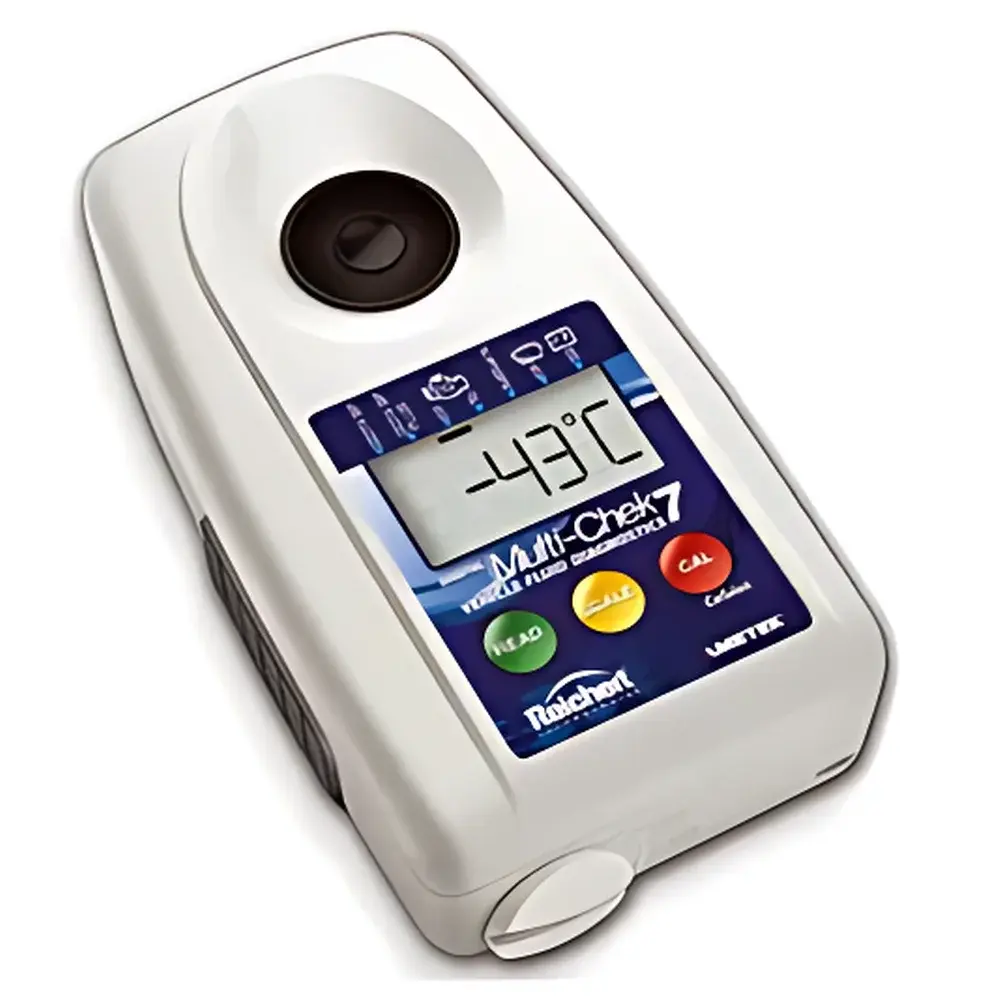
Reichert Multi-Chek7 Automotive Fluid Digital Refractometer
| Brand | Reichert |
|---|---|
| Origin | USA |
| Model | Multi-Chek7 |
| Type | Handheld Digital Refractometer |
| Temperature Control | Yes |
| Digital Display | Yes |
| Measurement Range | Engine Coolant Freeze Point: 0 to –57 °C |
| Coolant Concentration | 0–95% |
| AdBlue/DEF Concentration | 0–50% |
| Windshield Washer Fluid Freeze Point | 0 to –54 °C |
| Battery Electrolyte Specific Gravity | 1.000–1.463 SG |
| DOT4 Brake Fluid Boiling Point | 125–275 °C |
| DOT4 Plus Boiling Point | 150–275 °C |
| Accuracy | ±0.3 °C (freeze point), ±1% (concentration), ±0.1% (AdBlue), ±1% (washer fluid freeze point), ±0.003 SG (electrolyte), ±3 °C (brake fluid boiling point) |
| Dimensions | 54 × 27 × 100 mm |
| Weight | 100 g |
| IP Rating | IP65 |
| Compliance | ASTM D1120, ISO 2808, CE, RoHS, WEEE |
| Power | 2 × AAA batteries (included) |
| Battery Life | >10,000 measurements |
| Auto-off & Sleep Mode | Yes |
| Warranty | 1 year |
Overview
The Reichert Multi-Chek7 Automotive Fluid Digital Refractometer is a purpose-engineered handheld optical instrument designed for rapid, field-deployable analysis of critical vehicle service fluids. It operates on the principle of critical-angle refractometry—measuring the refractive index of transparent or semi-transparent liquids to derive thermophysical and compositional parameters. Unlike generic refractometers, the Multi-Chek7 integrates seven pre-calibrated measurement modes optimized specifically for automotive maintenance workflows, enabling technicians to assess freeze point depression, concentration, specific gravity, and boiling point elevation without laboratory infrastructure. Its optical path is temperature-compensated in real time via an integrated Peltier-assisted thermal sensor, ensuring measurement stability across ambient conditions from –10 °C to +50 °C. The device conforms to ASTM D1120 (coolant freeze point), ISO 2808 (refractive index correlation for glycol-based solutions), and relevant sections of SAE J1087 and ISO 22241 (for AdBlue/DEF verification), supporting compliance-driven service documentation in fleet maintenance and OEM-certified repair networks.
Key Features
- Seven dedicated automotive fluid measurement modes with factory-traceable calibration curves
- Real-time temperature compensation using embedded high-stability thermistor array (±0.1 °C resolution)
- IP65-rated enclosure with rubberized ergonomic grip and removable neck strap for workshop or roadside use
- Backlit LCD display with dual-unit capability (°C/°F toggle) and intuitive single-button mode navigation
- Optical system featuring Abbe-type prism assembly with sapphire-coated measuring surface for scratch resistance and chemical inertness
- Low-power architecture delivering >10,000 measurements per set of AAA batteries, including auto-sleep after 60 seconds of inactivity
- CE-marked, RoHS-compliant, and WEEE-registered—certified for use in EU, North America, and APAC regulatory environments
Sample Compatibility & Compliance
The Multi-Chek7 accepts direct droplet application from standard automotive service containers—no sample dilution, filtration, or pre-conditioning required. Compatible matrices include ethylene glycol/water and propylene glycol/water coolants, aqueous urea solutions (AdBlue/DEF), methanol/isopropanol-based windshield washer fluids, sulfuric acid electrolytes (1.2–1.3 SG range), and polyglycol ether-based DOT4 and DOT4 Plus brake fluids. All calibration algorithms are derived from NIST-traceable reference standards and validated against ASTM D1120 freeze point correlation tables and ISO 22241-3 AdBlue concentration protocols. Device firmware supports audit-ready logging when paired with optional PC interface (USB-C adapter sold separately), meeting GLP-aligned record-keeping requirements for certified service centers operating under ISO 9001 or IATF 16949 quality systems.
Software & Data Management
While the Multi-Chek7 operates as a standalone instrument, its internal memory stores the last 20 measurement sessions—including date/time stamp, selected mode, raw refractive index value, derived result, and ambient temperature. Data export is supported via optional Reichert Connect software (v3.2+), which enables CSV export, PDF report generation with technician ID fields, and batch comparison against OEM specification thresholds (e.g., GM 6277M, Ford WSS-M97B57-A2). The software enforces 21 CFR Part 11–compatible user authentication and electronic signature workflows when configured for regulated environments. Firmware updates are delivered via signed .hex files through authenticated Reichert support portal access, preserving cryptographic integrity of calibration constants.
Applications
- Routine coolant system diagnostics during preventive maintenance inspections
- Verification of DEF concentration prior to SCR system refill to prevent NOx sensor fault codes
- Windshield washer fluid freeze point validation in seasonal cold-climate servicing
- Battery state-of-charge assessment via electrolyte specific gravity in lead-acid starter batteries
- Brake fluid hygroscopic degradation screening through boiling point estimation (per SAE J1703)
- Pre-delivery inspection (PDI) fluid verification for dealership service departments
- Third-party fleet maintenance QA/QC audits requiring traceable, repeatable field measurements
FAQ
Does the Multi-Chek7 require recalibration between uses?
No—factory calibration is retained indefinitely; however, daily verification with distilled water (nD = 1.3330 at 20 °C) is recommended before first use per shift.
Can it measure undiluted brake fluid directly?
Yes—DOT4 and DOT4 Plus modes are calibrated for neat fluid; no dilution is necessary or advised.
Is the prism surface resistant to corrosion from battery acid or brake fluid residues?
Yes—the sapphire-coated borosilicate glass prism resists etching from pH 0–12 solutions and common automotive solvents; cleaning with deionized water and lint-free cloth is sufficient.
How does temperature compensation work during rapid ambient shifts?
A dual-sensor architecture monitors both sample interface temperature and prism bulk temperature, applying dynamic correction coefficients derived from 128-point thermal response mapping.
Is the device suitable for ISO 17025-accredited laboratories?
While designed for field use, its metrological traceability to NIST SRM 1701 (refractive index standards) and documented uncertainty budgets (±0.0002 nD) permit inclusion in accredited scope under Clause 6.4.6 of ISO/IEC 17025:2017.




