
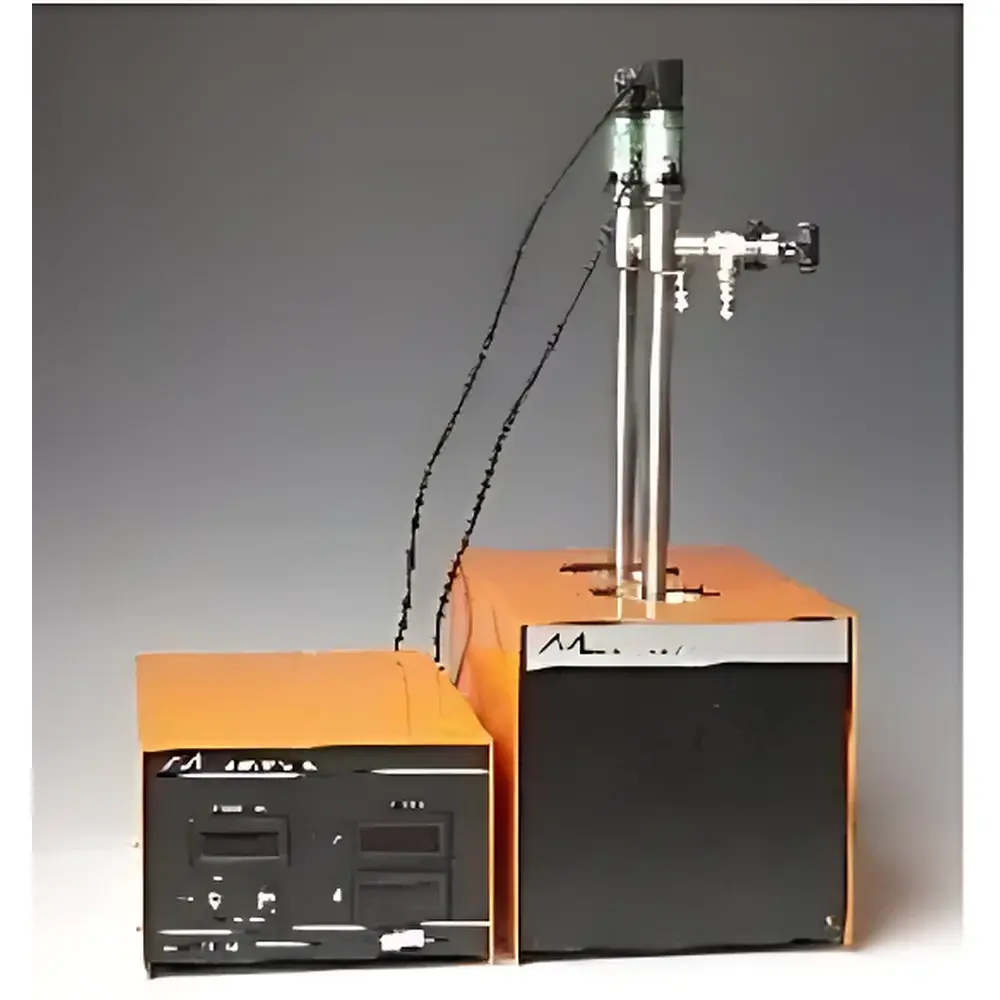
MIKROLAB OXIPRES Oil Oxidation Stability Analyzer
| Brand | MIKROLAB |
|---|---|
| Origin | Denmark |
| Model | OXIPRES |
| Sample Capacity | 100 mL (with ≥5 g fat) |
| Operating Pressure | up to 10 bar (1 MPa) |
| Temperature Range | 30–150 °C |
| Heating Block Max Temp | 150 °C |
| Pressure Sensing | Electronic transducer |
| Output Signal | 1 V FS or 5 V FS |
| Dimensions (2/4/6-sample configurations) | 41 × 30 / 62 × 30 / 83 × 30 cm |
| Footprint | ~600 mm (excl. PC) |
| Power Supply | 230 V / 50 Hz, max. 8 A |
| Software | PARALOG v3 |
| Gas Charging Station | Dual- or hexa-port with safety valve |
| Sample Vessel | 125 mL borosilicate glass jar with sealing lid and O-ring |
Overview
The MIKROLAB OXIPRES Oil Oxidation Stability Analyzer is a precision-engineered instrument designed for the accelerated oxidative stability assessment of lipid-containing matrices using the pressurized oxygen bomb method—also known as the Rancimat principle adapted for high-pressure static conditions. Unlike conventional open-air oxidation tests, the OXIPRES system subjects samples to controlled elevated oxygen partial pressure (up to 10 bar) within sealed, thermostatically regulated reaction vessels. Oxidation kinetics are monitored in real time via continuous electronic pressure transduction: as autoxidation proceeds, molecular oxygen is consumed stoichiometrically, resulting in measurable pressure decay. The inflection point—defined as the induction period (IP)—is determined algorithmically from the first derivative of the pressure-time curve and serves as a quantitative, reproducible metric of oxidative resistance. This principle enables direct correlation with shelf-life prediction and sensory deterioration thresholds, particularly for complex, heterogeneous food and feed products where lipid extraction would introduce bias or analytical loss.
Key Features
- Static high-pressure oxygen chamber design (max. 10 bar), eliminating flow artifacts and enabling true zero-shear oxidation kinetics.
- Modular architecture supporting 2-, 4-, or 6-sample parallel operation via interchangeable heating blocks and pressure vessel arrays.
- Integrated PID temperature control (30–150 °C, ±0.3 °C stability) with rapid thermal equilibration across all sample positions.
- High-accuracy electronic pressure transducers (full-scale output: 1 V or 5 V) calibrated traceably to NIST standards.
- Borosilicate glass reaction vessels (125 mL capacity) with chemically resistant O-ring seals and reusable threaded lids—designed for repeated sterilization and solvent compatibility.
- Dedicated gas charging station with integrated safety relief valve, supporting simultaneous pressurization of up to six vessels under ISO 4126-compliant overpressure protection.
- Compact footprint (<600 mm depth) optimized for benchtop integration in QC laboratories operating under ISO/IEC 17025 or GMP environments.
Sample Compatibility & Compliance
The OXIPRES analyzer accepts intact, non-extracted samples—including solid, semi-solid, and viscous matrices—without requiring lipid isolation. Validated applications span potato chips, margarine, mayonnaise, roasted peanuts, fish meal, infant formula, biscuits, and animal feed pellets. Each test requires only 100 mL of bulk material containing ≥5 g total fat, ensuring representativeness while minimizing preparation bias. Method performance complies with AOCS Cd 12b-92 (for pressurized oxidative stability), EN 14112 (oxidation stability of biodiesel), and supports alignment with FDA 21 CFR Part 11 requirements when used with PARALOG v3’s audit-trail-enabled data acquisition. All hardware components meet CE marking directives for electromagnetic compatibility (2014/30/EU) and low-voltage safety (2014/35/EU).
Software & Data Management
PARALOG v3 software provides full instrument control, real-time visualization of pressure decay curves, automated induction period calculation, and export-ready reporting. The interface supports multi-user login with role-based permissions, electronic signature capture, and time-stamped audit logs compliant with GLP and 21 CFR Part 11 Annex 11. Raw pressure vs. time datasets are stored in vendor-neutral CSV format; derivative analysis (dP/dt) is computed using Savitzky–Golay smoothing to suppress sensor noise without distorting kinetic inflection points. Batch reports include statistical summaries (mean IP, SD, CV%), outlier detection flags, and comparative overlays across multiple formulations or storage conditions.
Applications
- Quantitative evaluation of synthetic (BHA, BHT, TBHQ) and natural (tocopherols, rosemary extract, ascorbyl palmitate) antioxidant efficacy in finished foods and ingredients.
- Stability benchmarking of frying oils across successive thermal cycles under simulated industrial conditions.
- Shelf-life modeling for lipid-rich nutraceuticals and functional foods subjected to ambient or accelerated storage protocols.
- Regulatory dossier support for novel fat sources (e.g., algal oil, insect lipids) under EFSA or FDA GRAS submissions.
- QC release testing of edible oils, shortenings, and dairy analogs per internal specifications aligned with AOCS or ISO 6886.
FAQ
What sample preparation is required prior to OXIPRES analysis?
No lipid extraction is needed. Samples must be homogenized (if heterogeneous) and loaded directly into the 125 mL glass vessel at a volume not exceeding 100 mL and containing ≥5 g total fat.
Can the OXIPRES system be validated for GMP compliance?
Yes—when operated with PARALOG v3 under documented IQ/OQ/PQ protocols, the system meets requirements for computerized system validation per FDA Guidance for Industry (2003) and EU Annex 11.
Is calibration traceable to national standards?
Pressure transducers are factory-calibrated against dead-weight testers certified to ISO/IEC 17025; temperature sensors are verified using NIST-traceable PRTs prior to shipment.
How is oxygen consumption quantified from pressure drop?
Using the ideal gas law (PV = nRT), the system calculates moles of O₂ consumed based on measured ΔP, fixed vessel volume (125 mL), and real-time T compensation—no assumptions about headspace composition are required.
What maintenance intervals are recommended?
O-rings should be inspected and replaced every 200 cycles; glass vessels require visual inspection for etching or microfractures before each use; pressure transducers undergo annual recalibration per ISO 9001 internal procedures.






