
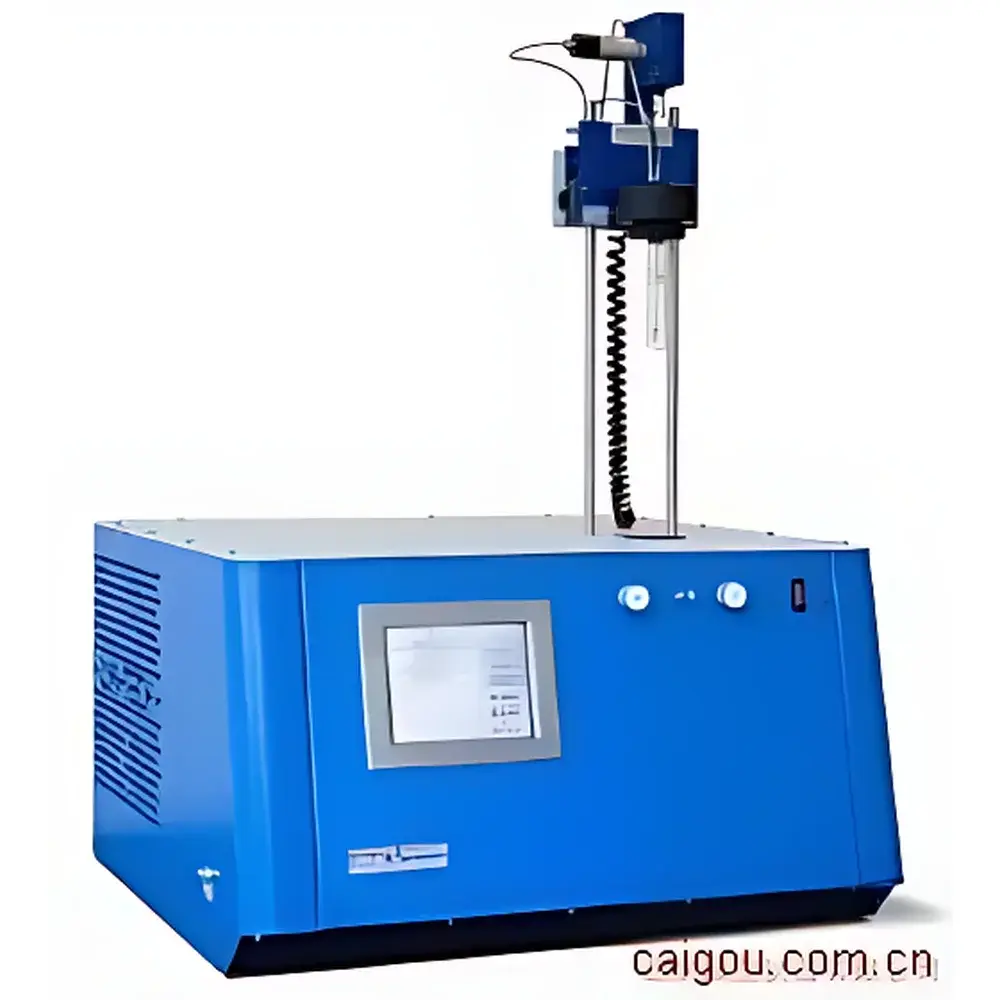
Linetechnic 410 Automatic Petroleum Freeze Point Analyzer
| Brand | Linetechnic |
|---|---|
| Origin | Switzerland |
| Model | 410 |
| Freeze Point Range | +80 °C to –100 °C |
| Temperature Resolution | 0.06 °C |
| Temperature Accuracy | ±0.1 °C |
| Compliance | ASTM D1177, D2386, D5901, D5972, D1655 |
| Measurement Principle | Coaxial pulsed IR spectroscopy with fiber-optic probe and reflective optical path |
Overview
The Linetechnic 410 Automatic Petroleum Freeze Point Analyzer is a precision-engineered instrument designed for the accurate, reproducible determination of the freeze point of hydrocarbon-based fluids in accordance with internationally recognized standard test methods. It operates on the principle of coaxial pulsed infrared (IR) spectroscopy: a fiber-optic probe emits controlled IR pulses into the sample while simultaneously detecting backscattered radiation from the crystallization front. As the sample cools under programmable refrigeration, the onset of solid-phase formation alters the optical signature—detected in real time by the integrated optical path comprising the probe and reflective mirror assembly. This non-contact, optically based detection method eliminates mechanical interference, avoids sample contamination, and ensures high measurement fidelity across the full operational range of +80 °C to –100 °C. The system’s dual-stage (single- or dual-compressor) cryogenic architecture enables stable thermal control at sub-ambient temperatures, critical for evaluating aviation fuels, turbine oils, engine coolants, brake fluids, and antifreeze formulations where low-temperature performance directly impacts safety and operational reliability.
Key Features
- Automated freeze point determination compliant with ASTM D1177, D2386, D5901, D5972, D1655; IP 16, 528, 529, 435; and ISO 3013—fully traceable to reference standards.
- Coaxial fiber-optic IR sensing system with integrated reflective optics for unambiguous crystal nucleation detection without physical contact or stirring artifacts.
- Programmable cooling rate control and multi-step thermal profiling to replicate standardized cooling protocols per method requirements.
- Dual-compressor refrigeration option (NewLab410/2 and variants) extending operational capability to –80 °C and –100 °C with enhanced thermal stability and reduced drift.
- Pressure-regulated refrigerant circuitry for both single- and dual-compressor configurations, ensuring safe, long-term operation under continuous laboratory duty cycles.
- High-resolution temperature monitoring: 0.06 °C resolution with ±0.1 °C absolute accuracy, validated against NIST-traceable references.
- Modular hardware design supporting 1-, 2-, or 3-sample head configurations (e.g., NewLab410/410/2, NewLab410/410/410/2) for throughput scalability in QC/QA environments.
Sample Compatibility & Compliance
The 410 analyzer accommodates a broad spectrum of petroleum-derived and synthetic low-viscosity liquids, including Jet A-1, JP-8, aviation gasoline (AVGAS), turbine fuels, ethylene glycol–based engine coolants, DOT 3/4/5.1 brake fluids, and commercial antifreeze concentrates. Sample volume requirement is 3–5 mL per test, compatible with standard ASTM/IP sample cups. All measurement sequences adhere strictly to the procedural constraints defined in referenced standards—including specified cooling rates, hold times, and visual/optical interpretation criteria. Instrument calibration and verification routines satisfy GLP and GMP documentation requirements, with audit trails supporting FDA 21 CFR Part 11 compliance when deployed with optional electronic signature modules.
Software & Data Management
The embedded OilLab™ software suite provides three functional menus: Analysis (for method selection, run initiation, and real-time curve visualization), Diagnostics (for sensor health checks, refrigerant pressure logging, and optical path integrity verification), and Calibration (for temperature sensor validation using certified reference fluids). Raw spectral and thermal data are stored in vendor-neutral CSV format with timestamped metadata (operator ID, method ID, ambient conditions, instrument serial number). Exported datasets integrate seamlessly with LIMS platforms via configurable ODBC drivers. All user actions—including parameter edits, calibration events, and report generation—are logged with immutable timestamps, fulfilling ALCOA+ data integrity principles.
Applications
- Quality assurance of aviation fuel batches prior to dispatch, verifying conformance to DEF STAN 91-91 and NATO F-34 specifications.
- Development and formulation screening of low-temperature lubricants and heat transfer fluids used in arctic-grade machinery.
- Regulatory testing of automotive brake fluids per SAE J1703 and ISO 4925.
- Stability assessment of biofuel blends exposed to seasonal temperature extremes.
- Root-cause analysis of filter plugging incidents linked to wax crystallization onset in diesel distillates.
- Supporting ASTM round-robin interlaboratory studies requiring method-equivalent instrumentation.
FAQ
What standards does the Linetechnic 410 fully support?
ASTM D1177, D2386, D5901, D5972, D1655; IP 16, 528, 529, 435; and ISO 3013—all implemented with hardware and software logic aligned to clause-specific procedural requirements.
Can the instrument measure below –80 °C?
Yes—the NewLab410/2 configuration with dual-compressor refrigeration achieves stable operation down to –100 °C, validated per ASTM D5901 Annex A1 for ultra-low-temperature aviation fuels.
Is optical calibration required between tests?
No. The coaxial IR probe is factory-aligned and drift-compensated via internal reference channels; only periodic verification with certified freeze-point standards (e.g., n-decane, iso-octane) is recommended per ISO/IEC 17025.
How is data integrity ensured during regulatory audits?
All measurements include embedded digital signatures, version-controlled method files, and tamper-evident audit logs—configurable to meet 21 CFR Part 11 Subpart B requirements for electronic records.
What maintenance intervals are recommended for compressor systems?
Single-compressor units require annual refrigerant pressure verification and oil inspection; dual-compressor variants follow a 6-month preventive maintenance schedule per Linetechnic Technical Bulletin TB-410-REV3.





