
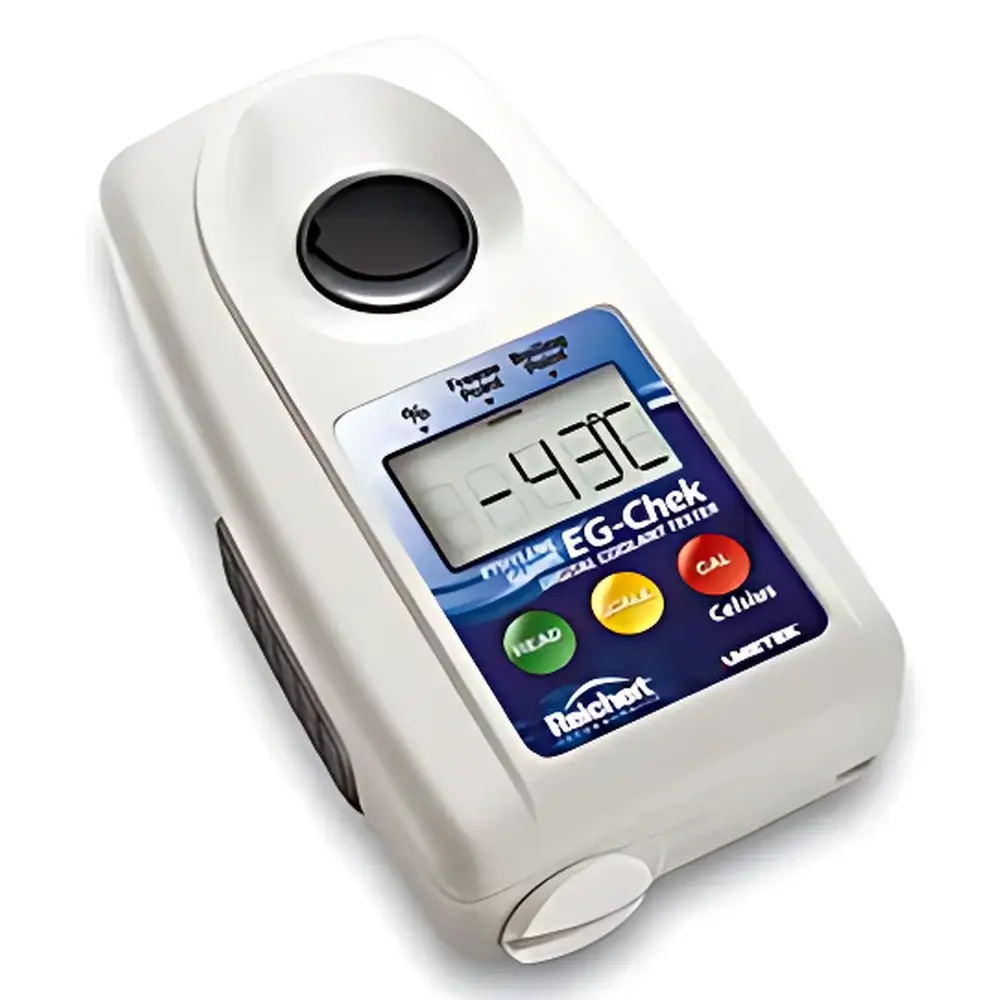
Reichert EG-Chek Digital Ethylene Glycol Coolant Refractometer
| Brand | Reichert |
|---|---|
| Origin | USA |
| Model | EG-Chek |
| Product Type | Handheld Digital Refractometer |
| Temperature Control | Yes (ATC) |
| Digital Display | Yes |
| Measurement Range | 0–95% EG concentration, −57 °C to +57 °C ice point, 117–180 °C boiling point |
| Accuracy | ±0.2% EG concentration, ±0.6 °C for temperature parameters |
| Light Source | 589 nm LED |
| Dimensions | 54 × 27 × 100 mm |
| Weight | 100 g |
| Power | 2 × AAA batteries (included) |
| Battery Life | ~10,000 measurements |
| Auto-off & Sleep Mode | Yes |
| IP Rating | IP65 |
| Compliance | CE, RoHS, WEEE |
| Warranty | 1 year |
Overview
The Reichert EG-Chek Digital Ethylene Glycol Coolant Refractometer is an optical measurement instrument engineered for precision quantification of ethylene glycol (EG)-based coolant solutions in automotive, HVAC, industrial engine, and power generation applications. It operates on the principle of critical-angle refractometry, where the refractive index of a liquid sample—correlated to its EG mass fraction—is measured via total internal reflection at the prism–sample interface. Unlike hydrometers or test strips, which suffer from operator dependency and limited resolution, the EG-Chek delivers traceable, repeatable results by integrating a stabilized 589 nm sodium-D-line-equivalent LED source and high-precision sapphire prism optics. Its built-in Automatic Temperature Compensation (ATC) system maintains calibration integrity across ambient conditions from 10 °C to 40 °C, ensuring accurate conversion of refractive index to % EG, freezing point (°C), and boiling point (°C) without manual correction.
Key Features
- Dual-parameter output: Simultaneous digital display of EG concentration (% w/w), freezing point (°C), and boiling point (°C) — all derived from a single 0.3 mL sample measurement.
- True ATC architecture: Compensates for thermal drift using integrated thermistor feedback, referenced to 20 °C standard, meeting ASTM D1120 and ISO 2859-1 sampling consistency requirements.
- Ruggedized handheld design: IP65-rated enclosure with rubberized grip, removable neck strap, and sealed optical path ensures reliable field use in workshops, service bays, and outdoor maintenance environments.
- Low-power, high-reliability operation: Powered by two AAA batteries (supplied), supporting >10,000 measurements with intelligent sleep mode and auto-shutdown after 90 seconds of inactivity.
- Factory-calibrated optical train: Sapphire prism surface, scratch-resistant and chemically inert to glycol–water mixtures, ethanol, and common corrosion inhibitors; zero user recalibration required under normal operating conditions.
Sample Compatibility & Compliance
The EG-Chek is validated for aqueous ethylene glycol solutions containing up to 95% EG by weight, including formulations with standard corrosion inhibitors (e.g., silicates, phosphates, azoles) and low-conductivity additives typical in OEM-specified coolants (e.g., GM Dex-Cool®, Ford WSS-M97B57-A, Toyota SLLC). It is not intended for propylene glycol (PG), methanol, or non-aqueous heat transfer fluids. The instrument conforms to EU regulatory frameworks: CE marking per Directive 2014/30/EU (EMC), 2011/65/EU (RoHS), and 2012/19/EU (WEEE). Its measurement methodology aligns with technical validation protocols used in ISO/IEC 17025-accredited laboratories for routine coolant verification in preventive maintenance programs.
Software & Data Management
As a standalone optical instrument, the EG-Chek does not feature Bluetooth, USB, or PC connectivity. All data are displayed in real time on its high-contrast LCD screen and retained only during active measurement. However, its deterministic output format supports manual entry into LIMS or CMMS platforms (e.g., SAP PM, Fiix, UpKeep) for audit-trail documentation. For regulated environments requiring electronic records, users may pair the device with external digital loggers compliant with FDA 21 CFR Part 11 — though the EG-Chek itself does not implement electronic signature or audit trail functionality. Its ATC stability and repeatability (±0.2% EG over 50 consecutive readings) support GLP-aligned operational qualification (OQ) protocols.
Applications
- Automotive service centers: Rapid verification of coolant freeze protection before winter deployment or post-flush validation.
- Fleet maintenance depots: Batch screening of coolant condition across diesel engine radiators, auxiliary power units (APUs), and electric vehicle battery thermal management systems.
- HVAC contractor operations: Ensuring proper glycol concentration in chilled water loops and snow-melt systems to prevent pipe freeze damage.
- Industrial OEM quality control: Incoming inspection of pre-mixed coolants against specification sheets (e.g., ASTM D3306, JIS K2234).
- Technical training labs: Demonstrating colligative property relationships — freezing point depression and boiling point elevation — as functions of solute concentration.
FAQ
Does the EG-Chek require periodic recalibration?
No. The optical system is factory-calibrated using NIST-traceable standards. Only verification with distilled water (expected reading: 0.0% EG, 0.0 °C ice point) is recommended before each shift or after exposure to extreme temperatures.
Can it measure propylene glycol (PG) concentrations?
No. The EG-Chek’s calibration curve and algorithm are specific to ethylene glycol–water binary systems. PG exhibits different refractive index–concentration behavior and requires a dedicated PG refractometer.
Is the prism resistant to coolant additives and cleaners?
Yes. The sapphire prism (Mohs hardness 9) resists abrasion from particulate contaminants and is chemically stable against common coolant corrosion inhibitors, organic acids, and pH-neutral cleaning agents.
What is the minimum sample volume required?
A single drop (~0.3 mL) fully covers the prism surface. Excess fluid is contained by the integrated sample well to prevent overflow onto electronics.
How does ATC affect measurement uncertainty?
ATC reduces temperature-induced error to <±0.1 °C equivalent across the 10–40 °C ambient range, contributing less than 0.05% to overall concentration uncertainty — well within the stated ±0.2% accuracy specification.




