
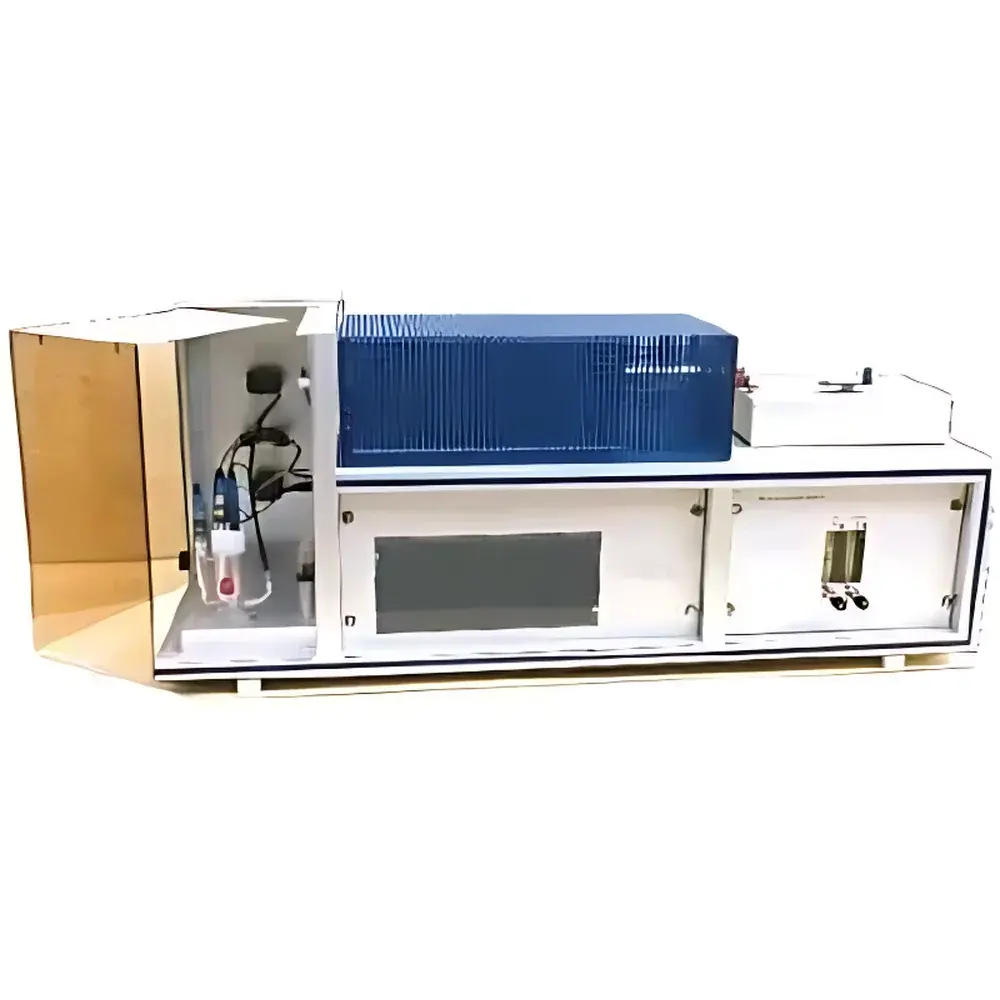
MIPO5 AOX Halogen Analyzer
| Origin | France |
|---|---|
| Manufacturer Type | Authorized Distributor |
| Origin Category | Imported |
| Model | MIPO5 |
| Pricing | Upon Request |
Overview
The MIPO5 AOX Halogen Analyzer is a fully automated, microcoulometric combustion-titration system engineered for the precise quantification of adsorbable organic halogens (AOX), as well as total organic chlorine (TOX), total organic bromine (TOBr), and total organic iodine (TOI) in solid, liquid, and gaseous matrices. Based on the ASTM D4929-99, ISO 9562, NF EN 1485, and GB/T 15959–1995 standardized methodologies, the instrument employs high-temperature oxidative combustion followed by electrochemical microcoulometric titration using silver ion generation. Sample introduction occurs under controlled inert or oxygen-rich atmospheres, ensuring complete mineralization of organohalogen compounds into halide ions (Cl⁻, Br⁻, I⁻), which are subsequently quantified via coulometric detection with Ag⁺ electrolysis at a silver indicator electrode and HgS reference electrode. The system delivers trace-level sensitivity (50% w/w), without manual reagent standardization or calibration solution preparation — eliminating operator-induced drift and enhancing method robustness across heterogeneous sample types.
Key Features
- Microcoulometric detection principle compliant with ISO 9562 and ASTM D4929-99 for AOX, POX (purgeable organic halogens), and EOX (extractable organic halogens)
- Dual-furnace combustion architecture: F1 programmable furnace (up to 1000 °C, He/O₂ configurable) and F2 fixed-temperature furnace (1000 °C), enabling complete oxidation of refractory organohalogens in complex matrices
- Integrated quartz combustion tube and oxygen injection manifold ensure stoichiometric oxidation and minimal carryover
- Single-cell coulometric titration cell with Ag/Ag⁺ generator electrode and HgS reference electrode for high reproducibility and low baseline noise
- Auto-regeneration of Ag⁺ electrolyte and automatic sulfuric acid adsorbent replacement during analysis cycle
- Variable sample introduction: syringe-based liquid injection (programmable flow rate), solid sampling via quartz boat, and optional gas sampling module
- No external calibration standards required — absolute quantification based on Faraday’s law of electrolysis
- Analysis time: 3–15 minutes per sample, dependent on halogen content and matrix complexity
- Sample mass range: 100 µg to 500 mg; compatible with volatile liquids, viscous oils, solids (e.g., coal, cement, plant tissue), and gases (LPG, ethylene, propylene)
Sample Compatibility & Compliance
The MIPO5 supports broad-spectrum regulatory and research applications across environmental, petrochemical, pharmaceutical, and industrial quality control laboratories. It meets full compliance requirements for AOX determination in wastewater, leachates, and sludge per ISO 9562 and EPA Method 1650 (adapted). For solid waste characterization, it satisfies EN 1485 (waste water and sludge) and ASTM D4929-99 (petroleum products and organic chemicals). The system is routinely deployed in GLP-compliant environments and supports audit-ready data handling aligned with FDA 21 CFR Part 11 when integrated with validated LIMS interfaces. Certified reference materials (CRMs) for AOX (e.g., NIST SRM 2781, 2782) are routinely used for performance verification. Precision meets ISO-defined repeatability criteria: ≤0.5% RSD at concentrations >1000 ppm Cl⁻; ≤10% RSD at 5 ppm Cl⁻. Detection limit is ≤1 µg Cl⁻ (±10%) per analysis — satisfying the minimum sensitivity requirement of all referenced standards.
Software & Data Management
The MIPO5 operates via dedicated Windows-based acquisition and control software featuring real-time coulometric current monitoring, automatic endpoint detection, and integrated calculation of AOX concentration (µg Cl/g or mg Cl/L) using user-defined sample mass/volume and dilution factors. All raw current-time integrals, furnace temperature profiles, and titration curves are stored with timestamped metadata. Software supports export to CSV, PDF, and XML formats, and includes built-in reporting templates compliant with ISO/IEC 17025 documentation requirements. Audit trail functionality logs all method changes, operator logins, and result modifications. Optional integration with laboratory information management systems (LIMS) enables automated data transfer and electronic signature workflows conforming to 21 CFR Part 11 Annex 11 requirements.
Applications
- Environmental monitoring: AOX in wastewater effluents, landfill leachate, drinking water, and sediment
- Petrochemical QA/QC: Chlorine speciation in naphtha, gasoline, kerosene, crude oil, catalysts, and refinery process streams
- Chemical manufacturing: Halogen impurity screening in high-purity solvents (methanol, toluene, benzene), polymers (polycarbonate, acetate), and intermediates
- Energy sector: Total halogen analysis in coal, coke, cement, and biomass feedstocks
- Automotive & aerospace: Halogen content in hydraulic fluids, motor oils, lubricants, and composite resins
- Pharmaceutical excipients: Residual halogen testing per ICH Q3D guidelines
- Research: Adsorption kinetics studies using activated carbon columns, batch reactors, or stirred-tank systems (with optional AOX adsorption accessories)
FAQ
Does the MIPO5 require daily recalibration with standard solutions?
No. The microcoulometric principle relies on Faraday’s law; quantification is absolute and independent of external calibration standards.
Can the MIPO5 analyze gaseous samples such as LPG or ethylene?
Yes — with the optional gas sampling module, which integrates thermal desorption and carrier-gas-assisted introduction into the combustion zone.
What is the typical detection limit for AOX expressed as chlorine?
The system achieves a minimum detectable mass of 1 µg Cl⁻ per analysis, corresponding to sub-ppm concentrations depending on sample mass and dilution.
Is the instrument suitable for GLP or GMP-regulated laboratories?
Yes — when operated with validated software, electronic signatures, and full audit trail enabled, it meets core requirements for regulated environments.
How is carryover minimized between high- and low-level samples?
The system features automated post-analysis cleaning cycles, high-temperature furnace purging, and replaceable sulfuric acid adsorbent cartridges — all managed autonomously by firmware.




