
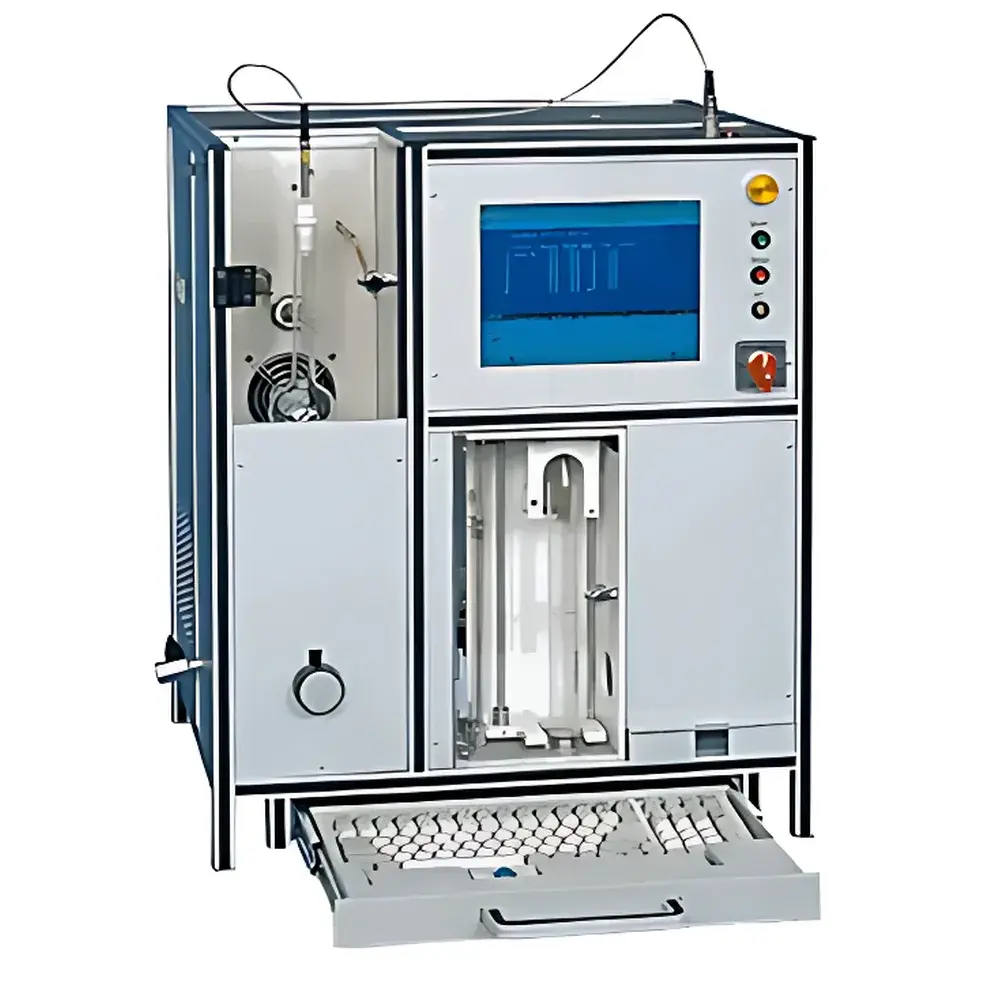
English Product Name
| Origin | Germany |
|---|---|
| Type | Automated Distillation Apparatus |
| Model | 3025 |
| Temperature Range | 0–420 °C |
| Volume Resolution | 0.01 mL |
| Distillation Rate Programmable | 2–15 mL/min |
| Compliance | ASTM D86, D850, D1078, D2892 |
| Receiver Chamber Heating | up to 60 °C |
| Safety Systems | Integrated N₂ fire suppression, optical level detection, real-time diagnostics |
| Software | LIMS-integrated, GLP-compliant data logging, ASTM repeatability/reproducibility calculation |
| Network Capacity | Up to 32 units via Ethernet |
| Power Supply | 230 V, 50/60 Hz, 10 A |
| Dimensions (L×W×H) | 53.3 × 54.6 × 70.5 cm |
| Net Weight | 91 kg |
Overview
The GERMANY-IMPORTED 3025 Automated Petroleum Distillation Apparatus is a fully integrated, microprocessor-controlled distillation system engineered for precise determination of boiling point distributions in volatile petroleum products and hydrocarbon-based liquids. It operates on the principle of standardized atmospheric distillation—where a representative sample is heated under strictly regulated conditions, vaporized progressively, condensed, and collected in calibrated receivers while continuously monitoring both temperature and recovered volume. This methodology directly supports quantitative characterization of key distillation parameters including Initial Boiling Point (IBP), Final Boiling Point (FBP), Dry Point, and percent recovery at defined temperatures—critical metrics for fuel blending, refinery process control, and regulatory compliance. Designed for full conformance with ASTM D86 (standard test method for distillation of petroleum products at atmospheric pressure), as well as complementary methods such as ASTM D850 (solvents), D1078 (volatility of volatile liquids), D2892 (detailed hydrocarbon analysis), ISO 3405, DIN 51751, and IP 123, the 3025 delivers traceable, auditable results suitable for ISO/IEC 17025-accredited laboratories and GMP-regulated environments.
Key Features
- High-precision Pt-100 RTD temperature sensors (±0.01 °C accuracy) installed at critical thermal nodes: distillation flask vapor space, condenser jacket, and receiver chamber—ensuring metrological equivalence to mercury-in-glass thermometers per ASTM requirements.
- Programmable distillation rate control (2–15 mL/min in 0.5 mL/min increments) via PID-regulated 24 VAC heating elements, enabling reproducible ramp profiles across ASTM Distillation Classes 0 through 4.
- Zero-fluorocarbon (non-CFC/non-HFC) refrigeration and heating architecture allows rapid thermal transitions—reducing cooldown time between runs by >40% versus conventional systems and minimizing inter-run carryover risk.
- Optical meniscus detection system with convex-position sensing provides continuous, contactless volumetric tracking at 0.01 mL resolution, eliminating mechanical float errors and supporting automated endpoint detection—including Dry Point identification per ASTM D850/D1078.
- Dual-mode receiver heating (ambient to 60 °C) prevents wax precipitation or condensate solidification during analysis of heavy naphthas, kerosenes, and paraffinic distillates.
- Integrated nitrogen-based automatic fire suppression system with manual override and optical flame detection—fully compliant with laboratory safety protocols and NFPA 45 requirements.
- Real-time embedded diagnostics monitor heater integrity, coolant flow, sensor continuity, door interlocks, and pressure stability—logging fault codes and initiating safe shutdown sequences before hazardous conditions develop.
Sample Compatibility & Compliance
The 3025 accommodates a broad spectrum of petroleum-derived and organic volatile samples, including gasoline, jet fuel (Jet A-1, JP-8), diesel, naphtha, light cycle oil, aromatic solvents (e.g., xylene, toluene), crude fractions, and synthetic hydrocarbons. Its modular design supports all ASTM-defined distillation classes (0–4) using standardized 125 mL distillation flasks and interchangeable heating plates (32 mm, 37.5 mm, and 50 mm diameters). All measurements are traceable to NIST-certified reference materials, and software enforces mandatory calibration verification per ASTM D86-23 Annex A1. Data integrity meets FDA 21 CFR Part 11 requirements through electronic signatures, audit trails, role-based access control, and immutable raw-data archiving. Full compliance documentation—including Declaration of Conformity, EC Type Examination Certificate, and ISO 17025 validation support files—is supplied with each unit.
Software & Data Management
The instrument is controlled via its embedded Windows-based operating system (3025PC variant includes touchscreen interface, keyboard, and mouse) or remotely via LAN-connected workstations. The proprietary distillation software provides: real-time graphical display of temperature vs. volume curves (with optional barometric correction and residue adjustment), dynamic calculation of IBP/FBP/Dry Point, automated generation of ASTM-compliant reports (including precision statements per D86-23 Section 13), statistical evaluation of repeatability (r) and reproducibility (R), and direct export to LIMS via ASTM E1384-compliant ASCII or XML formats. Method templates for D86, D850, D1078, and D2892 are preloaded; users may create, save, and password-protect custom protocols. All raw sensor data—including time-stamped temperature, volume, power input, and diagnostic flags—is stored locally and synchronized to network drives with configurable retention policies aligned with GLP record-keeping mandates.
Applications
This apparatus serves as a primary quality assurance tool across upstream, midstream, and downstream petroleum operations. In refineries, it verifies cut-point accuracy for fractionation columns and ensures product specifications meet API gravity, volatility, and driveability indices (e.g., RVP, TVP). In fuel testing labs, it supports certification for ASTM D439 (gasoline), D1655 (jet fuel), and D975 (diesel). For lubricant and specialty chemical manufacturers, it characterizes solvent volatility, flash point correlation, and compositional homogeneity. Research applications include kinetic modeling of distillation behavior, development of surrogate fuel blends, and validation of GC×GC or simulated distillation (SimDis) correlations. Its robustness, low maintenance burden, and quiet operation (<55 dBA) make it suitable for high-throughput QC labs, contract testing facilities, and university research centers requiring ISO 17025-compliant distillation data.
FAQ
Does the 3025 support ASTM D2892 (detailed hydrocarbon analysis)?
Yes—the system’s extended temperature range (0–420 °C), programmable slow-rate distillation mode (2 mL/min), and high-resolution volume detection enable full execution of D2892’s multi-stage vacuum-assisted procedure when paired with optional vacuum accessories.
Can dry point be determined automatically without additional hardware?
The standard configuration includes an integrated dry point detection board with optical endpoint recognition; however, ASTM D850/D1078-compliant dry point confirmation requires optional accessories: a dedicated dry point thermocouple, 200 mL flask, and PTFE stopper.
Is remote monitoring and multi-instrument fleet management supported?
Yes—up to 32 units can be centrally managed over standard Ethernet using the included network server module, with synchronized method deployment, real-time status dashboards, and consolidated audit trail aggregation.
What calibration standards are required for routine verification?
No external calibration equipment is needed—the system performs automatic temperature and volume zero/span checks using built-in references. Annual verification against NIST-traceable standards (e.g., mercury thermometer, certified volumetric pipettes) is recommended per ISO/IEC 17025 Clause 6.6.
How does the non-CFC cooling system impact environmental compliance?
The fluorocarbon-free refrigeration circuit eliminates ozone-depleting substances and high-GWP refrigerants, ensuring full alignment with EU F-Gas Regulation (EU) No 517/2014 and U.S. EPA SNAP program requirements for laboratory instrumentation.






