
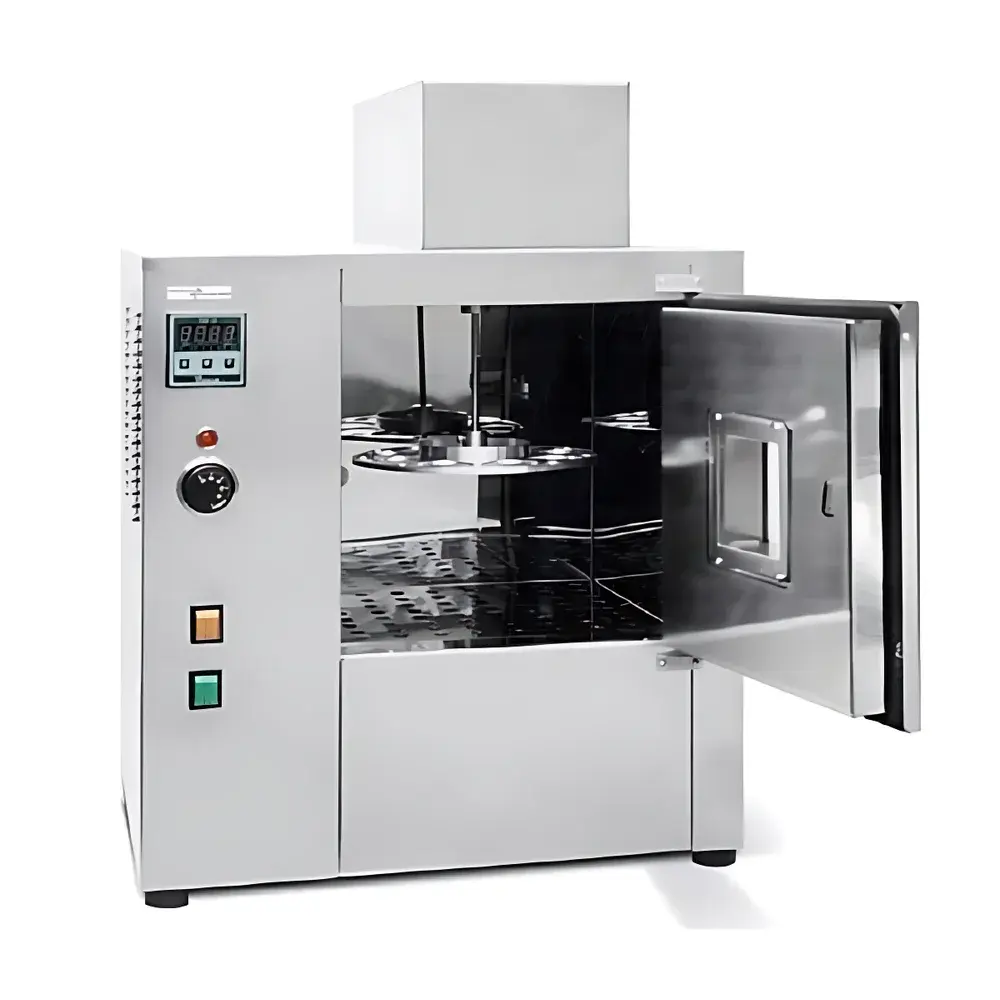
ASTM D6 Compliant 256000/M Bitumen Heating Loss Tester (Imported from Switzerland)
| Origin | Switzerland |
|---|---|
| Manufacturer Type | Authorized Distributor |
| Origin Category | Imported |
| Model | 256000/M, ASTM D6 |
| Power Supply | 220 V / 50 Hz, 2000 W |
| Temperature Range | Ambient to 180 °C ± 1 °C |
| Temperature Control Accuracy | ±0.1 °C (PID + Pt100 RTD) |
| Rotational Speed | 5.5 rpm (adjustable 5–6 rpm) |
| Internal Chamber Dimensions | 60 × 80 × 80 cm (W × H × D) |
| Net Weight | ~30 kg |
| Safety Certification | CE |
| Compliance Standards | ASTM D6, ASTM D1754, IP 145 |
Overview
The ASTM D6 Compliant 256000/M Bitumen Heating Loss Tester is a precision-engineered laboratory instrument designed for quantitative determination of volatile loss in semi-solid bituminous materials under controlled thermal and rotational conditions. Based on the gravimetric principle defined in ASTM D6 “Standard Test Method for Loss on Heating of Asphalt Cement”, this system measures mass reduction following standardized exposure to elevated temperature (up to 180 °C) over a fixed duration (typically 5 hours), while maintaining uniform sample agitation via constant-speed rotation. Its operational architecture integrates natural-convection heating, PID-regulated thermal stability, and mechanically synchronized sample rotation—ensuring high reproducibility across repeated determinations. The instrument serves as a core tool for quality assurance laboratories in asphalt production, road construction material certification, and regulatory compliance testing per international specifications including ASTM, IP, and EN standards.
Key Features
- Natural-convection oven with double-glazed, insulated dual-door design for real-time visual monitoring without thermal disruption
- Stainless-steel interior chamber (60 × 80 × 80 cm) with integrated cooling fan and high-efficiency thermal insulation for uniform temperature distribution and minimal energy drift
- Electronically driven, gear-reduced motor (¼ HP) delivering precise 5.5 rpm rotation (adjustable within 5–6 rpm range) to ensure consistent sample exposure during heating
- Electroplated aluminum rotating rack (Ø300 mm), centrally suspended via vertical support rod, accommodating two standard copper sample pans (ASTM D6-compliant geometry)
- Microprocessor-based PID temperature controller with digital display, Pt100 RTD sensor (Class A), and ±0.1 °C setpoint accuracy across ambient to 180 °C range
- Dedicated ASTM 13C thermometer (range +155 to +170 °C) mounted directly on the rotating shaft for in-situ reference measurement
- Overtemperature cut-off protection circuitry and CE-marked electrical safety architecture compliant with IEC 61010-1
- English-language user interface, front-panel controls, and comprehensive English operating manual included
Sample Compatibility & Compliance
This tester is validated for use with penetration-grade and viscosity-grade bitumens, oxidized bitumens, and modified bituminous binders meeting ASTM D946, D3381, and EN 13924 specifications. Sample containers are supplied as ASTM D6–compliant copper pans (LAB-102-562), ensuring dimensional and thermal mass consistency required for regulatory acceptance. The system fully satisfies test condition requirements outlined in ASTM D6 (loss on heating), ASTM D1754 (heating stability of asphaltic materials), and IP 145 (determination of loss on heating of bituminous binders). All thermal and rotational parameters are traceable to NIST-traceable references, supporting GLP-compliant documentation workflows and audit readiness for ISO/IEC 17025-accredited laboratories.
Software & Data Management
While the 256000/M operates as a stand-alone analog-digital hybrid instrument, its control electronics support optional integration with external data acquisition systems via analog voltage output (0–10 V) for temperature and rotation status signals. The built-in PID controller logs setpoint deviations and maintains stable thermal profiles without software dependency—reducing validation overhead in regulated environments. For laboratories requiring electronic records, optional accessories include LAB-160-015 digital temperature regulator (with RS-232 output) and LAB-140-001/A Pt100 probe for redundant monitoring. All configurations comply with FDA 21 CFR Part 11 principles when paired with validated LIMS or ELN platforms, enabling secure audit trails, user access control, and electronic signature capability.
Applications
- Quality control of asphalt cements prior to refinery dispatch or paving operations
- Evaluation of thermal stability in polymer-modified bitumens (PMBs) and crumb rubber–modified binders
- Research into volatilization kinetics and oxidative aging behavior under simulated storage conditions
- Supporting compliance with national highway agency specifications (e.g., AASHTO M20, EN 1426, JIS K 2207)
- Calibration verification of automated bitumen aging simulators (e.g., RTFOT, PAV)
- Comparative assessment of binder formulations for low-emission pavement technologies
FAQ
What standards does this instrument directly support?
ASTM D6, ASTM D1754, and IP 145 are fully implemented through hardware configuration, thermal profile validation, and sample handling geometry.
Is the rotation speed adjustable beyond 5.5 rpm?
Yes—the drive system permits fine-tuning between 5 and 6 rpm; however, 5.5 rpm is the nominal setting specified in ASTM D6 for routine testing.
Can the unit be operated continuously for extended periods?
Designed for 5-hour test cycles per ASTM D6, continuous operation beyond 8 hours requires periodic thermal stabilization checks and adherence to manufacturer-recommended duty cycles.
Are replacement parts available globally?
All critical components—including copper pans (LAB-102-562), ASTM 13C thermometers (T-AS13C), and Pt100 probes (LAB-140-001/A)—are stocked by authorized distributors in North America, EMEA, and APAC regions.
Does the system meet GLP or GMP documentation requirements?
As a stand-alone instrument, it supports GLP practices via manual logbook entries; for full GMP alignment, pairing with validated digital regulators and audit-trail-capable software is recommended.
Related Products





