
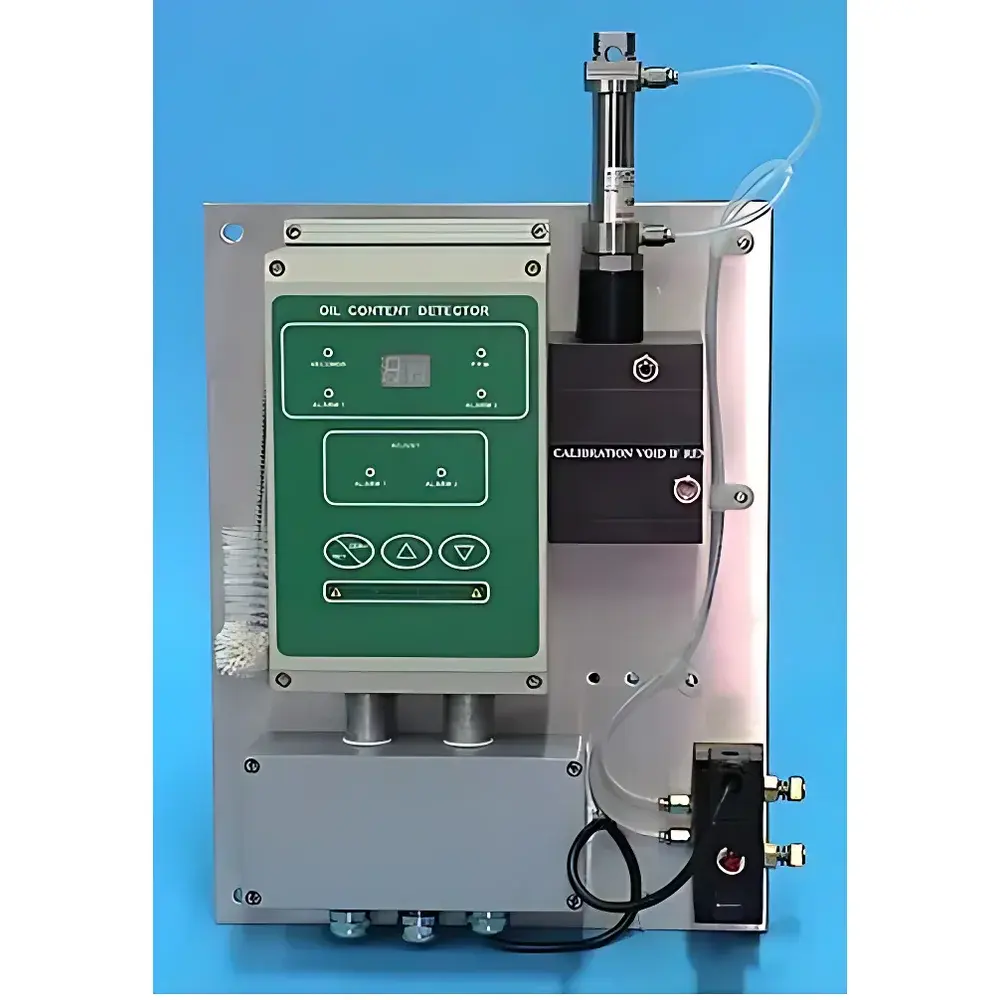
Rivertrace CW Series Online Industrial Wastewater Oil-in-Water Monitor
| Brand | Rivertrace |
|---|---|
| Origin | United Kingdom |
| Model | CW Series |
| Measurement Range | 0–99 ppm |
| Accuracy | ±5 ppm |
| Display | Dual-line 7-segment LED |
| Alarm Setpoints | Adjustable (1–98 ppm) |
| Alarm Delay | Alarm 1: 0–60 s |
| Alarm 2 | 10–240 s |
| Alarm Output | 8 A @ 240 V (inductive) |
| Analog Outputs | 0–20 mA / 4–20 mA (min. load 820 Ω) |
| Ambient Temperature | 1–50 °C |
| Relative Humidity | ≤90% RH (up to +55 °C) |
| Sample Temperature | 1–50 °C |
| Sample Flow Rate | 0.1–2 L/min |
| Sample Pressure | 0.1–10 bar |
| Dimensions (W×D×H) | 215 × 242 × 73 mm |
| Weight | 2.25 kg |
| Power Supply | 230 V/50 Hz or 24 V AC |
| Power Consumption | 10 VA |
| Electrical Safety | EN 61010-1 / IEC 61000-6-4 / IEC 61000-6-2 |
| Certification | Germanischer Lloyd (GL) Type Approved |
| Optical Components | High-temperature resistant fused silica windows & fluorosilicone seals |
| Wetted Materials | Optional 316 stainless steel probe, flow cell, and sample chamber |
| Auto-cleaning | Integrated ultrasonic or mechanical cleaning module (configurable) |
Overview
The Rivertrace CW Series Online Industrial Wastewater Oil-in-Water Monitor is an optical absorption-based analyser engineered for continuous, real-time quantification of hydrocarbon oil concentrations in aqueous industrial effluents and process streams. Operating on the principle of UV-Vis absorbance at characteristic wavelengths (typically 225–254 nm), the instrument detects dissolved and emulsified hydrocarbons—including mineral oils, lubricants, diesel, and synthetic esters—without requiring solvent extraction or reagents. Its design conforms to the physical measurement paradigm defined in ISO 9377-2 (Water quality — Determination of hydrocarbon oil index — Part 2: Infrared spectrometry method) and aligns with performance expectations outlined in ASTM D7622 and EPA Method 1664B for screening-level oil-in-water monitoring. The CW system delivers stable baseline performance across variable matrix conditions typical of boiler cooling water circuits, machine tool coolant systems, and freshwater influent channels—particularly when integrated with optional thermostatic cooling modules for elevated-temperature applications.
Key Features
- Optical path integrity maintained by high-purity fused silica windows and fluorosilicone gasketing, rated for continuous exposure up to 50 °C sample temperature
- Configurable wetted materials: standard borosilicate flow cell with optional 316 stainless steel probe, sample chamber, and inlet/outlet fittings for aggressive or abrasive media
- Integrated auto-cleaning mechanism—either ultrasonically actuated or mechanically swept—to mitigate fouling from biofilm, suspended solids, or viscous oil films
- Dual independent alarm outputs with fully adjustable setpoints (1–98 ppm) and programmable time delays (Alarm 1: 0–60 s; Alarm 2: 10–240 s), supporting fail-safe shutdown protocols and maintenance scheduling
- Multi-format analog outputs compliant with industrial control system standards: isolated 4–20 mA (min. 820 Ω load), 0–5 V, and 1–5 V (min. 50 kΩ load)
- Robust electrical architecture certified to EN 61010-1 (Safety Requirements for Electrical Equipment for Measurement, Control, and Laboratory Use) and EMC-compliant per IEC 61000-6-2/6-4
- GL Type Approval confirms suitability for marine and offshore wastewater monitoring applications under rigorous vibration, humidity, and corrosion testing regimes
Sample Compatibility & Compliance
The CW monitor accommodates a broad range of aqueous matrices including recirculating cooling water, machining coolant emulsions, surface water (rivers, lakes), and pre-treated industrial discharge streams. It maintains measurement stability across turbidities up to 100 NTU and suspended solids concentrations ≤100 mg/L, provided optical windows remain clean. Sample introduction requires laminar, bubble-free flow within 0.1–2 L/min at pressures between 0.1–10 bar—achievable via integrated peristaltic pump or pressurised loop integration. The system meets functional requirements for GL-certified ballast water treatment verification and supports audit-ready operation under ISO 17025-accredited laboratories when paired with documented calibration procedures using NIST-traceable mineral oil standards (e.g., hexadecane in deionised water). While not a replacement for laboratory GC-FID analysis per USP , it provides validated trending data for early leak detection and regulatory compliance screening.
Software & Data Management
Local configuration and diagnostics are managed via front-panel keypad navigation and dual-line 7-segment LED display. For networked deployment, optional RS-485 Modbus RTU interface enables integration into SCADA, DCS, or cloud-based IIoT platforms (e.g., Siemens Desigo CC, Honeywell Experion, or Azure IoT Edge). All alarm events, calibration timestamps, and diagnostic logs—including window transmittance decay rates and cleaning cycle execution—are timestamped and stored internally for ≥30 days. Data export follows CSV-compatible formatting, facilitating traceability during GL or ISO 14001 environmental management system audits. Firmware updates are performed via secure USB interface with SHA-256 signature verification, ensuring integrity in regulated environments.
Applications
- Early detection of heat exchanger tube leakage in boiler feedwater and condensate return lines
- Real-time monitoring of tramp oil accumulation in CNC machine coolant sumps to extend fluid life and reduce disposal frequency
- Compliance verification for local discharge permits (e.g., UK Environmental Permitting Regulations, EU Urban Wastewater Treatment Directive Annex I)
- Performance validation of oil-water separators and coalescing filters in metalworking and power generation facilities
- Baseline trending for freshwater intake protection in combined heat and power (CHP) plants and district heating networks
FAQ
Does the CW monitor require routine calibration with certified standards?
Yes—initial factory calibration is traceable to NIST SRM 2721a. Field recalibration is recommended every 90 days using Rivertrace-certified mineral oil reference solutions (0, 10, 50, and 90 ppm), especially after cleaning cycle interventions or seasonal temperature shifts.
Can the CW be installed in hazardous areas (e.g., Zone 1 or ATEX)?
No—the CW Series is rated for non-hazardous locations only (IP65 enclosure). For Zone 1 installations, Rivertrace offers the EX-CW variant with intrinsic safety barrier compatibility and ATEX/IECEx certification.
Is the 4–20 mA output intrinsically safe?
The standard output is non-IS. When connected via approved Zener barrier (e.g., Pepperl+Fuchs KFD2-STC4-EX1), it complies with IEC 60079-11 for use in hazardous zones.
What maintenance intervals are specified for the auto-cleaning system?
Cleaning frequency is programmable (1–24 hours); typical deployment uses 4-hour cycles. Ultrasonic transducers require inspection every 12 months; mechanical wipers demand biannual seal replacement per GL maintenance guidelines.
How does the instrument handle interference from surfactants or chlorinated solvents?
Surfactants may cause temporary signal drift due to micelle formation; this is mitigated by dynamic baseline correction algorithms. Chlorinated solvents (e.g., TCE, PCE) exhibit overlapping absorbance and require spectral deconvolution—available in the optional CW-Spectra firmware upgrade.







