
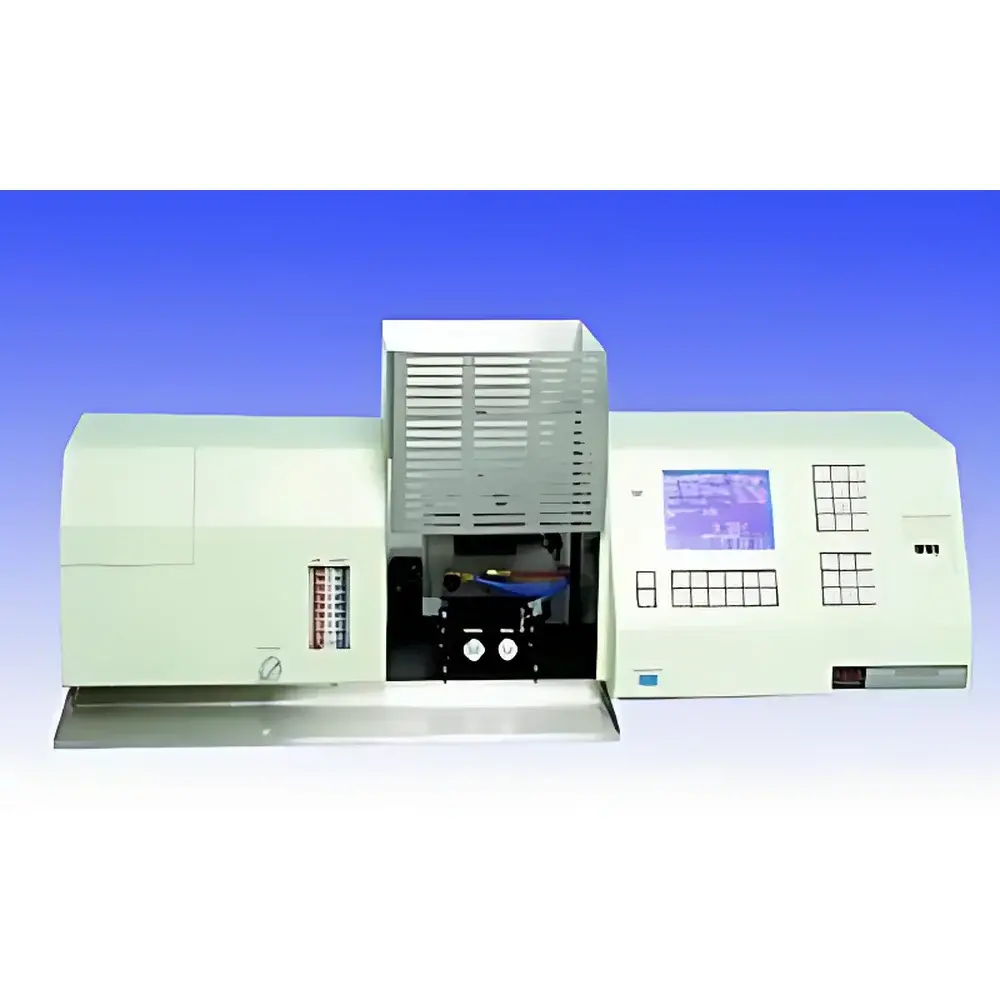
PerkinElmer 210VGP Flame and Graphite Furnace Atomic Absorption Spectrometer
| Origin | USA |
|---|---|
| Supplier Type | Authorized Distributor |
| Import Status | Imported |
| Model | 210VGP |
| Instrument Type | Flame and Graphite Furnace AAS |
| Monochromator | Concave Grating |
| Optical System | Single-Beam |
| Detector | Photomultiplier Tube (PMT) |
| Spectral Resolution | 0.1 nm |
| Sensitivity | Cu 5 ppm, Absorbance > 0.3 A |
| Repeatability (RSD) | < 0.3% |
| Detection Limit | Cu ≤ 0.005 mg/L |
| Wavelength Range | 190–900 nm |
| Wavelength Accuracy | ±0.2 nm |
| Wavelength Precision | ±0.1 nm |
| Slit Widths | 0.2 / 0.7 / 2.0 nm |
| Background Correction | Deuterium Lamp (190–350 nm) and Self-Reversal HCL (190–900 nm) |
| Atomization | Air/Acetylene, N₂O/Acetylene, Ar/H₂ premixed flame |
| Furnace Max Temp | 3000 °C in <1 s |
| Data Interface | RS-232C, IEEE-488 (GPIB), Parallel Printer Port |
| Dimensions (L×W×H) | 991 × 279 × 305 mm |
| Net Weight | 23 kg |
Overview
The PerkinElmer 210VGP Flame and Graphite Furnace Atomic Absorption Spectrometer is a dual-mode analytical instrument engineered for trace elemental quantification across diverse sample matrices. It operates on the principle of atomic absorption spectroscopy (AAS), where ground-state atoms in a gaseous state absorb characteristic radiation emitted by a hollow cathode lamp (HCL). The 210VGP integrates both flame atomization—optimized for rapid, high-throughput analysis of solution samples—and electrothermal graphite furnace atomization—designed for sub-part-per-trillion (ppt) detection limits in limited-volume or complex-matrix applications. Its single-beam optical architecture, coupled with a 250 mm Ebert monochromator and 600 lines/mm concave grating, delivers stable spectral isolation across the full 190–900 nm range. The system meets foundational performance criteria aligned with ASTM D3695 (trace metals in water), ISO 11885 (water quality), and USP (heavy metals in pharmaceuticals), supporting routine compliance in environmental, clinical, food safety, and metallurgical laboratories.
Key Features
- Dual-atomization capability: Seamless switching between air/acetylene, N₂O/acetylene, and argon/hydrogen flame modes—and integrated graphite furnace—enables method flexibility without hardware reconfiguration.
- Advanced background correction: Simultaneous deuterium-lamp correction (190–350 nm, 0.7 nm slit) and self-reversal HCL correction (190–900 nm) ensure accurate absorbance measurement in spectrally crowded or matrix-rich samples.
- High-power graphite furnace: Achieves 3000 °C in under one second via proprietary power modulation, enabling rapid thermal programming and minimizing memory effects during sequential multi-element analysis.
- Triple-lamp turret with independent control: Supports up to three HCLs; each lamp operates in standard (3–75 mA) or Giant Pulse mode (3–750 mA, pulse width 10–200 µs), enhancing sensitivity for volatile and refractory elements.
- Pre-mixed burner head with titanium nebulizer tip: Compatible with multiple fuel/oxidant combinations (e.g., N₂O/acetylene for refractory elements like Al, V, Mo); corrosion-resistant design ensures long-term stability.
- Embedded microcontroller (Intel 80C188, 12/24 MHz) with >200 stored methods: Eliminates external PC dependency for routine operation while retaining full programmability for method development.
Sample Compatibility & Compliance
The 210VGP accommodates aqueous solutions, digested biological tissues, acid-leached soils, and organic extracts following EPA Method 200.7, 200.8, or 7000B preparation protocols. Its graphite furnace module supports direct solid sampling (with platform modification) and hydride generation (via optional HG-200 accessory) for As, Se, Sb, Bi, Te, and Pb. All operational parameters—including integration time (0.5–10 s), slit width selection (0.2/0.7/2.0 nm), and multi-point calibration (1–8 standards)—are configurable to satisfy GLP/GMP documentation requirements. Audit trail functionality (via optional software upgrade) supports FDA 21 CFR Part 11 compliance when paired with validated data management systems.
Software & Data Management
The onboard firmware provides real-time signal processing, automatic 1–8 point calibration, linear/non-linear regression (including R² reporting), and immediate display of calibration curves on the 16-line LCD. Raw absorbance data, peak height/area integrals, and method metadata are exportable via RS-232C or IEEE-488 to LIMS or third-party analysis platforms. Optional PC-based software extends functionality to batch reporting, QC charting (X-bar/R), and electronic signature workflows. Internal SRAM retains >200 user-defined methods with full parameter recall—including lamp current, wavelength, slit width, and furnace temperature ramp profiles—ensuring method reproducibility across shifts and operators.
Applications
- Environmental monitoring: Quantification of Pb, Cd, Cr, Ni, and Zn in wastewater per EPA 200.8; analysis of total recoverable metals in soil per Method 3050B.
- Clinical toxicology: Measurement of Cu, Zn, Fe, and Mn in serum and whole blood using graphite furnace mode (LODs ≤ 0.005 mg/L).
- Pharmaceutical QA/QC: Heavy metal testing in APIs and excipients per ICH Q3D and USP /.
- Food and beverage safety: Determination of As in rice, Se in nuts, and Na/K/Ca/Mg in fortified beverages via flame AAS.
- Geochemical exploration: Multi-element analysis of rock digests (HF/HNO₃/HClO₄) using N₂O/acetylene flame for refractory elements.
FAQ
Does the 210VGP support hydride generation or cold vapor mercury analysis?
Yes—optional accessories include the HG-200 Hydride Generation System and CVAA-200 Cold Vapor Mercury Analyzer, both fully integrated via dedicated gas flow and timing control modules.
Is the graphite furnace module field-upgradable?
Yes—the GF-210 graphite furnace assembly is designed as a plug-in module; installation requires no optical realignment and is supported by factory-certified service engineers.
What regulatory standards does the instrument’s data handling meet?
The base firmware supports ALCOA+ data integrity principles. With optional software licensing and server-side validation, it achieves full 21 CFR Part 11 compliance—including electronic signatures, audit trails, and role-based access control.
Can the 210VGP operate without a connected PC?
Yes—full standalone operation is enabled by its embedded microcontroller and LCD interface; PC connectivity is required only for advanced reporting, method archiving, or remote diagnostics.
What maintenance intervals are recommended for the nebulizer and burner head?
Per manufacturer guidelines: daily cleaning of the nebulizer capillary with dilute HNO₃; quarterly inspection of the titanium burner head for carbon buildup; annual PM including PMT voltage verification and wavelength calibration using holmium oxide reference.
Related Products






