
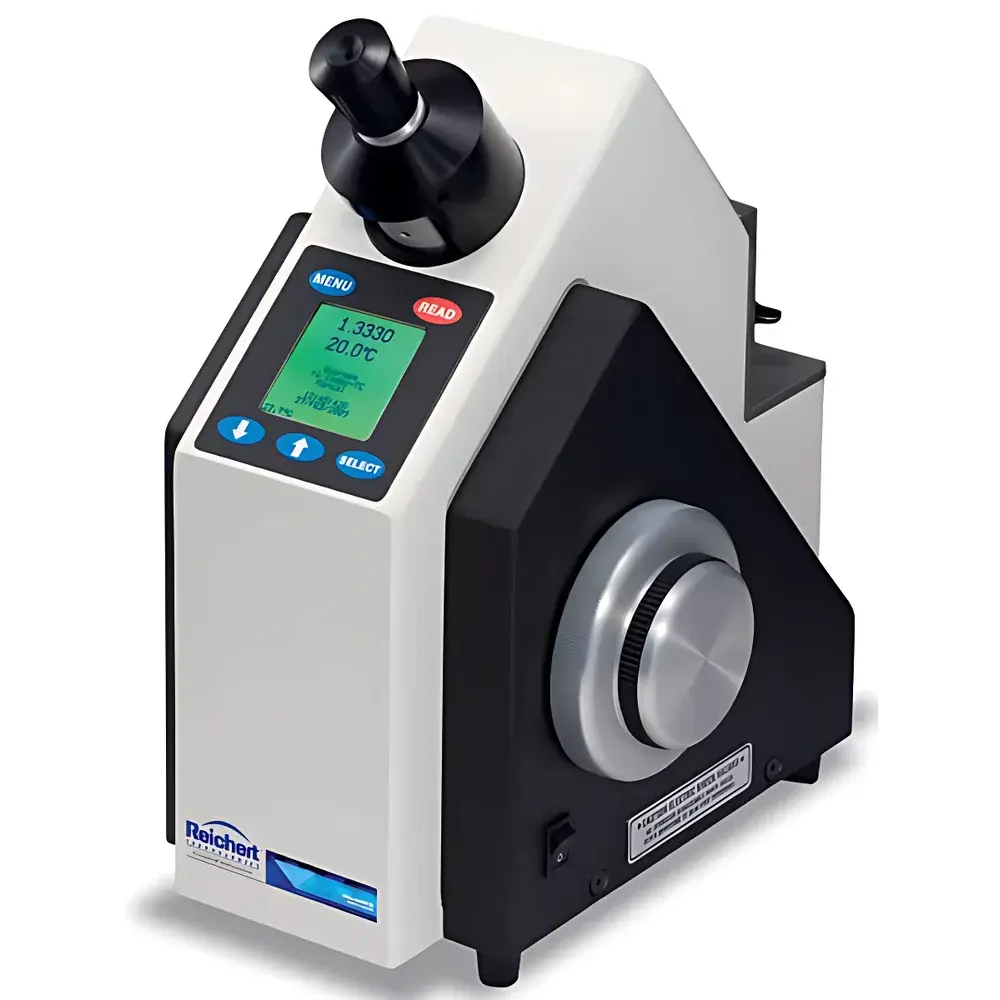
Reichert Mark III ABBE Refractometer
| Brand | Reichert |
|---|---|
| Origin | USA |
| Model | Mark III |
| Type | Benchtop Refractometer |
| Temperature Control | Yes |
| Digital Display | Yes |
| Refractive Index Range | 1.3106–1.7000 nD |
| Refractive Index Accuracy | ±0.0001 nD |
| Brix Range | 0.0–95.0 %Brix (ICUMSA) |
| Brix Accuracy | ±0.1 % |
| Light Source | High-intensity, long-life LED at 589 nm |
| Temperature Control Range | 10–80 °C |
| Temperature Stability | ±0.01 °C |
| Prism Material | Optical glass prism sealed with epoxy resin and 416 stainless steel sample well |
| Display | LCD, 44 × 44 mm active area |
| Interface | RS-232, user-configurable baud rate up to 57600 |
| Calibration History Storage | Hundreds of entries |
| Auto Thermal Equilibrium Detection | Yes |
| Password Protection | For method setup and menu parameters |
Overview
The Reichert Mark III ABBE Refractometer is a precision benchtop optical instrument engineered for high-reproducibility refractive index (RI) and %Brix measurements in regulated and research-intensive environments. Based on the classical Abbe principle—where light undergoes total internal reflection at the interface between a high-refractive-index prism and a liquid sample—the Mark III delivers traceable, temperature-compensated results compliant with international standard methods including ASTM D1218, ISO 287, ICUMSA Method GS7/3-12, and USP . Its dual-wavelength-capable optical path (centered at the sodium D-line, 589 nm) ensures metrological consistency across diverse sample matrices. Designed for laboratories requiring GLP/GMP-aligned operation, the instrument integrates robust thermal management, digital calibration traceability, and audit-ready data handling—all within a mechanically stable, vibration-damped housing.
Key Features
- High-resolution LCD display (44 × 44 mm active area) with intuitive menu navigation and real-time parameter feedback
- Long-life, spectrally stabilized 589 nm LED illumination—eliminating mercury lamp replacement cycles and spectral drift
- Integrated auto thermal equilibrium detection: continuously monitors prism–sample thermal gradient and delays measurement until thermal stability (±0.01 °C) is confirmed
- 15 programmable measurement modes: Mode 1 preconfigured for ICUMSA-compliant %Brix; Modes 2–15 fully customizable for user-defined scales (e.g., %NaCl, %Ethanol, %Glycerol, custom polynomial fits)
- Secure password protection for method configuration, calibration settings, and system menus—supporting multi-user lab environments under FDA 21 CFR Part 11 requirements
- RS-232 serial interface with configurable baud rates (up to 57600 bps) for bidirectional communication with LIMS or laboratory informatics platforms
- Prism assembly constructed from optical-grade glass, hermetically sealed with epoxy and 416 stainless steel sample well—resistant to corrosion from aggressive solvents and caustic solutions
Sample Compatibility & Compliance
The Mark III accommodates transparent, translucent, and opaque liquid samples—including suspensions, emulsions, and highly viscous fluids—without requiring dilution or filtration. Its wide RI range (1.3106–1.7000 nD) supports applications from aqueous sugar solutions to high-index polymers and halogenated solvents. Temperature control is achieved via external water bath (not included), enabling precise thermostating from 10 to 80 °C—critical for viscosity-dependent RI measurements and process validation studies. The instrument meets essential regulatory expectations: calibration records are timestamped and stored locally (hundreds of entries retained); all critical parameters—including temperature, RI, %Brix, and operator ID—are exportable in ASCII format for audit review. It is routinely deployed in facilities maintaining ISO/IEC 17025 accreditation and adhering to pharmaceutical quality systems per ICH Q2(R2).
Software & Data Management
No proprietary software installation is required for basic operation; however, the Mark III supports seamless integration with third-party laboratory data systems via its RS-232 port. All measurement events—including date/time stamp, measured value, temperature reading, mode identifier, and calibration status—are logged internally and retrievable as structured text files. The instrument’s firmware implements non-volatile memory with write-cycle protection to ensure integrity of calibration history during power loss. For labs operating under 21 CFR Part 11, the password-protected configuration layer enables role-based access control, while exported datasets retain full metadata necessary for electronic record verification. Optional PC-based utilities (available from Reichert) provide graphical trend analysis, statistical process control (SPC) charting, and PDF report generation with digital signature support.
Applications
- Pharmaceutical & Biotechnology: Concentration verification of IV solutions, excipient purity assessment, protein quantification in serum/plasma (via RI correlation), and counterfeit drug screening
- Food & Beverage Quality Control: Real-time %Brix monitoring in juice concentration, dairy product standardization, alcohol content estimation in fermented beverages, and sweetener formulation validation
- Chemical & Petrochemical Manufacturing: Solvent purity grading, polymer solution concentration, reaction endpoint detection in esterification/hydrolysis, and antifreeze/aircraft deicing fluid certification
- Cosmetics & Personal Care: Emulsion stability profiling, surfactant concentration tracking, and raw material identity testing per USP monographs
- Academic & Materials Research: Characterization of nanofluids, ionic liquid mixtures, and thermoresponsive polymer solutions where RI serves as a sensitive proxy for composition and phase behavior
FAQ
Does the Mark III require annual recalibration by an accredited service provider?
No—users may perform routine verification using NIST-traceable refractive index standards (e.g., distilled water, sucrose solutions). Full recalibration is recommended only after mechanical shock, prism cleaning with abrasive agents, or when verification fails two consecutive times.
Can the instrument measure samples below 10 °C or above 80 °C?
No—the specified temperature control range is strictly 10–80 °C. Operation outside this range risks condensation, prism stress, or LED wavelength shift, compromising accuracy and long-term reliability.
Is automatic temperature compensation (ATC) built-in?
The Mark III does not include internal Peltier-based ATC. Instead, it supports external thermostatic control and provides real-time temperature input for manual or software-based compensation using user-defined equations or standard tables (e.g., CRC Handbook values).
What sample volume is required for a valid measurement?
Approximately 0.5–1.0 mL is sufficient to fully cover the prism surface. Excess volume is contained within the stainless steel well and does not affect measurement integrity.
How is compliance with ISO 17025 documented for this instrument?
Reichert supplies a factory calibration certificate traceable to NIST SRM 1792 (refractive index standard), along with uncertainty budget documentation. Users are responsible for maintaining in-house verification logs, environmental monitoring records, and staff competency assessments per Clause 6.4 of ISO/IEC 17025:2017.





