
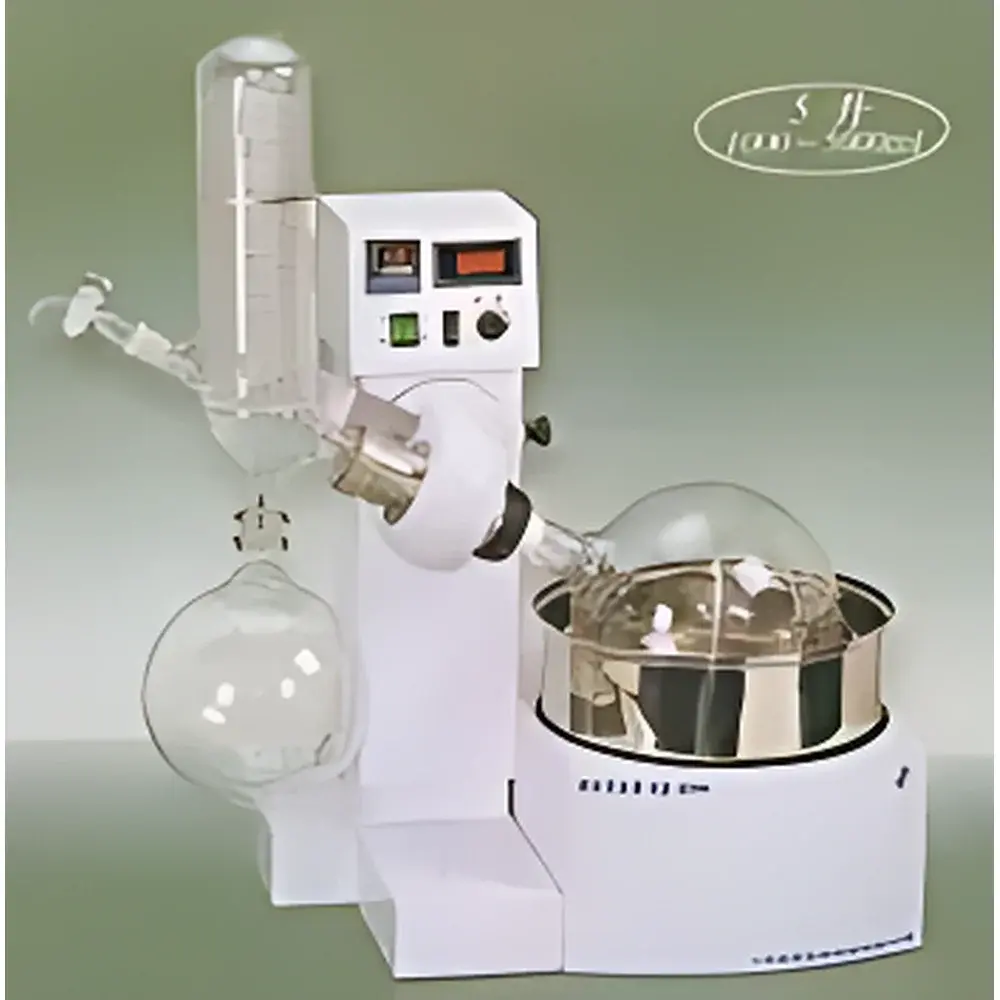
RE5000 Rotary Evaporator
| Origin | Shanghai, China |
|---|---|
| Manufacturer Type | Authorized Distributor |
| Origin Category | Domestic (China-made) |
| Model | RE5000 |
| Rotational Speed Range | 0–110 rpm |
| Heating Temperature Range (Water Bath) | Ambient to 98 °C |
| Condenser Type | Vertical dual-coil high-density serpentine condenser with large-diameter tubing |
| Evaporation Flask Capacity | 5 L |
| Collection Flask Capacity (Standard Ground Joint) | 3 L |
| Total Power Consumption | 2120 W |
| Dimensions (W×D×H) | 600 × 400 × 850 mm |
| Lifting Mechanism | Motorized tilt-type lift with tactile paddle switch |
| Speed Display | Digital LED readout |
Overview
The RE5000 Rotary Evaporator is an engineered solution for efficient solvent removal, concentration, and gentle distillation of heat-sensitive compounds under reduced pressure. Operating on the principle of rotary evaporation—where a rotating flask increases surface area while vacuum lowers boiling points—the system enables rapid, reproducible evaporation across diverse organic, aqueous, and mixed-solvent systems. Designed for routine use in synthetic chemistry labs, pharmaceutical QC environments, natural product isolation, and academic research settings, the RE5000 integrates mechanical precision with thermal stability to support scalable sample processing without compromising integrity. Its water-bath heating system delivers uniform temperature control up to 98 °C, compatible with standard glassware sets conforming to ISO 8573-1 and ASTM E2915 specifications for laboratory glass apparatus.
Key Features
- Motorized tilt-type lifting mechanism with ergonomic paddle switch for rapid, repeatable vertical positioning—enabling safe and controlled flask immersion and removal during operation.
- Digital LED speed display with precise rotational control from 0 to 110 rpm, ensuring optimal film formation and evaporation kinetics across varying viscosities and volumes.
- Vertical dual-coil high-density serpentine condenser with large-diameter tubing maximizes condensation efficiency and minimizes vapor bypass, especially critical for low-boiling solvents such as diethyl ether, acetone, or ethyl acetate.
- 5 L evaporation flask and 3 L collection flask (standardized 29/32 ground joint interface) provide scalable throughput while maintaining compatibility with globally recognized joint standards (DIN/ISO 29/32).
- Robust 2120 W total power architecture supports simultaneous heating, rotation, and vacuum integration—designed for continuous duty cycles in multi-user lab environments.
- Compact footprint (600 × 400 × 850 mm) facilitates integration into fume hoods or benchtop workflows without sacrificing capacity or thermal performance.
Sample Compatibility & Compliance
The RE5000 accommodates a broad range of sample types—including polar and non-polar solvents, polymer solutions, crude extracts, and thermally labile fractions—provided appropriate vacuum levels and bath temperatures are selected per compound volatility and decomposition thresholds. All wetted parts are constructed from borosilicate 3.3 glass (Duran®-equivalent), compliant with ISO 3585 and USP for chemical resistance and thermal shock tolerance. The unit meets CE safety directives (2014/35/EU Low Voltage Directive and 2014/30/EU EMC Directive) and conforms to IEC 61010-1:2010 for laboratory electrical equipment safety. While not inherently GLP/GMP-certified, its consistent operational parameters and mechanical repeatability support data traceability when paired with validated vacuum controllers and calibrated temperature probes.
Software & Data Management
The RE5000 operates as a standalone analog-digital hybrid instrument with no embedded microprocessor or network interface. All operational parameters—rotation speed and bath temperature—are manually set and monitored via front-panel controls and digital displays. For laboratories requiring audit-ready records, external data loggers (e.g., certified PT100-based temperature recorders or RPM tachometers) may be integrated per FDA 21 CFR Part 11 guidelines when used in regulated environments. Documentation templates—including equipment logs, calibration certificates, and preventive maintenance schedules—are provided to support ISO/IEC 17025-compliant quality management systems.
Applications
- Solvent recovery and concentration in synthetic organic chemistry workflows.
- Purification of active pharmaceutical ingredients (APIs) following extraction or crystallization steps.
- Concentration of botanical extracts, essential oils, and nutraceutical fractions under mild thermal conditions.
- Removal of residual solvents from polymer films, coatings, and nanomaterial dispersions.
- Preparative-scale dehydration of hygroscopic compounds prior to lyophilization or storage.
- Teaching laboratory demonstrations of phase equilibria, vapor pressure depression, and interfacial mass transfer principles.
FAQ
What vacuum level is recommended for optimal performance with the RE5000?
A stable vacuum between 10–100 mbar is typically sufficient for most common solvents; precise values depend on solvent boiling point and bath temperature—consult standard vapor pressure charts (e.g., CRC Handbook or DIPPR database) for optimization.
Is the RE5000 compatible with dry ice–acetone cold traps?
Yes—the vertical condenser design allows direct integration with optional cold trap assemblies mounted between the condenser outlet and vacuum pump inlet to prevent solvent backstreaming and protect pump oil integrity.
Can the heating bath accommodate silicone oil instead of water?
Yes—the bath chamber supports both aqueous and silicone oil media; maximum temperature must remain within the specified 98 °C limit when using water, but oil extends usable range up to 180 °C if upgraded bath vessel and seal materials are installed (not included with base configuration).
Does the unit include vacuum regulation capability?
No—vacuum control requires an external vacuum controller or regulator; the RE5000 features a standard vacuum port (KF16 or 1/4″ NPT) for seamless connection to diaphragm or scroll pumps.
What maintenance intervals are recommended for long-term reliability?
Daily visual inspection of seals and glassware, weekly lubrication of lift mechanism gears, and quarterly verification of bath temperature accuracy using a NIST-traceable thermometer are advised per manufacturer’s technical bulletin TB-RE5000-MNT-2023.



