
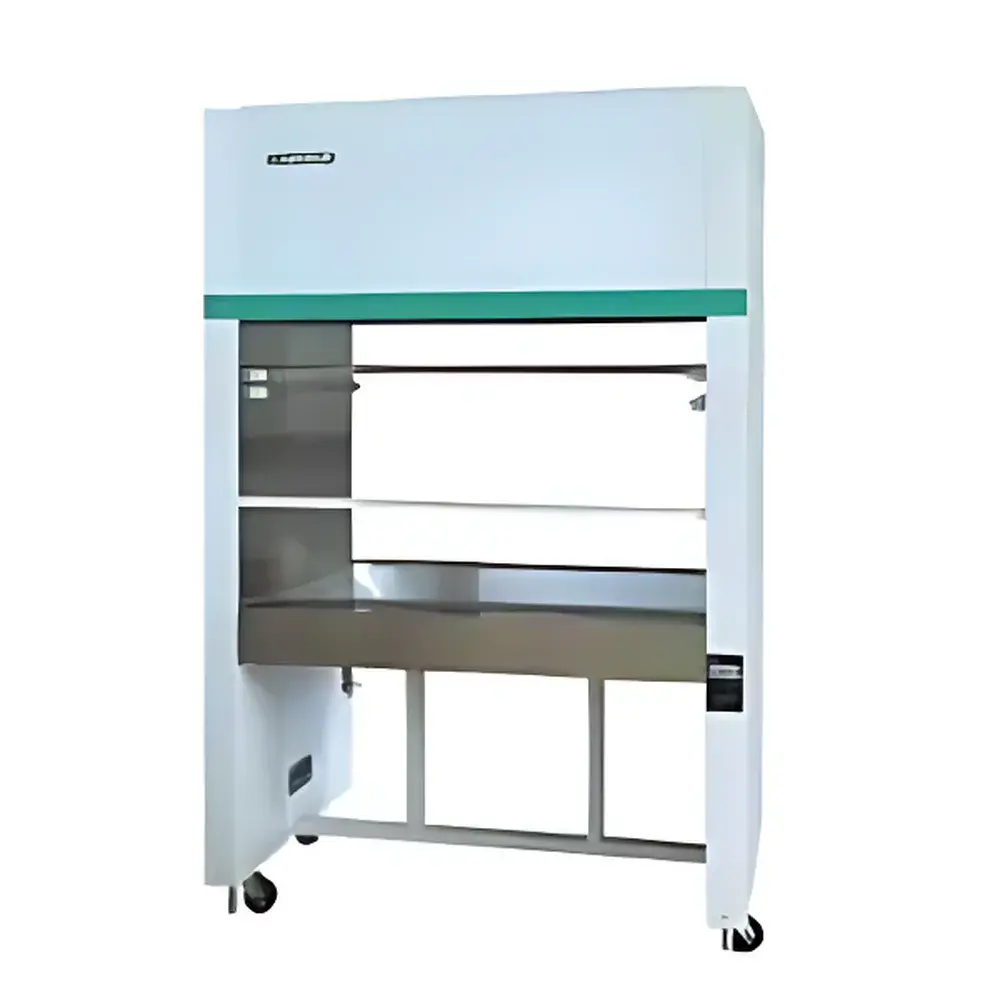
Sujie SW-CJ Series Vertical & Horizontal Flow Clean Benches
| Brand | Sujie |
|---|---|
| Origin | Jiangsu, China |
| Model Range | SW-CJ-1D, SW-CJ-1FD, SW-CJ-1F, SW-CJ-2D, SW-CJ-2FD, SW-CJ-2F, SW-CJ-1B/1BU, SW-CJ-1C/1CU, VS-840, VS-1300, HS-840, HS-1300, VD-650/HD-650, VD-850/HD-850 |
| Construction | Stainless Steel (Standard & Full SS Options) |
| Airflow Type | Vertical Downflow & Horizontal Laminar Flow |
| Filter | HEPA H14 (EN 1822) |
| Certifications | Compliant with ISO 14644-1 Class 5 (Formerly Class 100), GB/T 25220–2010, YY 0569–2011 |
| Power Supply | 220 V AC, 50 Hz |
| Noise Level | ≤62 dB(A) |
| Average Face Velocity | 0.3–0.5 m/s (Adjustable) |
| Operating Temperature Range | 10–35 °C |
| Relative Humidity | ≤80% RH (Non-condensing) |
Overview
The Sujie SW-CJ Series Clean Benches are engineered for precision-controlled laminar airflow environments in laboratories, pharmaceutical QC labs, microbiology facilities, and electronics assembly areas. These units operate on the principle of unidirectional laminar airflow—either vertical downflow or horizontal crossflow—generated by a low-turbulence centrifugal blower and conditioned through a certified HEPA H14 filter (≥99.995% efficiency at 0.1 µm per EN 1822). Unlike biological safety cabinets, clean benches provide product protection only—not personnel or environmental protection—and are therefore designated for non-hazardous applications where sterile surface integrity is critical. All models conform to ISO 14644-1 Class 5 (equivalent to Federal Standard 209E Class 100) performance criteria, ensuring consistent particle-free workspaces for aseptic handling of cell cultures, media preparation, semiconductor wafer inspection, and precision instrument calibration.
Key Features
- Two primary airflow configurations: vertical downflow (SW-CJ-D/F/VS-series) and horizontal laminar flow (SW-CJ-B/C/HS-series), each optimized for specific workflow ergonomics and contamination control priorities;
- Full stainless steel construction options (304 grade) available across all major models, enabling compatibility with aggressive disinfectants and compliance with cGMP facility requirements;
- Digitally adjustable fan speed control with real-time face velocity monitoring (0.3–0.5 m/s range), supporting reproducible validation protocols under varying ambient conditions;
- Integrated pre-filter + HEPA H14 final filtration system, with filter life indicators and standardized replacement procedures aligned with ISO 14644-3 maintenance guidelines;
- Ergonomic work surface design featuring rounded edges, seamless welds, and optional UV germicidal irradiation (254 nm, 15 W) with interlocked safety cutoff;
- Low-noise operation (≤62 dB[A]) achieved via vibration-damped motor mounts and acoustic insulation—critical for shared lab environments and long-duration operator use;
- Modular footprint variants including benchtop (VD/HD-650/850), single-person (SW-CJ-1x), and dual-operator (SW-CJ-2x) configurations, supporting flexible lab layout integration.
Sample Compatibility & Compliance
Sujie clean benches accommodate a broad spectrum of sample types—including Petri dishes, tissue culture flasks, microcentrifuge tubes, optical components, and printed circuit boards—without introducing airborne particulates or microbial contaminants. The vertical downflow configuration minimizes operator shadowing effects and is preferred for cell line maintenance and media pouring; horizontal flow units eliminate operator-induced turbulence and are widely deployed in optics alignment and microelectronics packaging. All units meet national standards GB/T 25220–2010 (Clean Bench Technical Requirements) and YY 0569–2011 (Pharmaceutical Clean Bench Performance Criteria), and support validation documentation required for GLP audits and ISO 9001-certified quality systems. Optional calibration certificates traceable to NIM (National Institute of Metrology, China) are available upon request.
Software & Data Management
While the SW-CJ series operates as a standalone mechanical system without embedded software, it supports comprehensive data governance through external validation tools. Integrated analog/digital interfaces enable connection to third-party environmental monitoring systems (e.g., Vaisala, Rotronic) for continuous logging of airflow velocity, temperature, and humidity. Each unit includes a dedicated test port for ISO 14644-3-compliant anemometer calibration and particle counter verification (using ≥0.3 µm and ≥0.5 µm channels). Audit trails for filter replacement, UV lamp usage, and operational runtime can be maintained manually or integrated into laboratory information management systems (LIMS) via CSV export from connected sensors. For regulated environments, the full stainless steel variants facilitate 21 CFR Part 11–compliant electronic recordkeeping when paired with validated data acquisition hardware.
Applications
- Aseptic preparation of microbial growth media and antibiotic stock solutions in clinical microbiology labs;
- Handling of primary cell isolates and stem cell lines under GMP-aligned workflows;
- Assembly and testing of high-reliability optoelectronic components requiring sub-micron particle control;
- Calibration and alignment of interferometers, spectrophotometers, and other metrology-grade instrumentation;
- QC release testing of sterile medical devices and pharmaceutical excipients;
- Education and training environments where repeatable, contamination-free technique demonstration is essential.
FAQ
What is the difference between vertical and horizontal laminar flow clean benches?
Vertical downflow units direct filtered air from top to work surface, offering superior operator comfort and reduced risk of cross-contamination during prolonged tasks. Horizontal flow benches project air parallel to the work surface—ideal for heat-sensitive samples and optical setups where vertical airflow could cause thermal drift or lens fogging.
Can this unit be used for handling pathogenic organisms?
No. Clean benches provide product protection only. Handling of Risk Group 2+ agents requires a Class II Biological Safety Cabinet (BSC) with recirculation and exhaust ducting per NSF/ANSI 49.
Is HEPA filter certification included with purchase?
Yes—each unit ships with a factory-issued HEPA filter test report confirming H14 classification per EN 1822, including aerosol photometer scan data and penetration values.
How often should the HEPA filter be replaced?
Under typical laboratory use (8 hrs/day, 5 days/week), replacement is recommended every 18–24 months—or sooner if differential pressure exceeds 250 Pa or face velocity falls below 0.25 m/s during routine checks.
Do these units comply with international cleanroom standards?
Yes—they are validated to ISO 14644-1 Class 5 (≤3,520 particles/m³ ≥0.5 µm) and support compliance with EU GMP Annex 1, USP , and JP 17 clean area requirements when installed and maintained per ISO 14644-3.



