
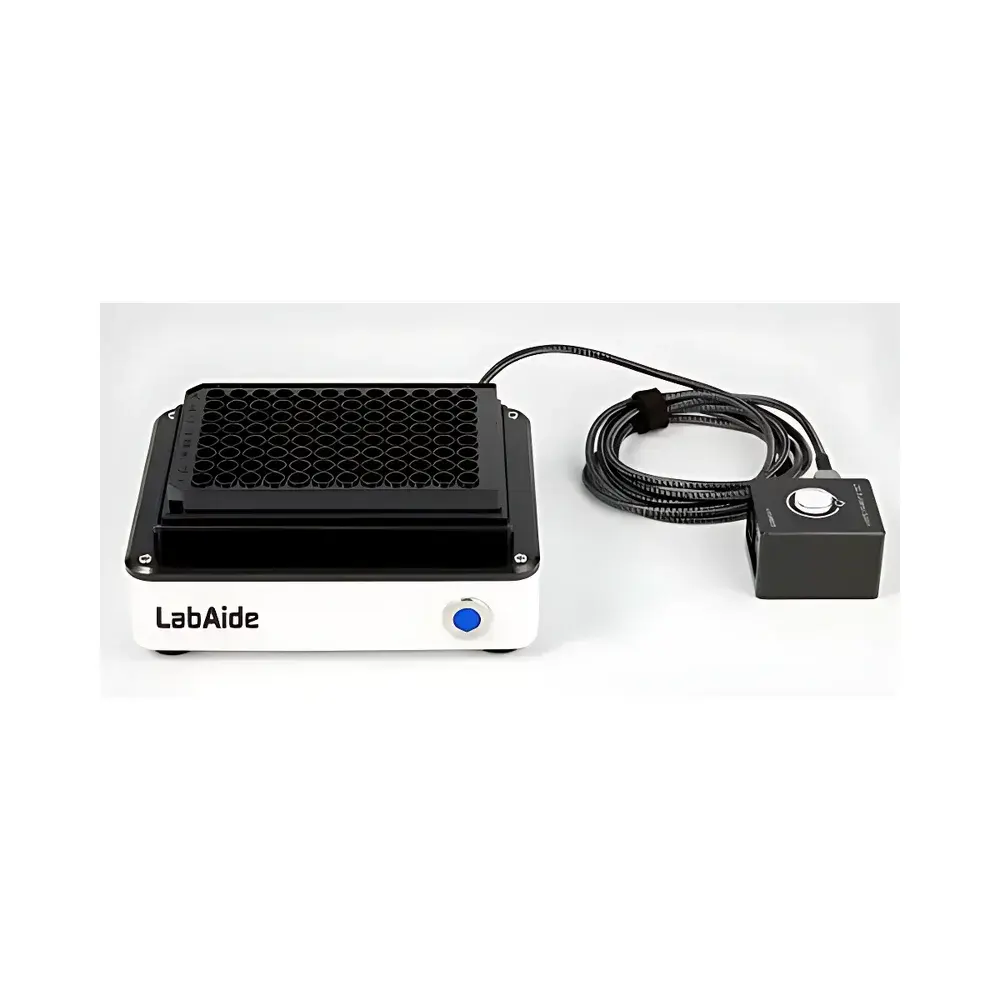
Chengmeng LA-30000 LED-Based Optical Stimulator for Cell Culture Plates
| Brand | Chengmeng |
|---|---|
| Origin | Jiangsu, China |
| Manufacturer Type | Authorized Distributor |
| Product Category | Domestic |
| Model | LA-30000 |
| Price | USD 56,000 (FOB) |
| Stimulation Principle | LED-driven optical excitation |
| Instrument Architecture | Multi-channel parallel stimulation |
| Wavelength | 625 nm (centered) |
| Spectral Bandwidth | ±10 nm (FWHM) |
| Irradiance Range | 0–100 mW/cm² (adjustable per well) |
| Temporal Resolution | 1 ms pulse width, 0.1–10 Hz frequency range |
| Pulse Duration | 1 ms to 60 min (programmable) |
| Operating Environment | 20–40 °C, up to 95% RH (IP55-rated electronics) |
| Dimensions (W×D×H) | 240 × 180 × 95 mm |
| Cooling | Active thermal regulation with linear PWM-controlled fan |
| Uniformity | ±5% irradiance deviation across all wells (factory-calibrated) |
| Compliance | CE, RoHS, ISO 13485-aligned design documentation |
Overview
The Chengmeng LA-30000 is a precision-engineered, multi-channel LED-based optical stimulator designed specifically for high-throughput, spatiotemporally controlled photostimulation of adherent and suspension cells in standard multi-well culture plates (6-, 12-, 24-, 48-, and 96-well formats). Unlike generic light sources, the LA-30000 implements monochromatic 625 nm illumination—optimized for red-light-responsive optogenetic actuators (e.g., ChrimsonR, ReaChR), photodynamic therapy (PDT) photosensitizers (e.g., Rose Bengal, Pc 4), and red/far-red light-regulated gene expression systems (e.g., PhyB-PIF). Its core architecture follows Coulombic current-driven LED control, ensuring stable photon flux output without spectral drift over extended operation. The system operates on a closed-loop thermal management principle: real-time thermistor feedback from each LED module regulates fan speed via linear PWM, maintaining junction temperature below 65 °C while limiting acoustic noise to <28 dBA at 30 cm—critical for integration inside CO₂ incubators or shared imaging suites.
Key Features
- Multi-well independent control: Each well receives programmable irradiance (0–100 mW/cm²) and timing parameters without crosstalk.
- Factory-calibrated irradiance uniformity: ±5% deviation across all stimulated wells, verified using NIST-traceable photodiode array mapping prior to shipment.
- Incubator-ready hardware: IP55-rated PCBs with conformal silicone coating; reinforced connectors and low-voltage DC input (24 V) minimize EMI susceptibility in humid (>90% RH), 5% CO₂ environments.
- Sub-millisecond temporal fidelity: Minimum pulse width of 1 ms with jitter <50 µs, enabling precise emulation of physiological light patterns (e.g., burst firing in optogenetic neuroscience).
- Dual-mode operation: Continuous-wave (CW) mode for PDT dose delivery; pulsed mode with user-defined duty cycle for optogenetic interrogation.
- Modular mechanical interface: Includes stackable aluminum spacers (1–10 mm increments) and light-tight well-specific caps to eliminate inter-well scatter and ambient leakage.
Sample Compatibility & Compliance
The LA-30000 supports polystyrene, glass-bottom, and hydrogel-coated microplates without optical coupling requirements. It has been validated with primary neurons, iPSC-derived cardiomyocytes, HeLa, U87MG, and 3T3-L1 cells under standard culture conditions (DMEM/F12 + 10% FBS, 37 °C, 5% CO₂). All firmware and calibration protocols adhere to GLP-aligned documentation standards. While not FDA-cleared, the device’s electrical safety design conforms to IEC 61010-1:2010 (Measurement, Control and Laboratory Equipment), and its EMC performance meets EN 61326-1:2013 Class B limits. Traceable calibration certificates—including spectral radiance (W·sr⁻¹·m⁻²·nm⁻¹) and irradiance (W·m⁻²) at 625 nm—are provided with each unit.
Software & Data Management
Control is executed via LabStim v3.2 software (Windows 10/11, 64-bit), featuring a dual-panel GUI: a visual plate map for per-well parameter assignment and a timeline-based pulse sequencer supporting nested loops, conditional triggers, and external TTL synchronization (via BNC input). All stimulation logs—including timestamped irradiance values, thermal telemetry, and user annotations—are exported as CSV/JSON with SHA-256 checksums. Audit trails comply with ALCOA+ principles: attributable, legible, contemporaneous, original, accurate, complete, consistent, enduring, and available. Data export supports direct ingestion into MATLAB, Python (via pandas), or commercial analysis platforms (e.g., GraphPad Prism, Imaris).
Applications
- Optogenetics: Activation of red-shifted opsins (e.g., ChrimsonR in cortical slices) with sub-second latency and minimal thermal artifact.
- Photodynamic Therapy Screening: Dose-response profiling of ROS generation in tumor spheroids using standardized 625 nm irradiation (e.g., 50 mW/cm² × 10 min = 30 J/cm²).
- Light-Gated Gene Expression: Induction of PhyB-PIF-mediated transcription in engineered HEK293T lines with spatial resolution down to single-well level.
- Circadian Rhythm Studies: Mimicking dusk/dawn spectral transitions via sequential red-light pulses synchronized to cellular clock reporters (e.g., Bmal1-luc).
- Neurotoxicity Assays: Combining optical stimulation with real-time impedance (xCELLigence) or calcium imaging (Fluo-4) readouts.
FAQ
Is the LA-30000 compatible with live-cell imaging setups?
Yes—the system emits no UV or IR leakage, features negligible electromagnetic interference, and operates silently, making it suitable for concurrent use with confocal, widefield, or phase-contrast microscopes.
Can I integrate the LA-30000 with third-party automation platforms?
Yes—LabStim v3.2 provides a documented REST API and TCP/IP socket interface for integration with Hamilton STAR, Tecan Fluent, or custom Python/LabVIEW control scripts.
What is the recommended recalibration interval?
Annual irradiance verification is advised using an external calibrated spectroradiometer; factory calibration remains valid for 12 months under normal usage (≤8 h/day, ambient T <35 °C).
Does the system support wavelength multiplexing?
No—the LA-30000 is a dedicated 625 nm platform. For multi-wavelength experiments, Chengmeng offers the LA-40000 series (470/530/625 nm tri-band variant) with independent per-channel control.
How is thermal stability ensured during prolonged stimulation?
Each LED channel incorporates a surface-mount thermistor feeding into a PID controller that dynamically adjusts fan speed and drive current to maintain LED junction temperature within ±2 °C of setpoint.



