
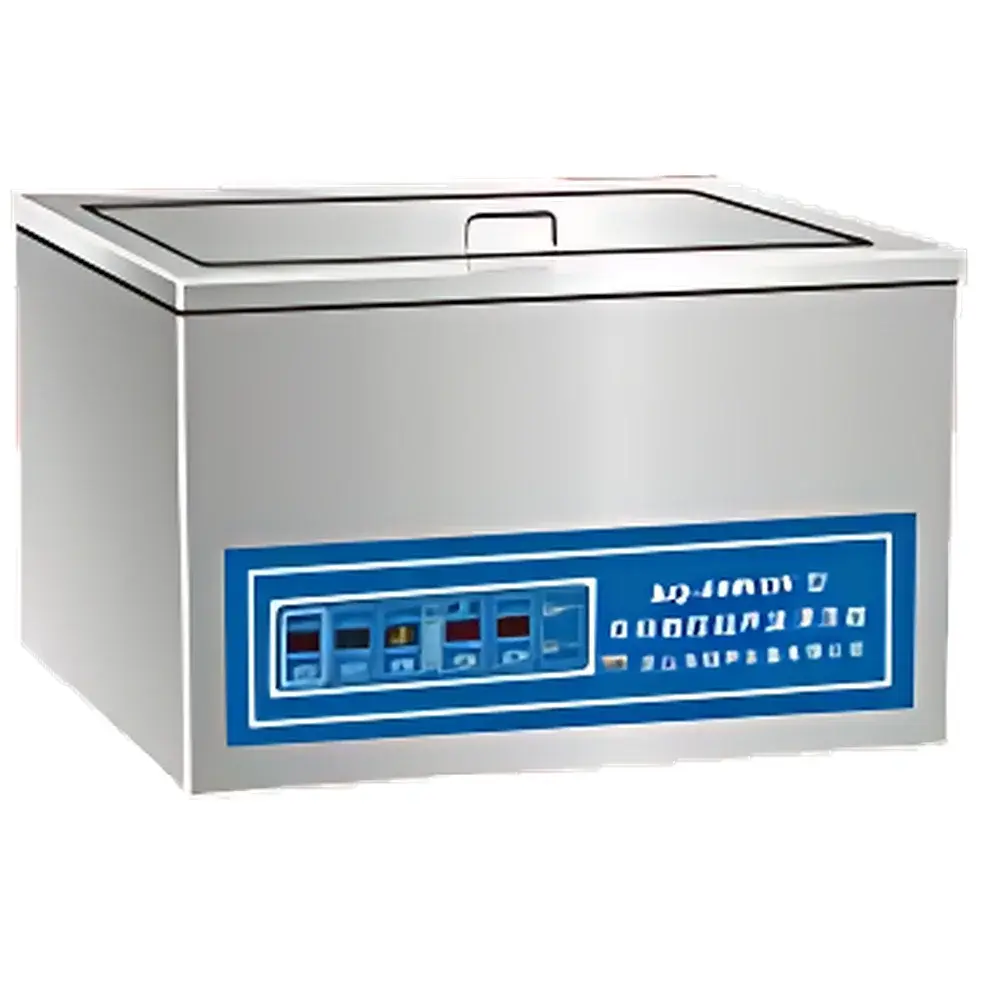
Shumei KQ3200B Benchtop Ultrasonic Cleaner
| Brand | Shumei |
|---|---|
| Model | KQ3200B |
| Type | Benchtop Ultrasonic Cleaner |
| Ultrasonic Frequency | 40 kHz |
| Ultrasonic Power | 150 W |
| Heating Power | 800 W |
| Temperature Range | 0–80 °C |
| Timer Range | 1–20 min |
| Tank Capacity | 6 L |
| Tank Dimensions (L×W×H) | 300×150×150 mm |
| Overall Dimensions (L×W×H) | 320×174×320 mm |
| Construction | Stainless Steel Tank & Housing |
| Drain Valve | Yes |
| Mesh Basket | Yes |
| Lid with Sound Dampening | No |
Overview
The Shumei KQ3200B is a precision-engineered benchtop ultrasonic cleaner designed for routine and demanding laboratory cleaning applications. It operates on the principle of ultrasonic cavitation—generating high-frequency sound waves (40 kHz) in a liquid medium to produce microscopic vacuum bubbles that implode with localized energy, effectively dislodging particulate contaminants, organic residues, and biofilms from surfaces without mechanical abrasion. This physics-based cleaning mechanism ensures uniform treatment of complex geometries—including lumens, crevices, and microstructured components—making it indispensable in analytical sample preparation, quality control labs, and pre-sterilization workflows. The unit integrates a thermostatically controlled heating system (0–80 °C), enabling temperature-assisted cleaning for viscous or thermally responsive soils, while maintaining compliance with standard laboratory safety protocols for aqueous-based decontamination.
Key Features
- Stainless steel tank and housing (304-grade) for corrosion resistance, structural integrity, and long-term compatibility with common solvents and cleaning agents
- 150 W total ultrasonic power output distributed across multiple transducers mounted to the tank base, delivering consistent energy density and stable cavitation field
- Digital timer with adjustable range from 1 to 20 minutes, supporting reproducible process cycles essential for SOP-driven environments
- Independent temperature control system with ±2 °C accuracy across 0–80 °C range; heating element rated at 800 W for rapid thermal equilibration
- Integrated drain valve located at the tank base for safe, spill-free solution disposal—critical for handling hazardous or regulated waste streams
- Included stainless steel mesh basket with handle, optimized for secure placement and retrieval of delicate or small-format samples (e.g., glassware, surgical instruments, semiconductor wafers)
- Compact footprint (320 × 174 × 320 mm) suitable for standard lab benches, fume hoods, or cleanroom support stations
Sample Compatibility & Compliance
The KQ3200B accommodates a wide range of sample types, including but not limited to: glass vials, pipette tips, chromatography columns, optical lenses, metal calibration standards, printed circuit boards, and reusable medical devices. Its 6 L capacity and 300 × 150 × 150 mm tank volume allow simultaneous processing of multiple items while preserving acoustic uniformity. All wetted parts are constructed from electropolished 304 stainless steel, minimizing leaching and ensuring compatibility with ISO 15190:2020 (laboratory safety), ASTM D2603 (ultrasonic cleaning validation), and USP (cleaning and sanitization of equipment). While the unit itself does not carry CE or UL certification out-of-box, its design adheres to IEC 61010-1 safety requirements for electrical laboratory equipment when operated within specified ambient conditions (max. 40 °C, ≤80% RH).
Software & Data Management
The KQ3200B is a standalone analog/digital hybrid instrument with no embedded software or network interface. Operation is managed via front-panel controls: a rotary timer knob and dual-function temperature dial with LED indicators. Though it lacks data logging or remote monitoring capabilities, its manual interface supports full traceability under GLP/GMP frameworks when paired with laboratory documentation systems. Users may record operational parameters—including time, temperature, bath composition, and load configuration—in batch records or electronic lab notebooks (ELN). For laboratories requiring audit-ready validation, IQ/OQ protocols can be executed using external calibrated thermometers and stopwatch verification per ISO/IEC 17025 guidelines.
Applications
- Pre-analytical sample preparation: removal of residual solvents, salts, or matrix interferences from HPLC vials, autosampler needles, and LC-MS interfaces
- Microelectronics: particle removal from photomasks, wafer carriers, and MEMS components prior to metrology or packaging
- Pharmaceutical QC: cleaning of dissolution apparatus baskets, tablet friability testers, and excipient contact surfaces in accordance with USP
- Medical device reprocessing: adjunctive cleaning of reusable endoscopic accessories, dental handpieces, and orthopedic trial implants before sterilization
- Academic research: surface decontamination of TEM grids, AFM probes, and catalytic substrates in materials science and nanotechnology labs
- Forensic labs: non-destructive residue recovery from ballistic evidence, toolmarks, and trace evidence carriers
FAQ
What cleaning solutions are compatible with the KQ3200B?
Aqueous alkaline, neutral, or mildly acidic detergents are recommended. Avoid halogenated solvents, strong oxidizers (e.g., concentrated HNO₃), and flammable liquids unless explicitly approved by the manufacturer and used in certified explosion-proof enclosures.
Can the unit operate continuously beyond 20 minutes?
No—the built-in timer enforces a maximum 20-minute cycle. For extended cleaning, users must manually restart the unit after cooldown to prevent transducer overheating and ensure longevity.
Is the stainless steel tank electropolished?
Yes—the interior surface undergoes electropolishing to reduce surface roughness (Ra < 0.8 µm), inhibit microbial adhesion, and facilitate visual inspection of cleanliness.
Does the KQ3200B meet FDA 21 CFR Part 11 requirements?
As a non-computerized device with no electronic data generation or user authentication, it falls outside the scope of Part 11. However, its operational parameters are fully documentable in compliant ELN or paper-based records.
How often should the ultrasonic bath solution be changed?
Solution replacement frequency depends on soil load and application criticality; typical practice ranges from per-shift (high-throughput labs) to daily (low-contamination workflows), with conductivity or pH monitoring advised for process consistency.



