
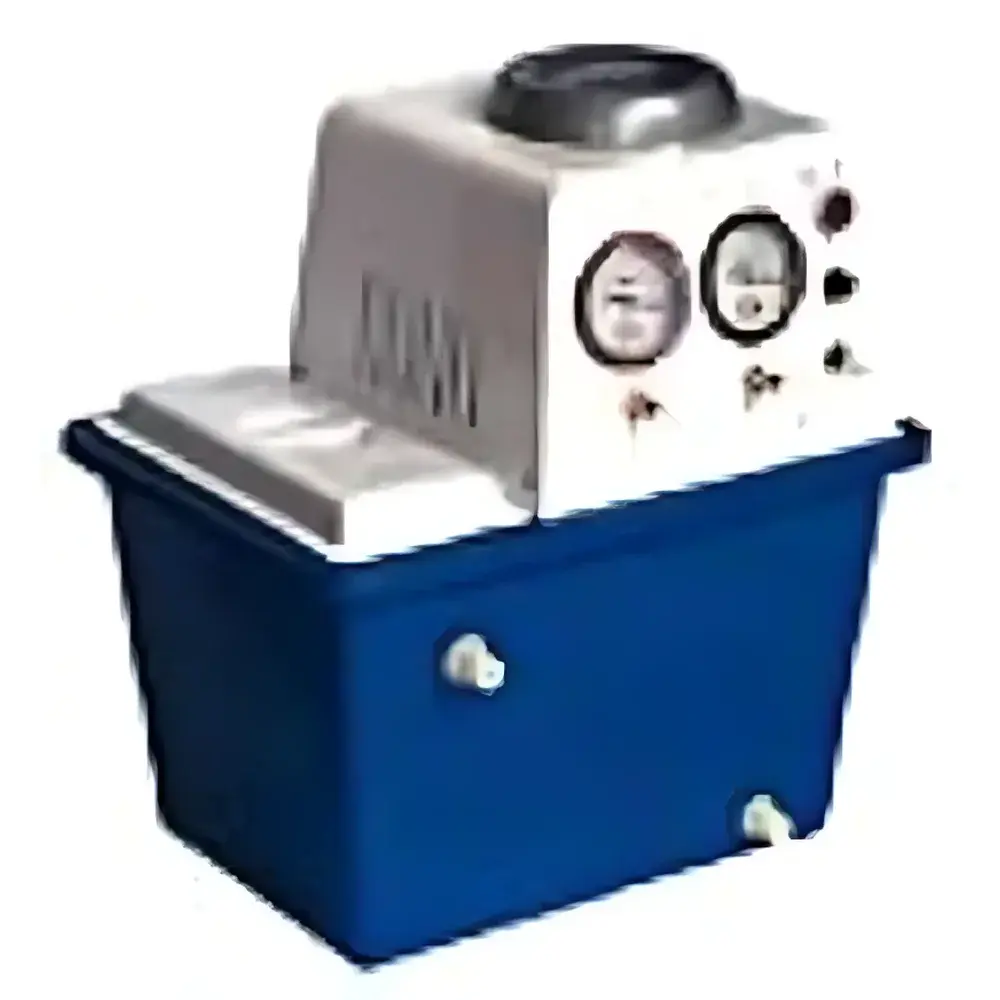
Yuhua SHZ-D(III) Circulating Water Vacuum Pump
| Brand | Yuhua |
|---|---|
| Model | SHZ-D(III) |
| Power | 180–220 V / 50 Hz |
| Flow Rate | 60 L/min |
| Max. Vacuum Degree | 0.098 MPa |
| Single-Head Suction Capacity | 10 L/min |
| Number of Suction Ports | 2 |
| Water Tank Volume | 15 L |
| Dimensions (L×W×H) | 400×280×420 mm |
| Weight | 15 kg |
| Housing Material | 1Cr18 Stainless Steel |
| Motor Power | 8 W |
Overview
The Yuhua SHZ-D(III) Circulating Water Vacuum Pump is a compact, benchtop vacuum generation system engineered for consistent, low-maintenance operation in academic teaching laboratories and routine analytical workflows. It operates on the principle of water-ring vacuum generation: ambient water within the sealed reservoir is rotated by an eccentrically mounted impeller, forming a liquid ring that traps and compresses gas from connected apparatus. As the impeller rotates, successive chambers between blades expand to draw in gas via suction ports and contract to expel it through the exhaust—delivering stable vacuum without oil or mechanical seals. Designed specifically to address spatial constraints in undergraduate chemistry labs, the SHZ-D(III) integrates dual independent suction ports with individual vacuum gauges, enabling simultaneous, isolated vacuum control for two separate reaction setups or distillation assemblies. Its maximum attainable vacuum level of 0.098 MPa (equivalent to ~735 Torr or ~98 kPa absolute) is sufficient for standard rotary evaporation, vacuum filtration, reduced-pressure drying, and aspiration applications under ambient conditions.
Key Features
- Benchtop form factor (400 × 280 × 420 mm) optimized for limited lab footprint—ideal for student workstations and modular teaching benches.
- Dual independent suction ports with dedicated analog vacuum gauges for real-time, side-by-side pressure monitoring and independent process control.
- Corrosion-resistant construction: stainless steel (1Cr18) pump body and internal wetted components ensure long-term compatibility with mildly acidic, alkaline, or organic solvent vapors commonly encountered in organic synthesis and extraction procedures.
- Low-noise, low-power motor (8 W) with thermal overload protection—designed for continuous unattended operation during multi-hour experiments.
- Integrated 15 L transparent or opaque water reservoir with level indicator; supports closed-loop recirculation and optional external cooling if ambient temperature exceeds 30 °C.
- Modular port configuration allows field upgrade to four-port variants (SHZ-D(III)-4G) without chassis replacement—facilitating scalability across lab cohorts.
Sample Compatibility & Compliance
The SHZ-D(III) is compatible with standard ground-glass jointed glassware (e.g., B-14, B-19, B-24), Buchner funnels, rotary evaporator condensers, and Schlenk line manifolds. Its water-sealed operation eliminates hydrocarbon contamination risks associated with oil-lubricated pumps—making it suitable for solvent-sensitive applications where residual oil vapor must be avoided. While not certified to ISO 8573 (compressed air purity) or ATEX standards, the unit complies with IEC 61010-1:2010 for electrical safety in laboratory equipment. Its design supports GLP-aligned documentation practices: vacuum stability (< ±2% fluctuation over 2 h at 0.095 MPa) and reproducible startup response (< 45 s to reach operating vacuum) enable traceable experimental conditions when logged manually or via external data acquisition systems.
Software & Data Management
The SHZ-D(III) is a standalone analog device with no embedded microcontroller, firmware, or digital interface. All operational parameters—including vacuum level, flow rate, and runtime—are monitored visually via dual analog gauges and manual observation. This architecture ensures electromagnetic immunity in environments with RF-intensive instrumentation (e.g., NMR, FTIR) and eliminates cybersecurity or validation overhead. For labs requiring electronic recordkeeping, third-party USB pressure transducers (e.g., Validyne DP15) may be plumbed in series with either suction port and interfaced with LabVIEW, MATLAB, or ELN platforms compliant with 21 CFR Part 11 audit trail requirements. No proprietary software or cloud dependency is introduced.
Applications
- Vacuum-assisted gravity filtration of crystalline precipitates using Buchner or Hirsch funnels.
- Rotary evaporation of heat-labile compounds below their atmospheric boiling points (e.g., terpenes, essential oils, polymer precursors).
- Reduced-pressure drying of filter cakes or hygroscopic solids in desiccators equipped with vacuum manifolds.
- Gas evacuation prior to inert-atmosphere reactions (e.g., Grignard, organolithium preparations) when paired with nitrogen purge cycles.
- Student-led pedagogical demonstrations of vapor pressure, boiling point depression, and phase equilibria in physical chemistry curricula.
FAQ
What is the recommended water temperature range for optimal performance?
Maintain reservoir water between 10 °C and 25 °C. Temperatures above 30 °C reduce vapor pressure margin and may cause premature cavitation or gauge drift.
Can this pump handle corrosive vapors from HCl or HF-based digestions?
It is rated for mild corrosion resistance (1Cr18 stainless steel + molded PVC housing), but not for continuous exposure to concentrated mineral acids. Use only with scrubbers or cold traps for such applications.
Is the water tank removable for cleaning or refilling?
Yes—the reservoir is secured with threaded fasteners and gasketed access panels; full disassembly requires no tools beyond a standard hex key set.
Does the pump require periodic oil changes?
No. As a water-ring vacuum pump, it uses deionized or distilled water as the sealing and compression medium—no lubricating oil is present or required.
How often should the water be replaced during extended use?
Replace water every 8–12 hours of cumulative operation or immediately if discoloration, particulate accumulation, or pH shift (> ±1 unit) is observed.
Related Products



