
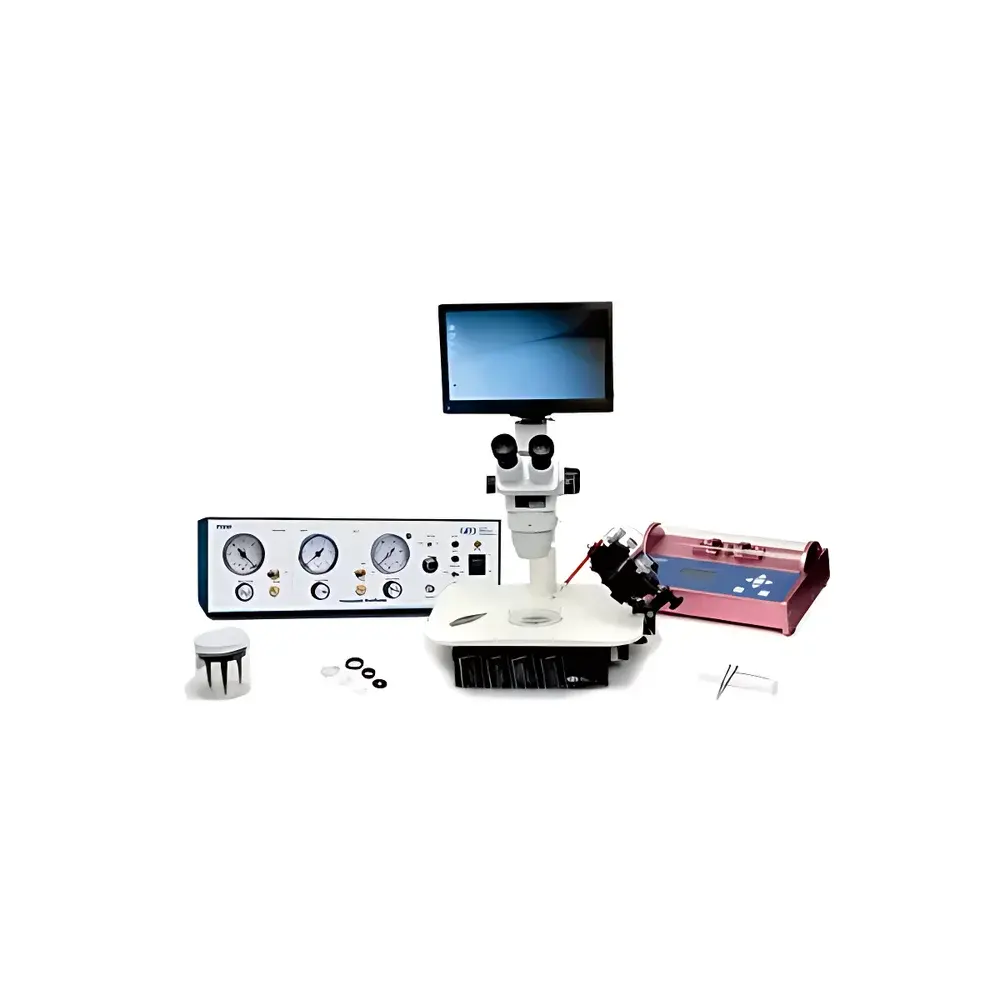
WPI SYS-PV830 Pneumatic Picoliter Microinjector
| Brand | WPI |
|---|---|
| Origin | USA |
| Model | SYS-PV830 |
| Instrument Type | Automated |
| Reservoir Volume | 100 ms and 10 s pulse duration options |
| Pressure Control Modes | Positive pressure (injection), negative pressure (vacuum hold/suction), and maintenance pressure (anti-siphon bias) |
| Flow/Volume Range | 1–1000 pL per pulse (dependent on capillary geometry, pressure, and duration) |
| Pulse Duration Options | 100 ms and 10 s |
| Operating Pressure Range | 0–100 psi (adjustable in 0.1 psi increments) |
| Vacuum Range | 0–−25 psi |
| Compliance | ASTM F2149-01 (for microinjection system performance verification), ISO 13485 (design-controlled manufacturing environment), GLP-compliant data logging capability |
Overview
The WPI SYS-PV830 Pneumatic Picoliter Microinjector is a precision-engineered, dual-mode pneumatic microinjection platform designed for high-fidelity intracellular and extracellular delivery in developmental biology, neurophysiology, and transgenic model organism research. Operating on the principle of regulated gas-driven pressure transients, the SYS-PV830 delivers repeatable, sub-nanoliter fluid displacement through glass micropipettes via digitally controlled positive-pressure pulses, vacuum-assisted cell immobilization, and a dedicated maintenance pressure circuit that actively suppresses capillary backflow—eliminating siphoning and diffusion-induced volume drift between injection events. Its architecture conforms to the fundamental requirements of single-cell manipulation: deterministic volume control, temporal resolution at the millisecond scale, mechanical stability during long-duration experiments, and compatibility with inverted and upright microscopy platforms. The system is widely deployed in core facilities and academic laboratories conducting CRISPR/Cas9 editing, mRNA/cDNA microinjection, fluorescent tracer loading, and targeted drug delivery in zebrafish embryos, C. elegans, Drosophila oocytes, aquaculture species (e.g., tilapia, medaka, sea urchin), and insect models including cotton bollworm and brown planthopper.
Key Features
- Dual independent pressure channels: Separate, calibrated positive-pressure (0–100 psi) and vacuum (0–−25 psi) outputs enable concurrent or sequential aspiration and ejection—critical for nuclear transfer, organelle isolation, and particle-mediated delivery.
- Three-state pressure logic: Injection pressure + maintenance pressure + vacuum hold operate within a single fluidic path, allowing pipette tip priming, cell adhesion, and precise volumetric expulsion without hardware reconfiguration.
- Pulse duration flexibility: Selectable 100 ms or 10 s injection windows accommodate both rapid neuronal puff applications and slow-volume cytoplasmic loading; timing resolution is hardware-gated and jitter-free.
- Capillary-compatible calibration: Volumetric output is empirically determined by pipette tip geometry (inner diameter, taper angle), applied pressure, and pulse duration—enabling reproducible pL–nL delivery across user-defined parameters.
- Manual and external triggering: Front-panel push-button operation and TTL-compatible footswitch input support hands-free workflow integration with electrophysiology rigs, confocal imaging systems, and automated embryo positioning stages.
- Anti-siphon maintenance pressure: A low-bias positive offset (typically 0.5–2 psi) remains active between pulses, preventing passive back-diffusion and ensuring baseline stability over extended experimental sessions (>8 hours).
Sample Compatibility & Compliance
The SYS-PV830 interfaces seamlessly with standard borosilicate or quartz patch-clamp and injection pipettes (1–5 µm tip ID). It supports live, unfixed specimens ranging from single-celled zygotes (Danio rerio, Xenopus laevis) to intact larval stages and semi-intact neural preparations. All pressure and vacuum circuits meet ISO 8536-4 (sterile fluid pathway integrity) and are compatible with ethanol, isopropanol, and aqueous saline-based solutions. System firmware logs all pressure setpoints, pulse durations, and trigger timestamps with microsecond resolution, satisfying GLP audit requirements for traceability. Data export adheres to ASTM E1482-20 (electronic laboratory notebook metadata standards) and supports 21 CFR Part 11–compliant digital signature workflows when integrated with validated LIMS platforms.
Software & Data Management
While the SYS-PV830 operates as a standalone analog/digital hybrid instrument, its pressure and timing parameters are fully programmable via optional WPI MicroManager-compatible drivers and LabVIEW VIs. All operational states—including pressure ramp profiles, inter-pulse intervals, and vacuum hold duration—are stored in non-volatile memory and recalled via front-panel presets. Audit trails include operator ID (if network-authenticated), date/time stamps, and parameter checksums. Export formats include CSV and HDF5, enabling direct ingestion into Python (NumPy/Pandas), MATLAB, or R-based analysis pipelines for injection efficacy quantification and dose–response modeling.
Applications
- Zebrafish embryology: Precise cytoplasmic or yolk injection of morpholinos, gRNA/Cas9 ribonucleoprotein complexes, and lineage tracers.
- Invertebrate transgenesis: Germline transformation in C. elegans and D. melanogaster via pronuclear microinjection.
- Aquaculture biotechnology: Genetic modification of freshwater and marine teleost oocytes under sterile laminar flow conditions.
- Neuroscience puff application: Localized odorant, neurotransmitter, or pharmacological agent delivery to defined brain nuclei in head-fixed preparations.
- Subcellular surgery: Mitochondrial, lysosomal, or nuclear transplantation using coordinated vacuum capture and pressure ejection.
- Nanoparticle delivery: Controlled transfer of quantum dots, liposomes, or polymer-based carriers into single cells without membrane rupture.
FAQ
What pipette types are compatible with the SYS-PV830?
Standard pulled glass micropipettes (borosilicate or quartz) with tip inner diameters from 0.5 µm to 5 µm are supported. Tip geometry must be characterized empirically for volume calibration.
Can the SYS-PV830 be integrated with automated micromanipulators?
Yes—TTL trigger inputs and analog pressure control outputs allow synchronization with Sutter MP-285, Scientifica PatchStar, or Luigs & Neumann MF-900 manipulators.
Does the system comply with FDA 21 CFR Part 11 for regulated studies?
When used with WPI’s validated software suite and network-authenticated user accounts, full electronic record integrity, audit trail generation, and role-based access control are achievable.
How is volume accuracy verified and maintained?
Volume is derived from calibrated pressure–duration–geometry relationships; users perform daily verification using fluorescent dye dilution assays and confocal volumetric reconstruction per ISO/IEC 17025 guidelines.
Is service and technical support available outside North America?
WPI maintains authorized service partners in the EU, APAC, and EMEA regions; all units ship with bilingual (English/French/German) service manuals and remote diagnostic capability.




