
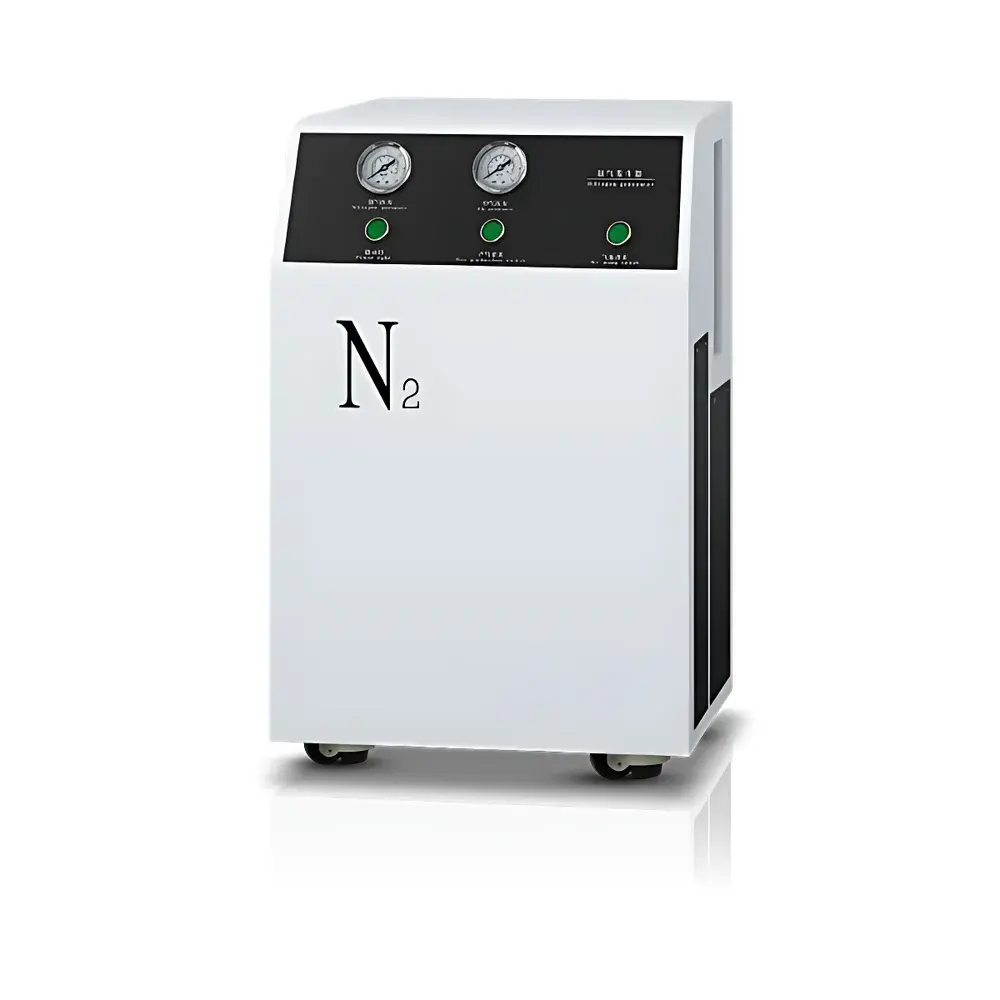
CM-30LB High-Pressure Nitrogen Generator for LC-MS and High-Flow Applications
| Brand | Chengmeng Technology |
|---|---|
| Origin | Beijing, China |
| Model | CM-30LB |
| Output Flow | 0–30 L/min |
| Output Pressure | 116 psi (adjustable) |
| Nitrogen Purity | 95–99.9% |
| Dew Point | −10°C |
| Particle Size Limit | <0.01 µm |
| Total Power | 1.3 kW |
| Noise Level | ≤58 dB(A) |
| Dimensions (L×W×H) | 800×500×750 mm |
| Weight | 130 kg |
| Input Power | 220 V ±10%, 50 Hz |
| Operating Ambient | Temp ≤30°C, RH ≤60% |
Overview
The CM-30LB High-Pressure Nitrogen Generator is an integrated, self-contained gas supply system engineered for continuous, on-demand delivery of high-purity nitrogen to demanding analytical applications—particularly liquid chromatography–mass spectrometry (LC-MS) systems operating under elevated backpressure, as well as high-flow nitrogen blow-down instruments (nitrogen evaporators). Unlike traditional cylinder-based solutions, the CM-30LB eliminates logistical constraints, safety hazards, and supply-chain dependencies associated with high-pressure gas cylinders. Its core architecture combines a dual-stage air compression module with a high-efficiency membrane separation system, enabling stable nitrogen production across variable load conditions without external compressed air infrastructure.
The generator operates on pressure-driven membrane separation: ambient air is drawn in, compressed, dried, and filtered before passing through proprietary polymeric hollow-fiber membranes. Under differential partial pressure, oxygen, water vapor, and CO2 permeate selectively through the membrane wall, while nitrogen—retained due to its lower permeability—emerges as the product stream. This principle ensures consistent output purity (95–99.9%) and dew point control (−10°C), meeting the baseline requirements for electrospray ionization (ESI) and atmospheric pressure chemical ionization (APCI) sources in LC-MS platforms. The built-in stainless-steel storage tank buffers transient demand spikes, while intelligent pressure-sensing logic governs compressor cycling to maintain system efficiency and longevity.
Key Features
- Integrated dual-compressor design with active vibration damping and thermal insulation—reducing mechanical stress and extending service life
- Self-contained air intake system with multi-stage filtration (particulate, coalescing, and activated carbon), eliminating dependency on facility-supplied compressed air
- High-selectivity nitrogen separation membranes optimized for sustained operation at elevated feed pressures (up to 116 psi)
- Stainless-steel air receiver tank (grade 304 or equivalent) with ASME-compliant pressure vessel certification and integrated automatic condensate drainage
- Dual-level protection circuitry: overpressure cutoff (mechanical + electronic) and overcurrent shutdown, compliant with IEC 61000-4 immunity standards
- Intelligent control panel with real-time monitoring of outlet pressure, flow rate, and runtime hours; programmable pressure setpoint and auto-restart after power interruption
- Passive cooling architecture with optimized finned heat exchangers and low-noise axial fans (≤58 dB[A] at 1 m)
- Four-point leveling feet and industrial-grade swivel casters for secure repositioning within regulated laboratory environments
Sample Compatibility & Compliance
The CM-30LB is validated for use with major LC-MS platforms requiring inlet nitrogen at ≥60 psi—including Thermo Fisher Scientific (Orbitrap, TSQ series), Waters (Xevo, Vion series), Agilent (6470, 6550), and Shimadzu (Nexera UC, LCMS-8060). It meets the minimum gas quality specifications outlined in ASTM D6352 (Standard Guide for Gas Purity Requirements in Analytical Instrumentation) and ISO 8573-1:2010 Class 2:2:2 for particulate, moisture, and oil content. While not certified to FDA 21 CFR Part 11 out-of-the-box, its firmware supports audit-trail-enabled logging when integrated with third-party LIMS or ELN systems. The unit complies with CE marking requirements (EMC Directive 2014/30/EU and Low Voltage Directive 2014/35/EU) and conforms to GB/T 19001–2016 (equivalent to ISO 9001:2015) for manufacturing quality control.
Software & Data Management
The CM-30LB features embedded microcontroller-based firmware with RS-232 and optional Ethernet (Modbus TCP) interfaces for remote status interrogation and parameter adjustment. Data logs—including cumulative runtime, compressor cycles, and pressure deviation events—are stored internally for up to 30 days and exportable via USB-C port in CSV format. No proprietary software installation is required; configuration is accessible through a browser-based interface (HTTP/HTTPS) supporting TLS 1.2 encryption. For GLP/GMP environments, timestamped event records (e.g., “Compressor Start,” “Low-Pressure Alarm”) satisfy basic traceability requirements. Firmware updates are performed via signed binary files to prevent unauthorized modification.
Applications
- LC-MS mobile phase nebulization and desolvation gas supply (ESI/APCI sources)
- High-throughput nitrogen blow-down for sample concentration prior to GC-MS or HPLC analysis
- Inert blanketing during solvent evaporation, derivatization, or standard preparation
- Carrier gas for purge-and-trap systems and headspace analyzers
- Lab-wide nitrogen distribution networks in centralized gas supply configurations (when paired with pressure regulators and manifold systems)
FAQ
Does the CM-30LB require external compressed air?
No. It incorporates a dual-stage oil-free air compressor and requires only standard 220 V AC power.
What maintenance intervals are recommended?
Air intake filters should be inspected monthly and replaced every 6 months; membrane modules are rated for ≥15,000 hours of continuous operation under specified ambient conditions (≤30°C, ≤60% RH).
Can output purity be verified in-house?
Yes—integrated pressure-swing adsorption (PSA) calibration ports allow connection to portable electrochemical oxygen analyzers (e.g., Michell XDT-100) for periodic purity validation.
Is the unit suitable for cleanroom environments?
It meets ISO Class 8 (Class 100,000) particulate emission limits when installed with appropriate exhaust ducting; optional HEPA exhaust filtration kits are available upon request.
How does ambient humidity affect performance?
Exceeding 60% RH may reduce membrane lifespan and elevate dew point; operation above 30°C ambient temperature triggers thermal derating to preserve long-term stability.



