
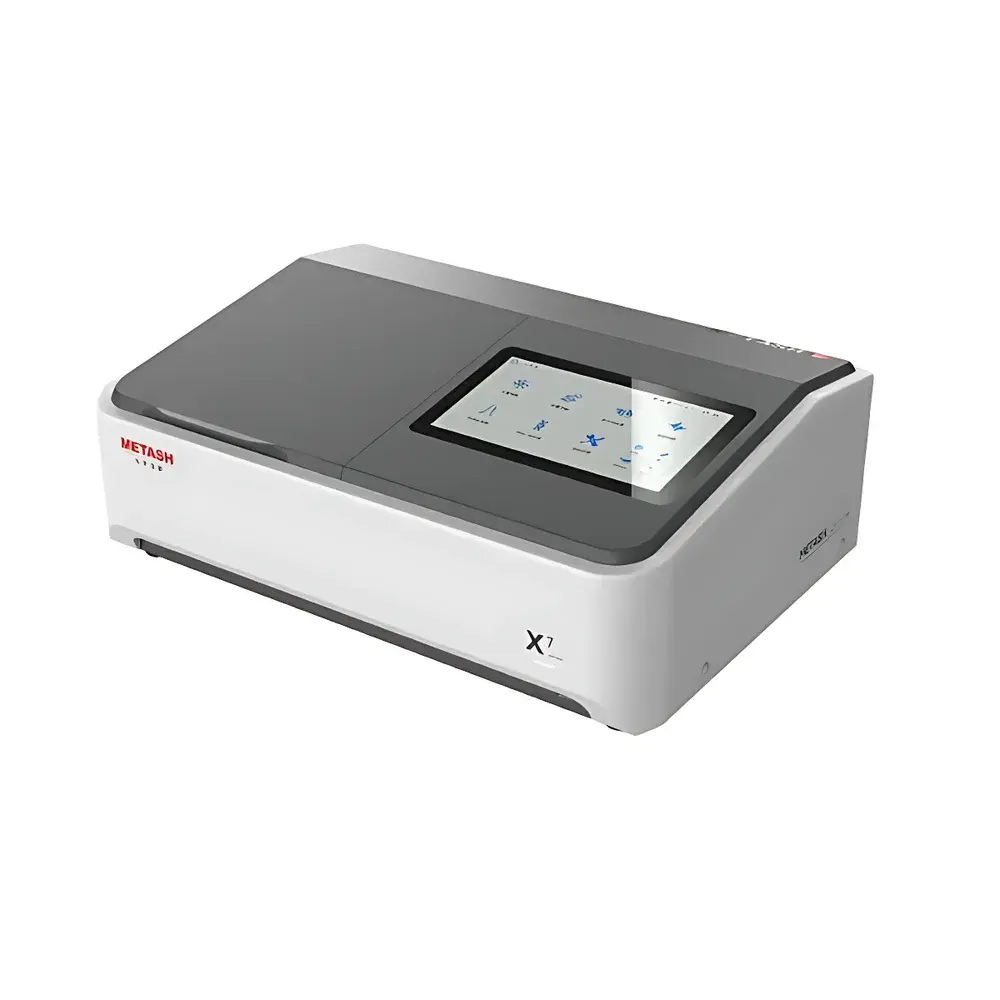
Metash X-7S Touchscreen UV-Vis Spectrophotometer
| Brand | Metash Instruments |
|---|---|
| Origin | Shanghai, China |
| Manufacturer Type | Original Equipment Manufacturer (OEM) |
| Model | X-7S |
| Optical Design | Pseudo-Double-Beam |
| Detector | Silicon Photodiode |
| Wavelength Range | 190–1100 nm |
| Wavelength Accuracy | ±0.1 nm at D₂ line (656.1 nm), ±0.3 nm across full range |
| Wavelength Repeatability | ≤0.1 nm |
| Spectral Bandwidth | 0.5 / 1.0 / 2.0 / 4.0 / 5.0 nm (selectable) |
| Stray Light | ≤0.03% T |
| Photometric Accuracy | ±0.2% T (0–100% T), ±0.002 A (0–0.5 A), ±0.004 A (0.5–1.0 A) |
| Photometric Repeatability | ≤0.1% T, ≤0.001 A (0–0.5 A), ≤0.002 A (0.5–1.0 A) |
| Baseline Drift | ±0.0005 A/h at 500 nm |
| Baseline Flatness | ±0.001 A |
| Noise Level | ±0.0005 A |
| Photometric Range | 0–200% T, –4.0 to +4.0 A, 0–9999 C |
| Display | 10-inch capacitive multi-touch TFT color screen |
| Data Interface | USB 2.0 (host and device) |
| Power Supply | AC 220 V/50 Hz or 110 V/60 Hz |
| Dimensions (W×D×H) | 460 × 380 × 180 mm |
| Weight | 20 kg |
Overview
The Metash X-7S Touchscreen UV-Vis Spectrophotometer is a high-performance, pseudo-double-beam optical instrument engineered for precision absorbance, transmittance, and concentration measurements across the ultraviolet, visible, and near-infrared spectral regions (190–1100 nm). Its optical architecture employs a dynamically balanced beam ratio monitoring system that continuously compensates for source intensity drift—particularly critical during extended spectral scans or kinetic assays—thereby ensuring long-term photometric stability without manual recalibration. The instrument integrates a thermally stabilized dual-lamp source (deuterium for UV, tungsten-halogen for VIS/NIR) and a high-fidelity monochromator with five selectable slit widths (0.5–5.0 nm), enabling rigorous compliance with method-specific resolution requirements defined in pharmacopoeial standards (e.g., USP , EP 2.2.25) and industrial QA/QC protocols.
Key Features
- Pseudo-double-beam optical path with real-time reference beam monitoring, minimizing baseline drift and enhancing measurement reproducibility under variable ambient conditions.
- 10-inch industrial-grade capacitive multi-touch display with intuitive GUI—enabling direct parameter input, spectrum navigation, peak annotation, and report preview without external PC dependency.
- Rigid 8-mm machined aluminum optical baseplate with suspended monochromator and detector assembly—mechanically isolating the optical train from chassis vibration and thermal expansion effects.
- Five-step adjustable spectral bandwidth (0.5/1.0/2.0/4.0/5.0 nm) to optimize signal-to-noise ratio versus spectral resolution trade-offs per application (e.g., narrow bandwidth for sharp protein peaks; wider for turbid samples).
- Comprehensive onboard functionality: photometric mode, quantitative analysis (single/multi-point calibration, equation-based concentration calculation), full-spectrum scanning (190–1100 nm), time-resolved kinetics, DNA/protein A260/A280 ratio analysis, multi-wavelength quantitation, and A4-format printing via USB-connected thermal or inkjet printers.
- USB-host interface supporting direct data export to FAT32-formatted USB drives—including spectra (.csv), method files (.met), and audit-ready reports with embedded timestamps and operator IDs.
Sample Compatibility & Compliance
The X-7S supports standard 10-mm rectangular cuvettes (glass, quartz, or plastic), optional 5-mm and 1-mm microcells, and specialized accessories including an automated 8-cell turret, Peltier-controlled temperature-regulated cell holder (±0.1 °C), integrating sphere for diffuse reflectance, and rotating solid-sample stage. All hardware and firmware comply with ISO/IEC 17025:2017 general requirements for testing laboratories and support GLP/GMP workflows through built-in user role management (admin/operator/auditor), electronic signature-capable audit trails, and immutable data logging per FDA 21 CFR Part 11 Annex 11 principles. Stray light performance (≤0.03% T at 220 nm) meets or exceeds ASTM E275 and ISO 9001 validation criteria for pharmaceutical raw material identification.
Software & Data Management
Metash SpectraPro™ software (optional PC-based suite) extends instrument capability with advanced curve fitting (Gaussian/Lorentzian deconvolution), derivative spectroscopy, spectral subtraction, batch processing of multi-sample datasets, and customizable report templates compliant with internal SOPs or regulatory submissions. All data—including raw absorbance values, processed results, metadata (lamp hours, calibration dates, environmental logs), and operator actions—are stored with cryptographic hash integrity verification. Export formats include CSV, TXT, PDF/A-2b, and XML for LIMS integration. Audit trail records retain full traceability: who performed each action, when, and what parameters were modified—enabling full forensic reconstruction during regulatory inspections.
Applications
- Pharmaceutical QC: Active pharmaceutical ingredient (API) assay, excipient purity screening, dissolution profile analysis per USP .
- Life sciences: Nucleic acid quantification (A260), protein concentration (Bradford/Lowry/BCA), enzyme kinetics (NADH/NADPH monitoring at 340 nm), and cell culture density (OD600).
- Environmental testing: Nitrate/nitrite, phosphate, COD, and heavy metal (Cr, Fe, Cu) determination via colorimetric methods per EPA 365.2 and ISO 6060.
- Food & beverage: Color index (CIE L*a*b*), antioxidant capacity (FRAP/DPPH), and preservative (sulfite, nitrate) quantification.
- Materials science: Thin-film thickness estimation via interference fringe analysis and bandgap energy calculation from Tauc plots.
FAQ
Is the X-7S compliant with FDA 21 CFR Part 11 for electronic records and signatures?
Yes—the optional SpectraPro™ software includes role-based access control, electronic signature capture, and tamper-evident audit trails meeting Part 11 requirements for regulated environments.
Can the instrument perform kinetic measurements over extended durations (e.g., >1 hour)?
Yes—baseline drift is specified at ±0.0005 A/h at 500 nm, enabling reliable monitoring of slow enzymatic reactions or degradation studies without active zero-tracking intervention.
What is the minimum sample volume required with the standard 10-mm cuvette?
Standard quartz/glass cuvettes require ≥3.5 mL for full beam coverage; optional 1-mm microcuvettes reduce volume to 70 µL while maintaining photometric accuracy.
Does the X-7S support wavelength calibration verification using NIST-traceable standards?
Yes—built-in holmium oxide and didymium filters are supported for periodic verification; calibration certificates traceable to NIST SRM 2034 and 930e are available upon request.
How is data security ensured during USB export or network transfer?
All exported files are digitally signed and timestamped; SpectraPro™ enforces AES-256 encryption for archived method and result databases stored on external media.



