
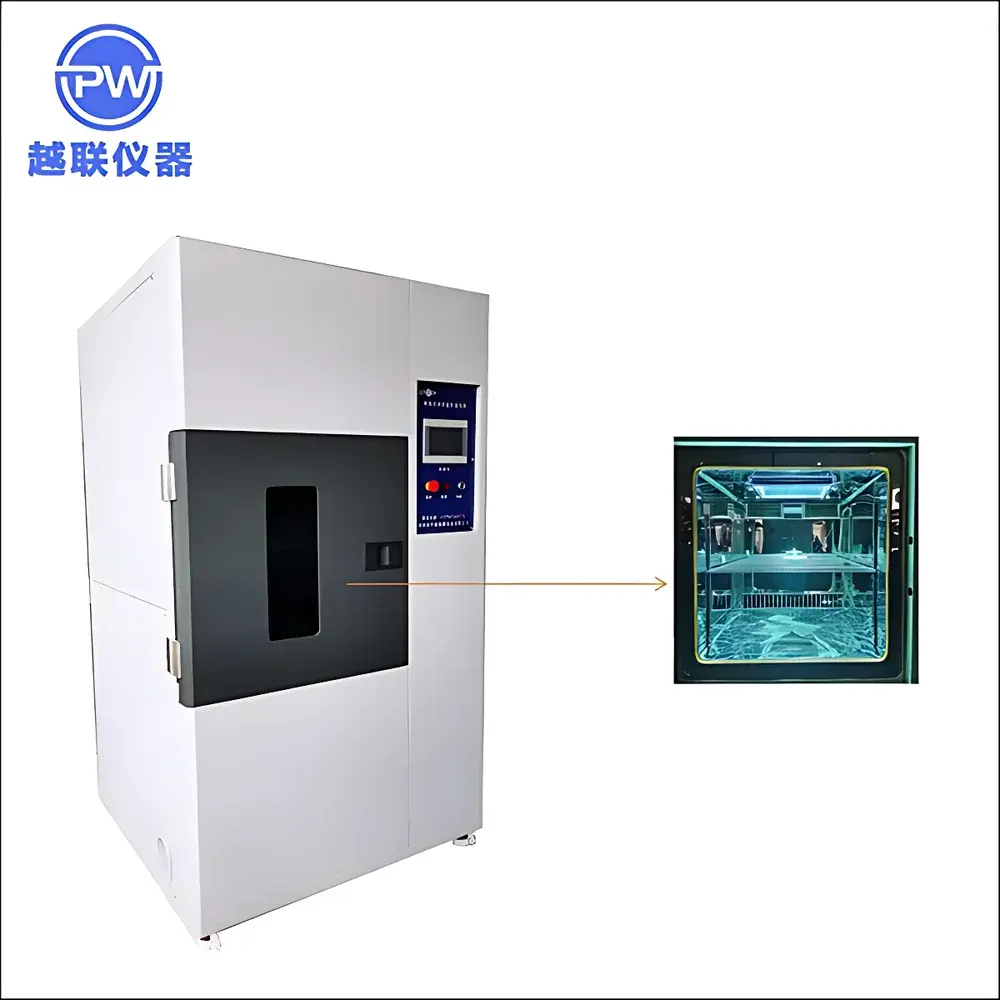
Yuelian / PW PW-CX4000B Air-Cooled Xenon Arc Weathering Chamber
| Brand | Yuelian / PW |
|---|---|
| Origin | Guangdong, China |
| Manufacturer Type | Authorized Distributor |
| Country of Manufacture | China |
| Model | PW-CX4000B |
| Chamber Dimensions (W×D×H) | 1000 × 1000 × 1000 mm |
| External Dimensions (W×D×H) | 1450 × 1450 × 2250 mm |
| Lamp Power | 4 kW (Imported Xenon Arc Lamp) |
| Lamp Life | ≥1000 h |
| Irradiance Control Points | @340 nm, @420 nm, or broadband 280–890 nm |
| Irradiance Range | 0.25–0.58 W/m² @340 nm |
| Black Panel Temperature Range | 35–100 °C |
| Air Temperature Range | 35–80 °C |
| Temperature Uniformity | ±3 °C |
| Temperature Stability | ±0.5 °C |
| Humidity Range (Light Cycle) | 20–75 %RH |
| Humidity Range (Dark Cycle) | 45–95 %RH |
| Humidity Uniformity | ±5 %RH |
| Sample Tray Size | 950 × 950 mm (Flat, 3D-Compatible) |
| Spray Mode | Front-surface water spray |
| Spray Flow Rate | 0.2 L/min |
| Cooling Method | Forced-air convection with interlocked fan-lamp safety logic |
| Compliance Standards | GB/T 16422.2-2014, GB/T 16259-2008, GB/T 1865-2009, ISO 4892-2, ISO 11341, AATCC TM16, AATCC 169, GB/T 8427-2008, ASTM G155 |
Overview
The Yuelian / PW PW-CX4000B Air-Cooled Xenon Arc Weathering Chamber is an engineering-grade accelerated aging test system designed to replicate full-spectrum solar radiation, thermal cycling, humidity variation, and simulated rainfall under controlled laboratory conditions. It employs a 4 kW imported xenon arc lamp as its primary irradiation source, coupled with precision optical filtering to deliver spectral power distribution closely matching terrestrial sunlight (CIE No. 85, ASTM G155 spectral class A/B). The chamber operates on the principle of xenon arc exposure—where high-intensity broadband radiation (280–3000 nm) induces photochemical degradation, thermal oxidation, and hydrolytic breakdown in polymeric, coated, textile, and composite materials. Its air-cooled architecture eliminates dependency on external chilled water systems, enabling stable long-term operation in standard industrial lab environments. This design supports continuous, unattended testing per GLP-compliant protocols while maintaining traceable irradiance calibration across multiple spectral bands.
Key Features
- Large-volume test chamber (1 m³ internal volume) accommodates full-size automotive interior components, instrument panels, and irregular 3D specimens without disassembly.
- Digitally regulated irradiance control via closed-loop “Sun Eye” fiber-optic sensor system, supporting real-time PID adjustment at user-selectable monitoring wavelengths (@340 nm, @420 nm, or broadband 280–890 nm).
- Dual-temperature monitoring: independent black panel temperature (BPT) and chamber air temperature (CAT) sensors enable precise simulation of surface vs. ambient thermal loading—critical for automotive and aerospace qualification.
- Nanotechnology-enhanced PTC humidification system delivers stable RH control with 80% versus conventional steam-based units.
- Front-surface spray system with calibrated high-pressure nozzles delivers uniform deionized water impact to simulate rain-induced thermal shock and surface erosion.
- 7-inch Weintek color touchscreen HMI with multilingual interface (English firmware optional), offering programmable light/dark cycles, spray timing, temperature ramps, and real-time curve visualization of all critical parameters.
- Comprehensive safety architecture: interlocked lamp-fan cooling, dry-run protection for humidifier, phase-loss/leakage detection, overtemperature cutoff, and automatic fault logging with diagnostic guidance.
- USB data export functionality enables direct transfer of time-stamped irradiance, temperature, humidity, and spray event logs into Excel-compatible CSV files for audit-ready reporting.
Sample Compatibility & Compliance
The PW-CX4000B is validated for testing flat, curved, and dimensionally complex samples—including injection-molded thermoplastics, painted metal substrates, laminated composites, textile fabrics, and coated electronics housings. Its flat 950 mm × 950 mm stainless-steel sample tray allows flexible mounting of standardized coupons (e.g., ISO 105-B02, ASTM D2244) or production-intent parts. The system conforms to international standards governing material weathering performance, including ISO 4892-2 (plastics), ISO 11341 (coatings), AATCC TM16 and 169 (textiles), GB/T 1865-2009 (paints), and ASTM G155 (xenon arc apparatus classification). All irradiance sensors are factory-calibrated traceable to NIST-equivalent reference standards, and annual stability is certified at ≤2% deviation—meeting requirements for ISO/IEC 17025-accredited laboratories.
Software & Data Management
The embedded controller firmware supports both fixed-value and multi-step programmable test profiles, with up to 11 user-defined standard templates stored in non-volatile memory. Real-time parameter monitoring includes BPT/CAT, RH%, irradiance (W/m²), elapsed exposure time, and spray cycle status—displayed simultaneously in numeric, trend-curve, and tabular formats. Data logging resolution is 1-second interval, with internal storage capacity exceeding 30 days of continuous operation. USB export generates timestamped, comma-delimited files compatible with statistical analysis tools (e.g., JMP, Minitab) and LIMS integration. Remote supervision is enabled via Ethernet/Wi-Fi connectivity using vendor-provided PC software or mobile application (iOS/Android), supporting live view, alarm push notifications, and secure parameter modification—all compliant with FDA 21 CFR Part 11 electronic record requirements when configured with audit trail and user access controls.
Applications
This chamber serves R&D, QC, and regulatory validation workflows across automotive OEMs and Tier-1 suppliers (e.g., dashboard UV resistance, seat fabric fade testing), paint and coating manufacturers (gloss retention, chalking assessment), textile labs (AATCC-compliant colorfastness), and building material producers (roofing membrane durability, PVC window profile embrittlement). It is routinely deployed for IEC 61215 photovoltaic module prequalification, UL 746C polymer tracking evaluation, and MIL-STD-810G Method 505.5 environmental stress screening. The ability to decouple irradiance intensity from thermal load enables mechanistic studies of synergistic degradation pathways—such as photo-oxidation acceleration under elevated humidity or hydrolytic cleavage triggered by cyclic wet/dry transitions.
FAQ
What spectral range does the xenon lamp cover, and how is it filtered?
The lamp emits continuous radiation from 280 nm to 3000 nm. Optical filtering using imported quartz and borosilicate glass assemblies selectively attenuates unwanted IR and UV-C components to match CIE daylight reference spectra (Class A/B per ASTM G155).
Is the system suitable for testing non-flat or large automotive components?
Yes—the 1 m³ chamber and 950 mm × 950 mm flat sample platform support dimensional parts up to 900 mm in height, including door trims, center consoles, and HVAC ducts.
How is irradiance uniformity ensured across the sample plane?
A rotating sample holder (optional accessory) and optimized reflector geometry ensure ±10% irradiance uniformity over the central 80% of the exposure area, verified per ISO 4892-2 Annex B.
Does the system meet regulatory requirements for pharmaceutical or medical device packaging validation?
While not specifically designed for USP or ISO 10993-12, its traceable irradiance control and GLP-aligned data handling make it suitable for supplemental stability studies where photostability is a defined critical quality attribute.
What maintenance intervals are recommended for lamp and filter replacement?
Lamps require replacement after ≥1000 hours of operation; filters should be inspected quarterly and replaced annually or after 2000 h of cumulative exposure to maintain spectral fidelity.



