
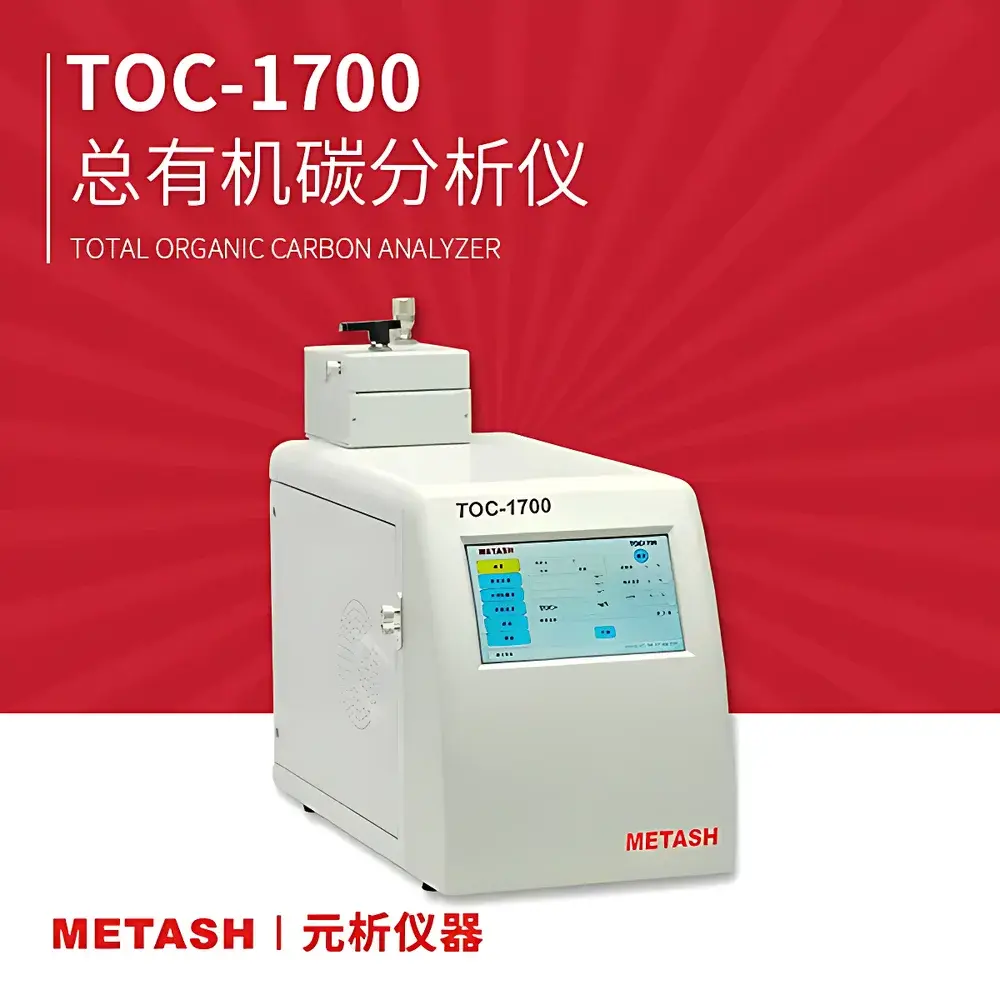
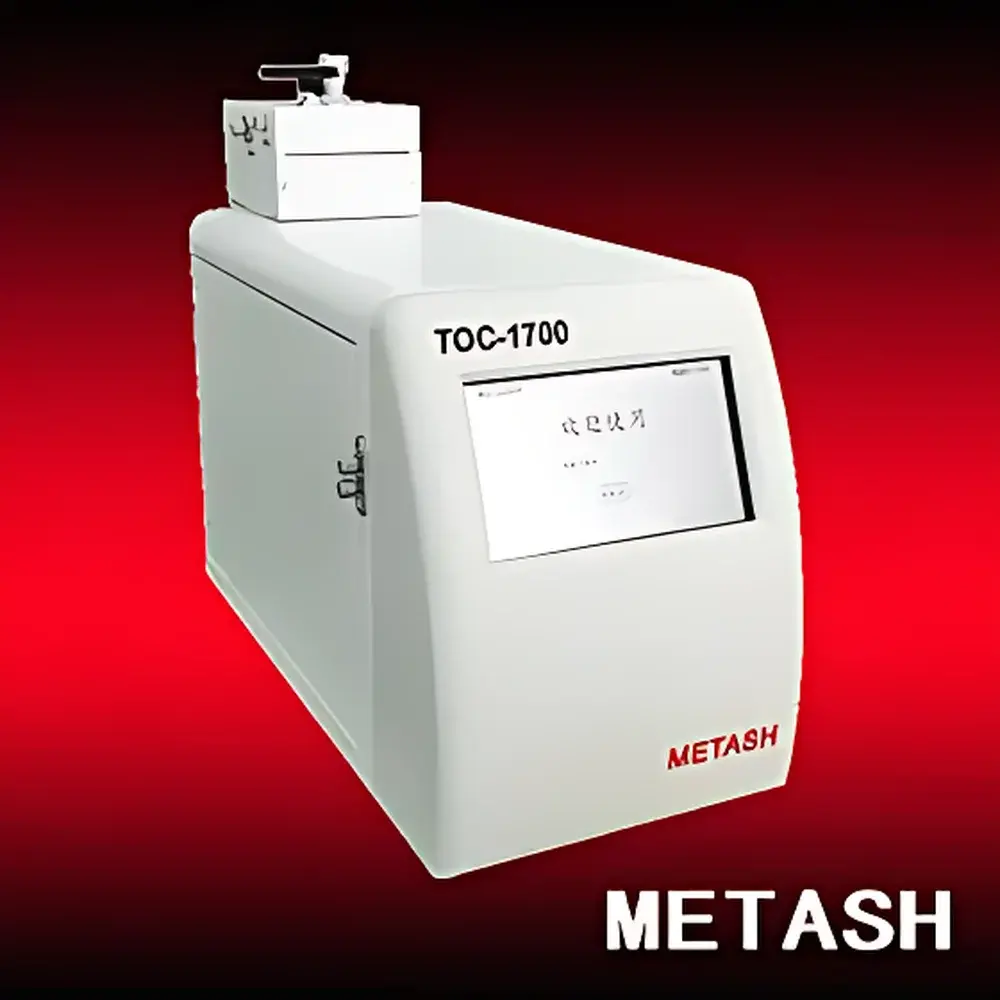
Metash TOC-1700 Total Organic Carbon Analyzer
| Brand | Metash Instruments |
|---|---|
| Origin | Shanghai, China |
| Manufacturer Type | Direct Manufacturer |
| Region of Origin | Domestic (China) |
| Model | TOC-1700 |
| Instrument Type | Online & Offline TOC Analyzer |
| Detection Principle | Direct Conductivity Detection |
| Oxidation Method | UV Photocatalytic Oxidation |
| Measurement Range | 0.001–1.5 ppm |
| Accuracy | ±3% |
| Resolution | 0.001 ppb |
| Detection Limit | 0.05 ppb |
| Repeatability | ≤3% RSD |
| Display | 7-inch Color Touchscreen |
| Data Storage | 8 GB Internal Flash Memory |
| Analysis Time | ≤3 minutes per sample |
| Compliance | CP2025 General Chapter <0901>, USP <643>, FDA 21 CFR Part 11 (Audit Trail & User Authentication) |
Overview
The Metash TOC-1700 is a high-sensitivity, dual-mode (online and offline) total organic carbon analyzer engineered for ultra-pure water systems in pharmaceutical manufacturing, biotechnology facilities, and semiconductor cleanroom utilities. It employs direct conductivity detection following low-pressure ultraviolet (UV) photocatalytic oxidation—a reagent-free, non-invasive oxidation method that converts dissolved organic carbon (DOC) into CO₂, which is then quantified via changes in solution conductivity. Unlike combustion-based or persulfate-mediated TOC analyzers, the TOC-1700 eliminates dependency on acid reagents, metal catalysts, carrier gases, or high-temperature furnaces—significantly reducing operational complexity, consumable costs, and risk of system contamination. Its design targets trace-level TOC quantification in waters with background organics below 1.5 ppm, making it especially suited for monitoring purified water (PW), water for injection (WFI), and ultrapure water (UPW) distribution loops per current pharmacopeial requirements.
Key Features
- UV photocatalytic oxidation at 185/254 nm wavelengths ensures complete mineralization of labile and semi-refractory organic compounds without chemical additives.
- Direct conductivity detection eliminates interference from inorganic carbon species through real-time background compensation and dual-cell differential measurement architecture.
- Automated micro-volume sampling (adjustable 20–100 µL) minimizes carryover and preserves sample integrity; integrated rinse cycles prevent cross-contamination between analyses.
- 7-inch capacitive touchscreen interface supports multilingual navigation (English default), intuitive workflow guidance, and context-sensitive help—designed for both technician and QA personnel operation.
- FDA 21 CFR Part 11-compliant firmware includes role-based user authentication, electronic signatures, immutable audit trails, and password-protected method editing.
- Acoustic alarm triggers upon TOC excursion beyond configurable upper control limits, safeguarding system integrity during continuous online monitoring.
- Modular hardware layout enables field-replaceable components—including UV lamp assembly, conductivity cell, and fluidic manifold—reducing mean time to repair (MTTR) to under 15 minutes.
Sample Compatibility & Compliance
The TOC-1700 is validated for aqueous matrices with conductivity <5.0 µS/cm and pH 5.0–7.5, including PW, WFI, UPW, and clean steam condensate. It meets system suitability criteria defined in Chinese Pharmacopoeia 2025 Edition (General Chapter ) and United States Pharmacopeia , including precision (≤3% RSD), accuracy (±3%), and detection limit (0.05 ppb). All firmware and data handling protocols conform to ALCOA+ principles (Attributable, Legible, Contemporaneous, Original, Accurate, Complete, Consistent, Enduring, Available) and support GLP/GMP audit readiness. No external calibration gases or secondary reference standards are required for routine operation.
Software & Data Management
Embedded firmware provides full-cycle data governance: automatic timestamping, sample ID tagging, operator logging, and method version tracking. Internal 8 GB NAND flash memory retains ≥100,000 test records with no time-based expiration. Historical data retrieval is filterable by date range, sample ID, or operator name. USB export functionality allows selective download of daily datasets (CSV format) to portable drives; exported files retain native metadata and audit trail linkage. Optional Bluetooth 5.0 connectivity supports certified thermal printers for immediate hardcopy generation of QC reports—fully traceable and compliant with internal SOPs.
Applications
- Real-time TOC surveillance of PW/WFI storage and distribution loops in ISO Class 5–8 cleanrooms.
- Validation and routine monitoring of still and multiple-effect distillation units.
- TOC trending analysis for root cause investigation of membrane fouling or resin exhaustion in polishing systems.
- Supporting Annex 1 (EU GMP) and PIC/S TR 72 requirements for water system qualification and continued process verification.
- Environmental release testing of treated effluent where sub-ppb sensitivity is mandated by local regulatory authorities.
FAQ
Does the TOC-1700 require acid reagents or catalysts for oxidation?
No. It uses only low-pressure UV lamps (185/254 nm) for photocatalytic oxidation—no sulfuric acid, persulfate, or platinum catalysts are needed.
Can the instrument operate in both online and offline modes?
Yes. It supports continuous flow-through online installation via ¼” Swagelok fittings and discrete batch analysis using its integrated autosampler and syringe pump.
Is the conductivity detector temperature-compensated?
Yes. The dual-electrode conductivity cell incorporates a built-in Pt1000 RTD sensor and automatic temperature correction (0–40°C range) per ASTM D5905.
How is data integrity ensured during power interruption?
All measurements are written to non-volatile memory before confirmation; unsaved data buffers are preserved across cold restarts with automatic recovery sequence.
What validation documentation is supplied?
Factory-issued IQ/OQ documentation, as-found/as-left calibration reports, and a Certificate of Conformance per ISO/IEC 17025 are included with each unit.







